
Learning Objectives
- Define person perception and its fundamental components.
- Differentiate between sensation, observation, interpretation, and inference in the perceptual process.
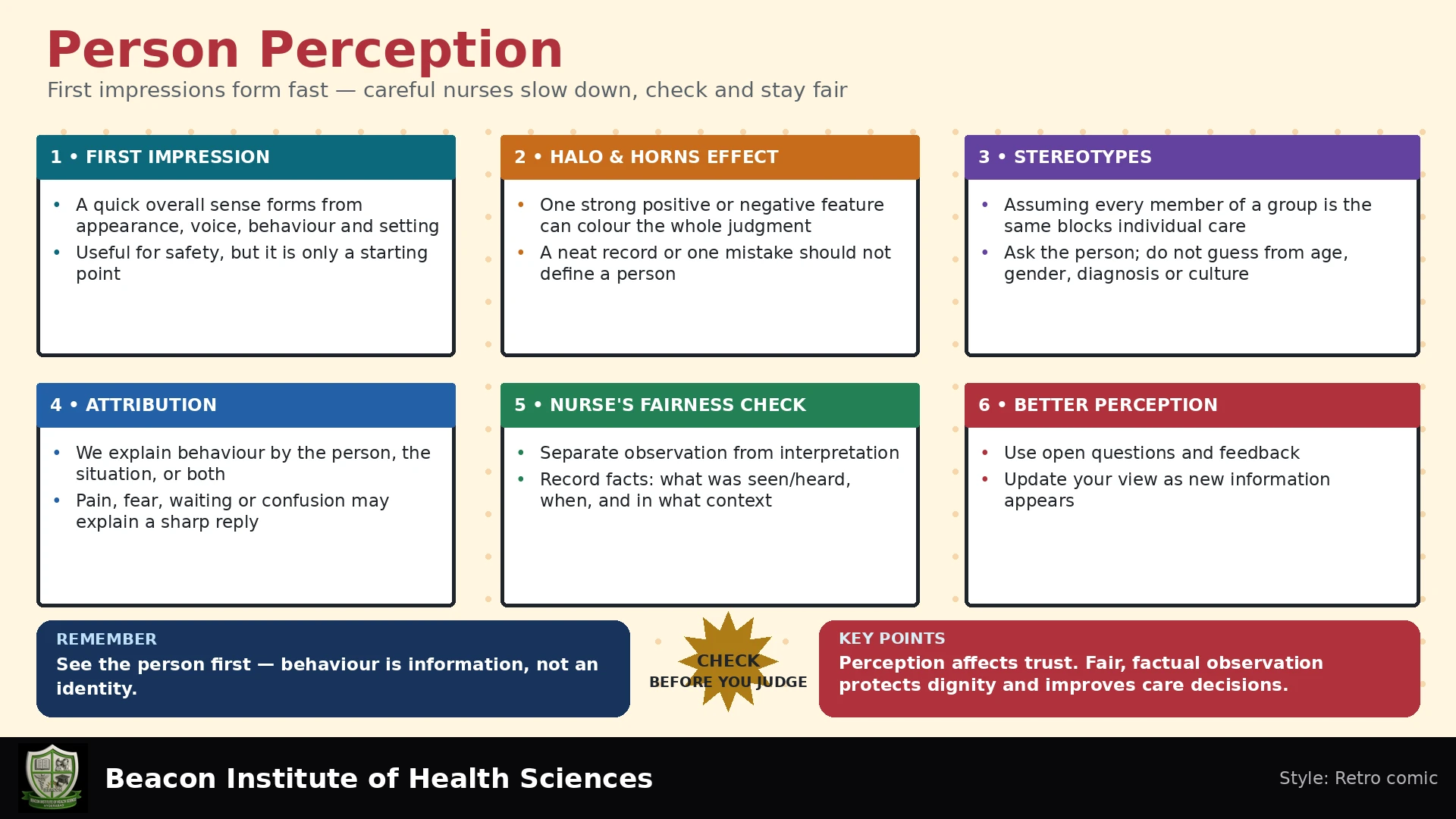
- Identify key factors that influence person perception, including verbal and nonverbal cues, context, prior experience, expectations, and culture.
- Recognize common perceptual biases and errors such as attribution errors, halo/horns effect, primacy/recency effect, confirmation bias, stereotypes, prejudice, and discrimination.
- Distinguish between empathy and assuming knowledge of another person's mind.
- Apply strategies to enhance accurate person perception in nursing practice, including separating observable facts from interpretations and utilizing neutral inquiry.
- Analyze a clinical case study to illustrate the application of accurate person perception in patient care.
Foundations of Person Perception
Person perception refers to the cognitive process of interpreting information about other people. It involves how individuals form impressions and make judgments about the characteristics and intentions of others. In nursing, accurate person perception is crucial for effective patient assessment, communication, and care planning.
Defining Person Perception
At its core, person perception is about making sense of the social world around us. It's not merely seeing someone but actively processing a multitude of cues to construct an understanding of who they are, what they might be thinking or feeling, and why they might be behaving in a certain way.
Core Components of Perception
The process of person perception can be broken down into distinct yet interconnected components:
- Sensation: This is the initial, raw data received by our sensory organs (e.g., seeing a facial expression, hearing a tone of voice). It's the immediate detection of stimuli without meaning.
- Observation: This involves focused attention on specific cues from an individual. It moves beyond raw sensation to a deliberate act of noticing particular aspects of a person's appearance, behavior, or communication.
- Interpretation: Once cues are observed, the mind assigns meaning to them. This step is heavily influenced by an individual's past experiences, knowledge, and current emotional state.
- Inference: Based on the interpretations, conclusions are drawn about the person's traits, intentions, or reasons for behavior. Inferences go beyond directly observed facts and involve making assumptions or generalizations.
The Perceptual Process
The journey from encountering a person to forming an impression is dynamic:
- Attention and Selection of Cues: Individuals do not process every piece of information available. Instead, attention is selectively focused on certain cues, which may be prominent, unusual, or align with existing interests or expectations.
- Organization and interpretation: Schemas are mental frameworks that help arrange information. They can make understanding quicker, but can also direct attention toward what we expect rather than what is present.
Factors shaping an impression
What the observer notices depends on attention, previous experience, expectations, current mood and cultural learning. The other person’s words, tone, expression and actions provide clues, but their meaning depends on context. An impression should remain open to revision as new information appears.
For example, looking away might relate to discomfort, concentration, tiredness, personal preference or cultural expectations. Silence may reflect reflection, a language barrier, difficulty hearing or a wish for privacy. None of these cues proves dishonesty, disinterest or a specific diagnosis. Ask rather than treating one possible explanation as established fact.
Attribution: explaining behaviour
A dispositional explanation attributes an action to a relatively enduring characteristic of the person. A situational explanation considers immediate circumstances. A learner who arrives late might have poor time management, but might also have encountered a transport breakdown. Both person and situation can contribute; one observation does not tell us their relative importance.
Fundamental attribution error describes a tendency to overemphasize a person’s characteristics and underestimate circumstances when explaining another person’s behaviour. The strength of this tendency varies across settings and cultures. It is a useful prompt to consider alternatives, not a universal rule about everyone.
Common biases and their practical effects
| Bias or concept | Meaning | Reflective safeguard |
|---|---|---|
| Halo effect | One favourable impression influences judgments about unrelated qualities. | Assess each relevant skill or need separately. |
| Horns effect | One unfavourable impression colours the whole assessment. | Look for evidence that challenges the initial impression. |
| Primacy effect | Early information receives disproportionate weight. | Review later observations too. |
| Recency effect | The most recent event dominates recall. | Review the full sequence of relevant events. |
| Confirmation bias | Evidence supporting an existing belief receives more attention than conflicting evidence. | Ask what information would change your conclusion. |
| Stereotype | A generalized belief about a group is applied to an individual. | Ask about this person’s preferences and circumstances. |
| Prejudice and discrimination | Prejudice concerns attitudes; discrimination concerns unfair treatment or actions. | Use consistent assessment standards and address unequal treatment. |
Bias can affect anyone, including a well-intentioned professional. Awareness is useful only when it changes assessment, communication or action. A standardized form can support consistency, but does not remove the need for individualized questions and reflection.
Observation, inference and verification
| Observed information | Unverified inference | Respectful question or action |
|---|---|---|
| The patient looks away during teaching. | The patient is uninterested. | “Is this a comfortable time and place to talk?” |
| The patient asks for instructions again. | The patient was not listening. | “Which part would you like me to explain differently?” Check hearing and language needs. |
| A learner misses one session. | The learner is lazy. | Ask what happened before judging motivation. |
Documentation should distinguish what was seen, what the person said and the professional assessment. “Asked for the instructions twice” is more precise than “uncooperative.” Quote relevant words accurately and include context. Do not write an interpretation as though it were a direct observation.
Empathy without mind-reading
Empathy involves trying to understand another person’s experience and communicating that understanding. It does not mean claiming certainty about their feelings. “You seem worried; have I understood correctly?” invites correction. “I know exactly how you feel” can close discussion and place the nurse’s assumptions ahead of the person’s account.
Cultural knowledge may help generate respectful questions, but it must not become a checklist of fixed group characteristics. Ask about preferred language, support people, privacy and communication needs. A patient is the source of their own preferences, rather than a representative of everyone from a particular background.
Fictional nursing case
A patient misses a planned teaching session and looks away during a later discussion. A student initially interprets this as lack of interest. Before documenting that judgment, the student asks privately, “What made it difficult to attend, and how can we make this discussion easier?” The patient reports hearing difficulty and a transport commitment.
The nurse checks communication needs, reduces background noise and arranges an acceptable teaching time. The nurse explains in short sections and asks the patient to describe the main points in their own words. The account is recorded as patient-reported information, with the observed response to teaching recorded separately. No personality diagnosis is inferred.
The lesson is not that hearing or transport problems explain every missed session. It is that an initial impression needs verification. In a real encounter, pain, fatigue, illness, language barriers or other causes might also need assessment. New confusion or an abrupt behavioural change requires prompt clinical review rather than a judgment about attitude.
A practical reflective sequence
- Describe the actual cue or action without a label.
- Notice your immediate interpretation and any emotion it produces.
- List at least two plausible alternatives.
- Ask a neutral question and listen to the person’s explanation.
- Check relevant clinical and communication factors within your role.
- Revise the impression, agree an appropriate action and document precisely.
- Review whether the action met the person’s needs.
Self-check with explained answers
1. A confident speaker is assumed to be excellent at every clinical skill. Which bias is illustrated?
Answer: The halo effect. Confidence in speaking is being used as evidence for unrelated skills. Assess performance of each required skill directly.
2. Is a patient’s silence sufficient evidence of refusal?
Answer: No. Clarify understanding, communication needs and the person’s wishes. Silence alone has several possible meanings and does not establish informed consent or refusal.
3. How can a nurse reduce confirmation bias after forming an initial impression?
Answer: Seek information that could contradict it, consider alternative explanations and invite the patient to correct your understanding. Repeating only questions that support the original belief reinforces bias.
Key terms and summary
Schema: a mental framework for organizing information. Attribution: an explanation for behaviour. Inference: a conclusion extending beyond what was directly observed. Verification: checking a tentative understanding against additional information.
Person perception supports nursing relationships when impressions remain provisional. Separate facts from assumptions, ask the person about their experience, consider both individual and situational influences, and revise your understanding when evidence changes.