
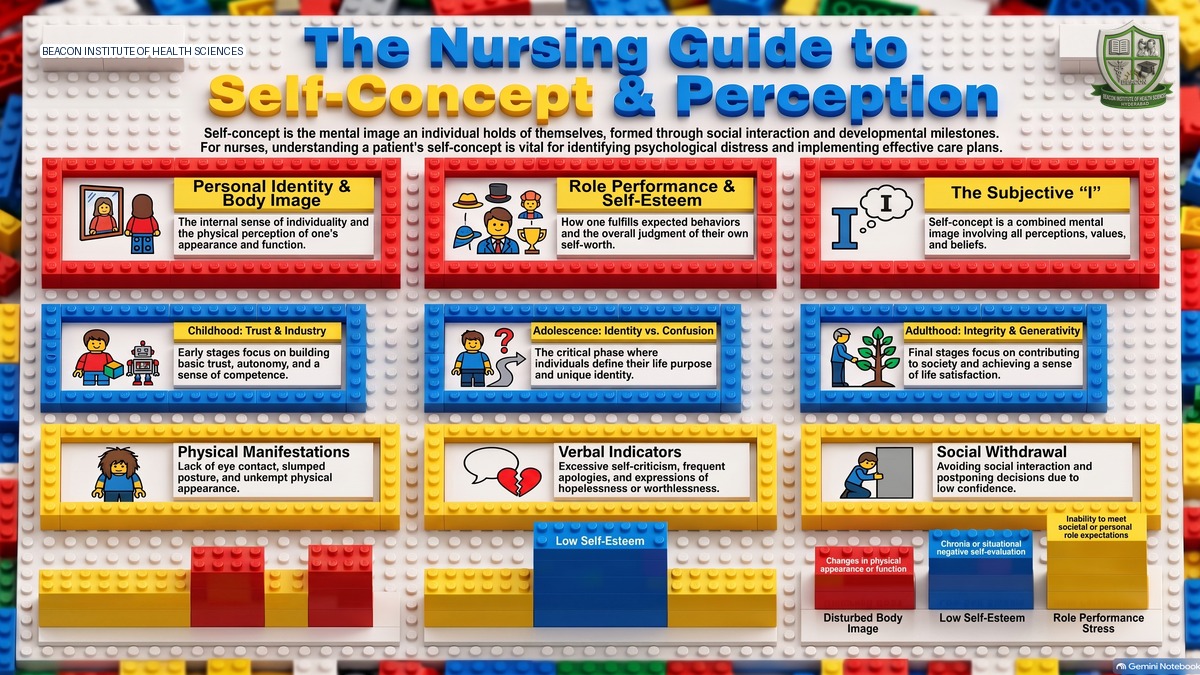
In professional BSN nursing education, effective clinical assessments begin with a scientifically grounded understanding of a patient's self-view. Healthcare is inherently personal, and a patient's physical healing is deeply intertwined with their psychological self-conception. Unit 3 of Fundamentals of Nursing II introduces the Self-Concept Pattern as one of Marjory Gordon's eleven Functional Health Patterns. This pattern specifically focuses on how individuals view themselves, their personal worth, and their identity. To execute clinical duties successfully, nurses must master fundamental definitions and clinical applications related to self-concept and self-perception.
Core Conceptual Definitions & Terminology
To understand self-concept in nursing, it is essential to differentiate between key terms:
Self-Perception
Self-Perception is defined as the general idea, thought, or perception an individual holds about the kind of person they are. It represents how an individual cognitively 'appraises' or 'sees' themselves, answering the internal question: 'Who do I think I am?' It encompasses all the beliefs, attitudes, and feelings a person has about their personal characteristics. For instance, a person might perceive themselves as highly confident, an achiever, or an intelligent leader, or, conversely, as a 'loser' or someone weak, incompetent, or bad. Self-perception dictates how a person interprets their environment and determines their level of self-confidence.
Self-Concept
Self-Concept is defined as an individual's complete mental image of themselves. It is a multidimensional, cognitive, and affective representation of one's entire identity. Self-concept is the sum of all self-perceptions combined into a structured, unified whole. It includes how a person views their physical appearance, holds specific core values, maintains beliefs, and projects their personal qualities. Self-concept dictates how a person behaves and functions. It is represented whenever an individual thinks, speaks, or acts using the words 'I' or 'Me' (e.g., 'I am capable of doing this task' or 'I will never succeed in this situation'). It is not static; rather, it is a continuously evolving, dynamic self-framework.
Marjory Gordon's Self-Concept Pattern
Within the nursing assessment framework, Gordon's Self-Concept & Self-Perception Pattern is a vital diagnostic tool. It evaluates a patient's cognitive and emotional self-views, focusing on their:
- Baseline self-esteem and feelings of self-worth.
- Perception of physical appearance, size, and body integrity.
- Cognitive understanding of their roles, capabilities, and goals.
- General emotional state, including levels of anxiety, confidence, or distress.
Clinical Correlation: In nursing care, the self-concept pattern is evaluated to understand how a patient's psychological state impacts their physical recovery. A patient with a broken or degraded self-concept often shows poor compliance, slower physical healing, and heightened anxiety.
Operational Functions of Self-Concept
Self-concept is not merely a passive state of mind; it is an active cognitive processor. Once an individual's self-concept is formed, it performs four major life-sustaining, psychological functions that dictate human behavior and choices:
The Organization Function
Self-concept acts as an active, cognitive filter and organizer of incoming information. Throughout daily life, an individual is bombarded with external data, opinions, and experiences. The self-concept organizes this information about the self, interpreting it, sorting it, and determining whether it is relevant to the individual's existing self-image. It helps the person organize, categorize, and integrate new data into their structured self-system, maintaining a stable cognitive world.
Behavior Regulation & Future Planning
An individual's self-concept serves as a direct regulator of behavior. Human beings behave in a manner consistent with how they view themselves. A well-developed, positive self-concept helps a person formulate healthy behavior plans for the future. It sets expectations, guides goal-setting, and regulates actions. If a person possesses a positive, capable self-concept, they plan for success, take on challenging roles, and strive for self-improvement. If they have a negative self-concept, they act in a self-limiting manner, avoiding goals due to an expectation of failure.
Psychological Self-Defense & Survival
A resilient self-concept acts as a protective shield for psychological survival. In hostile, highly stressful, or critical clinical conditions, a strong self-concept provides the internal strength necessary to cope, adapt, and maintain personal integrity. It helps individuals process failure, survive crises, and defend themselves against debilitating emotional collapse.
Framework for Decision-Making & Uniqueness
Self-concept establishes a standard internal framework for independent decision-making and problem-solving. It also gives the individual a profound sense of individuality and uniqueness. It represents their distinct identity, which is continuously evolving and changing across the lifespan.
The Four Core Components of Self-Concept
To analyze and manage a patient's self-concept, the nurse must break it down into four distinct but highly interactive components. These components form the structure of Gordon's Self-Concept assessment:
Personal Identity
Personal Identity is a person's underlying sense of individuality and uniqueness that distinguishes them from all other human beings. It is the core framework that answers the question: 'Who am I?' Personal identity encompasses a person's name, gender, personal characteristics, values, beliefs, and overall personality style. It determines whether an individual is generally friendly, reserved, quiet, outgoing, helpful, or private. While personal identity remains relatively stable throughout adulthood, it is dynamic and can adapt slowly to major life shifts.
Body Image
Body Image is how an individual cognitively perceives and emotionally feels about their physical body. It is how they view their body's size, shape, appearance, structures, and overall physiological capabilities. Body image has two main dimensions: it can be realistic (aligning with physical reality) or unrealistic (such as in eating disorders or severe body dysmorphia). In clinical nursing care, body image is highly vulnerable. Severe body image disturbances occur when patients face major physical changes, including:
- Surgical amputations of limbs or organs.
- Loss of motor function due to spinal cord injuries (causing paralysis) or strokes (causing hemiplegia).
- Disfiguring scars, severe burns, or traumatic injuries.
Role Performance
Role Performance refers to how an individual behaves in a particular social, occupational, or familial role compared to the expectations associated with that role. Throughout life, every individual occupies multiple roles simultaneously (e.g., being a student, parent, nurse, and spouse). Five key clinical concepts define role performance:
- Role Mastery: Occurs when an individual successfully meets and fulfills the behavioral expectations and requirements of a specific role, feeling highly competent.
- Role Development: The active process of learning and adapting to a new role (e.g., a student nurse undergoing socialization to learn the behaviors of a professional nurse).
- Role Ambiguity: Occurs when the expectations of a role are unclear, poorly defined, or unknown. The individual does not know what behaviors are expected of them, causing severe confusion.
- Role Strain: The feeling of inadequacy or unsuitability when forced to perform a role that an individual feels they are not prepared, capable, or suited for.
- Role Conflict: Occurs when an individual is faced with incompatible, competing, or opposing role expectations. For example, a young person who suddenly loses a parent may experience conflict as they try to balance their student role with the forced role of becoming the family's primary breadwinner.
Self-Esteem
Self-Esteem is an individual's personal judgment of their own worth. It is how much they value, approve of, respect, and appreciate themselves compared to two standards:
- The standards set by others (society, family, peers).
- Their own internal standards of their 'ideal self' (who they want to be).
Self-esteem is divided into two distinct categories:
- Global Self-Esteem: How much an individual likes, approves of, and values themselves as a whole person.
- Specific Self-Esteem: How much they approve of or like a specific, isolated aspect of themselves (e.g., their academic performance, athletic skill, or physical appearance).
Psychosocial Lifespan Development (Erik Erikson's 8 Stages)
Self-concept is not innate; it is built over time through developmental stages. In the BSN curriculum, Erik Erikson's 8 Stages of Psychosocial Development are highly emphasized and tested across all four years of nursing. Understanding these stages is critical for evaluating a client's self-concept, as each stage presents a developmental task that either strengthens or degrades the self-framework:
| Psychosocial Stage & Age | Core Developmental Conflict | Clinical Definition & Impact on Self-Concept |
|---|---|---|
| 1. Infancy (0–18 months) | Trust vs. Mistrust | If basic needs (nutrition, comfort, safety, love) are met consistently, the infant develops trust in caregivers and the environment. If neglected, they develop basic mistrust, perceiving the world as hostile and unpredictable. |
| 2. Early Childhood (18 months – 3 years) | Autonomy vs. Shame & Doubt | Focuses on self-control and independence (toilet training, walking). Support from parents builds autonomy and self-confidence. Over-criticism or restriction leads to shame, self-doubt, and low self-worth. |
| 3. Preschool (3–5 years) | Initiative vs. Guilt | Children explore, ask questions, and take initiative. If allowed to play, build, and explore, they develop initiative. If scold or discouraged, they develop guilt regarding their independent desires. |
| 4. School Age (6–12 years) | Industry vs. Inferiority | Children face school projects, academic tasks, and social comparison. Success and praise build industry (feeling capable and productive). Repeated failure or lack of support breeds a deep sense of inferiority. |
| 5. Adolescence (12–18 years) | Identity vs. Role Confusion | A highly turbulent phase with rapid physical, hormonal, and psychological changes. Teenagers strive to discover their personal identity, career goals, and beliefs. Success leads to clear identity; failure leads to role confusion. |
| 6. Young Adulthood (18–40 years) | Intimacy vs. Isolation | Focuses on building committed, deep, and loving relationships (marriage, deep friendships). Success leads to intimacy and healthy self-concept. Failure or fear of rejection leads to psychological isolation. |
| 7. Middle Adulthood (40–65 years) | Generativity vs. Stagnation | Focuses on raising children, supporting family, working, and contributing to society. Success breeds generativity (feeling useful and accomplished). Self-absorption or failure to contribute leads to stagnation. |
| 8. Late Adulthood (65+ years) | Integrity vs. Despair | Reflecting back on one's past life. If they feel satisfied with their achievements, fulfilled roles, and lived fully, they achieve integrity and peace. If they view life as wasted with missed opportunities, they fall into despair. |
Factors Influencing & Disrupting Self-Concept
A patient's self-concept is highly dynamic and sensitive to external forces. Five primary factors influence, shape, or can severely disrupt self-concept:
Stage of Development
As discussed in Erikson's stages, each phase of life requires different psychological supports. An infant requires consistent physical and emotional care to build baseline trust. In contrast, an adolescent requires independence, privacy, and freedom to explore identity without restrictive parental control. Failing to provide developmental-specific care degrades self-concept development.
Family and Culture
Early childhood values, beliefs, and behaviors are directly shaped by family structures, parenting styles, and cultural norms. As children grow into adolescence and adulthood, peer groups emerge as highly powerful influencers. Disagreements between familial expectations and peer cultures can cause intense cognitive conflict.
Clinical Example: An adolescent raised in a strict household where their parents expect them to strictly avoid alcohol may experience severe distress, anxiety, and self-doubt when their college peer group constantly encourages weekend drinking.
Severe Environmental Stressors
Life stressors can either strengthen or shatter an individual's self-concept, depending on their coping skills. In healthcare, four types of stressors directly target self-concept components:
- Identity Stressors: Drastic changes in physical appearance, aging, declining sensory or cognitive abilities, or setting unrealistic, unattainable goals that are impossible to achieve.
- Body Image Stressors: Loss of body parts (e.g., amputation), loss of body functions (e.g., paralysis, spinal cord injury, or stroke causing hemiplegia), and disfiguring scars, burns, or surgeries.
- Role Stressors: Loss of a loved one or parent, divorce, loss of employment, or navigating unclear, conflicting role expectations.
- Self-Esteem Stressors: Lacking positive feedback from significant others, chronic failure in academic or career pursuits, constant criticism, or repeated personal failures.
Internal and External Resources
Resources function as psychological cushions that protect and enhance self-concept. A patient with a greater number of available resources will view themselves in a much more positive light.
- Internal Resources: High self-confidence, positive coping mechanisms, and strong ethical values.
- External Resources: A supportive network of family, friends, and peers; financial security; and organizational help or home-care services.
History of Success and Failure
A person's past experiences heavily dictate their current self-view. A history of repeated successes builds a resilient self-concept, as the person perceives themselves as capable and useful. Conversely, a history of chronic failures can degrade self-esteem, leading to a negative self-concept where the person feels useless, helpless, and redundant.
Clinical Alert: Patients facing severe physical limitations (e.g., lower body paralysis following a spinal cord injury) frequently suffer from concurrent body image, role performance, and self-esteem stressors. The nurse must address these psychological crises to promote physical rehabilitation.
Clinical Manifestations of Altered Self-Concept
When a patient suffers from a disrupted or altered self-concept, they rarely express their distress directly in clinical words. Instead, they exhibit distinct physical, behavioral, and verbal signs. The nurse must actively observe the patient to detect these thirteen clinical manifestations:
- Complete Absence of Eye Contact: Avoiding eye contact during conversations, looking down, or staring at the floor due to deep shame or lack of confidence.
- Slumped or Stooped Posture: Maintaining a dejected, slumped physical posture and walking or moving slowly, indicating low energy and self-worth.
- Poor Hygiene & Unkempt Appearance: Showing complete neglect of personal care, resulting in messy hair, dirty skin, and unorganized, unwashed clothing.
- Hesitant, Faltering Speech: Speaking with severe hesitation, stuttering, or holding back thoughts due to a fear of being criticized or rejected.
- Frequent Self-Criticism: Constantly verbalizing highly negative, critical, or self-deprecating remarks about their own capabilities and worth.
- Inability to Accept Praise: Rejecting positive feedback or compliments from others, believing they do not deserve them or suspecting the praise is fake.
- Frequent and Excessive Apologizing: Saying 'sorry' constantly, even when they have done nothing wrong, due to a baseline feeling of being a burden.
- Expressing Hopelessness & Powerlessness: Verbalizing feelings of complete helplessness, noting that 'nothing will ever change' or 'I can't do anything.'
- Disturbed and Strained Relationships: Experiencing frequent conflicts or complete breakdown in relationships with family members, friends, or caregivers.
- Postponing Decisions Frequently: Demonstrating extreme indecisiveness and constantly postponing decisions due to an overwhelming fear of making mistakes.
- Disturbed or Disorganized Thought Processes: Struggling with concentration, displaying scattered thinking, and expressing highly irrational fears.
- Active Social Isolation: Withdrawing completely from social circles, avoiding gatherings, and refusing to interact with visitors or other clinical patients.
- Spiritual Distress: Feeling spiritually abandoned, questioning their faith, or expressing distress that God has punished them or abandoned them in their illness.
Nursing Tip: Never dismiss a patient who constantly apologizes or avoids eye contact as simply 'shy.' These are classic behavioral indicators of situational or chronic low self-esteem that require immediate therapeutic nursing interventions.
Clinical Application of the Nursing Process (ADPIE)
To manage a patient with an altered self-concept, the nurse must systematically apply the five-step Nursing Process (ADPIE framework), grounding every action in scientific clinical principles:
Step 1: Assessment
The nurse must collect comprehensive subjective and objective data regarding the patient's self-concept, focusing on personal identity, body image, self-esteem, and role performance. To obtain accurate information, the nurse must follow these four professional interviewing guidelines:
- Create a Quiet, Private Environment: Ensure absolute privacy and minimize interruptions, as patients will not discuss deeply personal self-views or body insecurities in a busy, public ward.
- Maintain Appropriate Eye Contact: Use steady, comforting eye contact to demonstrate attentiveness, empathy, and build clinical trust.
- Ask Open-Ended Questions: Avoid simple 'yes' or 'no' questions. Open-ended questions allow patients to explore and express their feelings (e.g., 'How do you feel about yourself since your injury?' or 'Are you satisfied with your life?').
- Avoid Constant Writing During the Interview: Active listening is critical. Constantly writing or typing during the interview makes the patient feel like a clinical subject rather than a human being. Listen intently first, and record notes immediately after the conversation.
| Component of Self-Concept | Targeted Clinical Assessment Questions |
|---|---|
| Personal Identity |
|
| Body Image |
|
| Self-Esteem |
|
| Role Performance |
|
Step 2: Diagnosis
Based on the collected and validated assessment data, the nurse formulates specific nursing diagnoses. Standard NANDA nursing diagnoses for altered self-concept include:
- Body Image Disturbance: Related to physical disfigurement, amputation, scarring, or loss of function.
- Chronic Low Self-Esteem: A long-standing, deep-seated negative self-view and self-evaluation.
- Situational Low Self-Esteem: An acute, temporary drop in self-esteem related to a specific life crisis, illness, or loss.
- Altered Role Performance: Related to inability to fulfill family, occupational, or social expectations.
Step 3: Planning
The nurse collaborates with the patient and their family to develop a highly individualized care plan. Goals must be realistic, attainable, and measurable. Planning must take into account:
- The client's current health status and severity of physical illness.
- Available support resources (family, friends, finance).
- Current coping mechanisms (positive or negative).
- Socio-cultural and religious values that guide the client's life.
Step 4: Implementation (Nursing Interventions)
To help the patient rebuild a positive self-concept, the nurse must execute the following ten clinical interventions:
- Active Listening: Spend dedicated time sitting with the patient, listening to their concerns without judgment, showing that their words possess immense value.
- Reinforce Core Strengths: Actively identify and verbally remind the patient of their personal strengths, past successes, and positive qualities.
- Promote Positive Body Image: Help the patient accept physical changes by offering realistic, constructive feedback. Praise their functional capabilities rather than focusing strictly on physical appearance.
- Improve Coping Skills: Educate the patient on positive coping skills (e.g., positive thinking, verbalizing fears) and guide them to avoid negative mechanisms (e.g., denial, substance use).
- Facilitate Support Systems: Help the patient connect with emotional, financial, or organizational resources, including family support, peer groups, or specialized healthcare services.
- Enhance Self-Awareness: Guide the patient to focus on 'what they can do' and their strengths, rather than obsessing over physical limitations or 'what they cannot do.'
- Set Achievable, Gradual Goals: Establish small, easily attainable daily goals. When the patient succeeds, verbally celebrate and document the success. This creates a psychological 'ladder of successes' that rapidly builds self-esteem. (e.g., planning a simple hygiene task or moving to a chair).
- Maintain Respect and Privacy: Always respect the client's physical privacy and personal space. Keep them covered during procedures and speak to them with dignity.
- Explain All Procedures in Advance: Provide simple, clear explanations before performing any treatment. This helps the patient feel respected, informed, and in control of their body.
- Encourage Active Participation: Actively involve the patient in planning their own hygiene, diet, and care schedule. This fosters a sense of independence and self-control, boosting self-esteem.
Step 5: Evaluation
Evaluation is a continuous quality-control loop. The nurse reassesses the patient against the pre-established goals to determine if their self-concept has improved. To evaluate care successfully, the nurse must answer these key clinical questions:
- Has the patient's self-esteem increased, or are they still displaying low self-esteem behaviors (such as poor eye contact or slumped posture)?
- Are there continuous, unresolved stressors that are preventing psychological recovery?
- Is the patient still expressing deep feelings of hopelessness, powerlessness, or worthlessness?
- Are family members or significant others successfully supporting and reinforcing the patient's self-esteem?
Based on these answers, the nurse decides whether to continue, modify, or terminate the care plan.
The Nursing Process (ADPIE) applied to the Self-Concept Pattern ensures that nursing care is highly holistic. By identifying physical disfigurement, role conflicts, and low self-esteem early, the nurse builds a supportive relationship that allows the patient to regain autonomy and heal.