
1. Purpose and learning outcomes
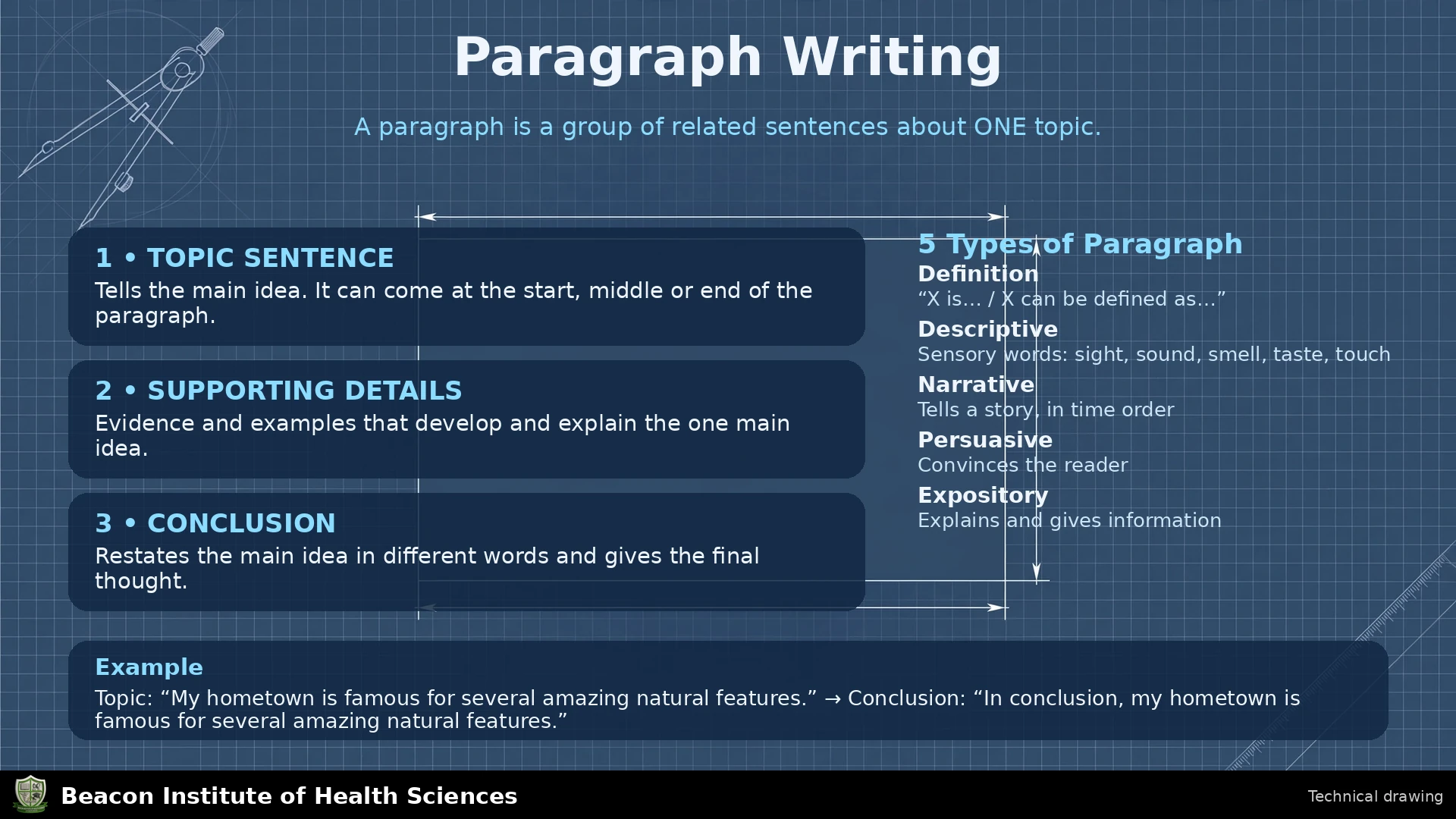
A paragraph develops one main idea through connected sentences. For BSN students, this skill helps with assignments, reflective writing and clear professional messages. After this lesson, you should be able to identify a topic sentence, select relevant details, connect ideas logically, and revise an unclear paragraph. These original classroom examples teach writing rather than clinical procedures.
2. What a paragraph does
Paragraph breaks help readers see where one point ends and another begins. A new paragraph usually introduces a new main point, stage, speaker or perspective. Length depends on purpose and the detail needed; there is no universal rule requiring five sentences. A short announcement may need fewer sentences than an academic explanation.
3. Topic and controlling idea
The topic is the subject; the controlling idea identifies the particular point about that subject. In “A weekly study plan helps students organize competing assignments,” the topic is a weekly study plan and the controlling idea is organizing competing assignments. Every later sentence should explain, illustrate or qualify that idea rather than discuss student life generally.
4. Writing a topic sentence
For beginner writers, placing the topic sentence near the beginning makes the focus easy to find. Compare “Libraries are important” with “The college library supports independent study by providing quiet space and reliable resources.” The second sentence provides a clear direction. A topic sentence need not express a controversial argument: description and explanation also have main ideas.
5. Supporting details and explanation
Supporting details answer questions raised by the topic sentence. Give an example, reason, definition, observation or properly cited fact, then explain its connection. For a paragraph about organized notes, describe headings, dates and a separate space for questions. Explain how these features help a student locate information. Never invent statistics or write “research proves” without identifying suitable evidence.
6. Unity and relevant evidence
Unity means that all sentences serve the same central point. In a paragraph about library study, a sentence about a favourite football team would normally be irrelevant. Remove it or develop it elsewhere. Evidence must also be relevant and trustworthy. An interesting fact does not support a claim merely because it contains a word from the topic sentence.
7. Coherence and logical order
Coherence means that readers can follow the movement between ideas. Arrange instructions in time order, describe a place in spatial order, or present reasons in an order that fits the argument. Avoid changing your organizing pattern halfway through. A useful check is to write a short label beside each sentence and see whether the sequence makes sense.
8. Transitions and pronoun reference
Transitions show relationships: “for example” introduces an illustration, “however” signals contrast, and “therefore” signals a result. Select the relationship before selecting the linking word. Pronouns must have clear references. “Sara gave Ayesha her notes” may be unclear about ownership; write “Sara gave her own notes to Ayesha” if that is the intended meaning.
9. Sentence variety and grammar
Use complete sentences with subjects and appropriate verbs. Correct “The students prepares notes” to “The students prepare notes.” Avoid joining complete sentences with only a comma: use a full stop, semicolon or suitable conjunction. Mix short sentences with longer ones when helpful. Readability matters more than impressive vocabulary, and sentence variety should never hide the main point.
10. Concluding sentences
A concluding sentence can restate the main point in fresh words, explain its importance or connect it to the next paragraph. It should follow from the discussion rather than introduce a large unsupported claim. Not every paragraph needs a separate conclusion; in short writing, one may sound repetitive. Judge whether it helps your reader understand the point.
11. The planning and drafting process
Begin by identifying the reader and purpose. Brainstorm details, choose one focus and arrange relevant points. Draft without stopping at every spelling concern. Revise the ideas and order first, then edit grammar and punctuation. Finally, proofread the finished version. This separates the larger question “Does the paragraph make sense?” from the smaller question “Is each sentence correct?”
12. Original model paragraph with sentence-by-sentence analysis
Original model: “A weekly study plan helps nursing students organize assignments. First, students list each task and its deadline. Next, they divide larger tasks into smaller steps, such as reading a chapter and drafting an outline. They then reserve time for those steps while allowing space for rest and unexpected commitments. Reviewing the plan at the end of the week helps them adjust unfinished work. In this way, the plan turns a long list of duties into manageable actions.” The first sentence gives the focus. The next four develop a sequence. The final sentence draws the details together without adding a new topic.
13. Revision workshop with corrected example
Weak draft: “The library is useful. It has books. My cousin plays cricket. Students goes there. It is good.” Revised: “The library provides a useful place for independent study. Students can consult books, compare sources and make notes in a quiet setting. Asking the librarian for help can make unfamiliar resources easier to find.” The revision removes the unrelated cricket sentence, corrects subject–verb agreement, replaces vague praise with specific details and keeps one clear focus.
14. Practice questions and explained answers
Practice with answers: (1) What is the controlling idea in “Clear headings make notes easier to review”? Answer: making notes easier to review; headings are the topic. (2) Which detail is irrelevant to a paragraph about essay planning: outlining, grouping ideas or buying shoes? Answer: buying shoes. (3) Correct “Each student have a notebook.” Answer: “Each student has a notebook,” because “each” is singular. (4) Which transition introduces contrast? Answer: “however,” not “therefore.” (5) Must every paragraph contain exactly five sentences? Answer: no; purpose and development determine length. Now write your own paragraph and explain the role of every sentence.