
1. Learning objectives and purpose
A report is a structured account of information and analysis prepared for a defined purpose and reader. BSN students may write reports about academic activities, projects or observations. By the end of this lesson, you should be able to identify a report's purpose, organize findings, separate evidence from interpretation, write clear recommendations and revise your work. The examples are fictional English-learning tasks, not instructions for clinical records, incident reporting or research approval.
2. Reports, essays and professional documents
An essay commonly develops an argument through connected paragraphs. A report often uses headings to help readers locate purpose, methods, findings and recommendations. Both need logical reasoning and accurate source use. The assigned task determines the actual format; there is no single structure required for every document called a report.
Descriptive reports explain what happened or what exists. Analytical reports interpret information. Progress reports describe work completed and remaining. Research reports explain a study and its results. Patient records and incident reports have distinct institutional requirements, approved systems and confidentiality obligations. Do not substitute an academic report template for those professional documents.
3. Interpret the task and plan
Identify the reader, purpose, scope, required length and submission instructions. Decide what questions the report should answer and what evidence is needed. A report on an orientation session should not drift into unrelated claims about the whole nursing program. Clear boundaries help the writer select relevant information.
Create an outline before drafting. List the main sections and place evidence under the section where it belongs. Check whether the reader can move from the problem to findings and conclusions without missing a step. Planning is flexible: change the outline if the evidence shows that the original organization does not fit.
4. Gather and evaluate information
Use information that is accurate, relevant and obtained appropriately. Record sources while gathering material so you can attribute claims later. Distinguish direct observation, another person's statement and your interpretation. Never invent real data, respondents or events to make a report seem complete.
Assess the evidence's limits. A small set of informal comments cannot establish the views of all students. Missing responses, short observation periods and narrow sampling can affect interpretation. If real people or sensitive information are involved, follow the institution's permissions, ethics and privacy procedures. Fictional classroom examples avoid those real-data claims by labeling themselves clearly.
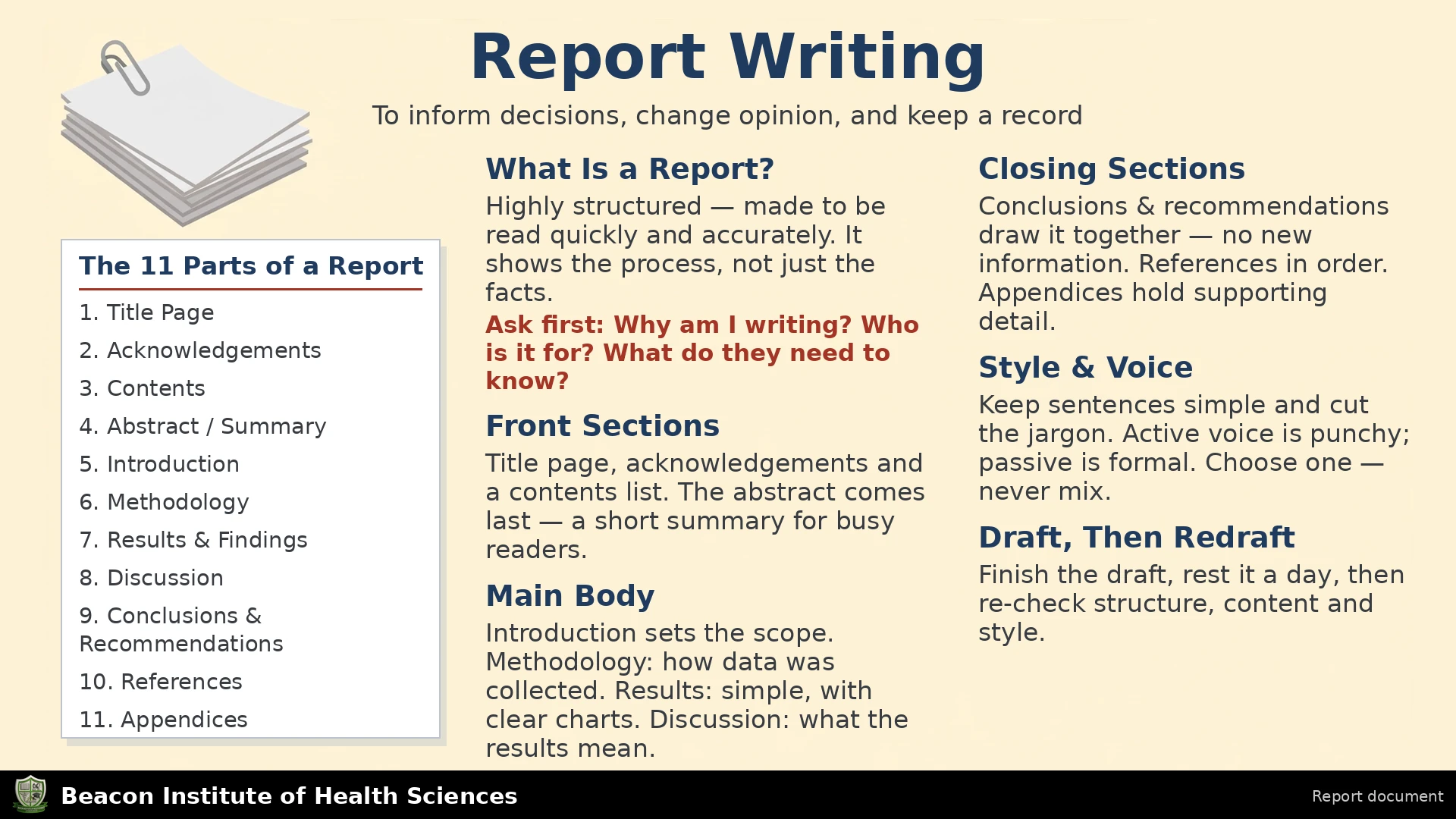
5. An adaptable report structure
- Title: identifies the subject accurately.
- Introduction: explains purpose, background and scope.
- Method: describes how information was obtained.
- Findings: presents what the information shows.
- Discussion: interprets findings and recognizes limitations.
- Conclusion: answers the purpose using the established evidence.
- Recommendations: proposes suitable next actions when requested.
- References and appendices: provide source details and relevant supporting material.
Longer reports may also need a title page, contents page or executive summary. A short report may use fewer sections. Follow the actual assignment requirements rather than inserting every possible heading. Prepare an executive summary after the report is complete so it accurately represents the final content.
6. Findings, interpretation and recommendations
Findings state results. Discussion explains what those results may mean. Conclusions draw together the answer to the report's purpose. Recommendations propose action. Keeping these functions distinct helps readers judge how a proposed response follows from evidence.
For example, a finding may state that ten respondents requested a longer demonstration. Interpretation may suggest that the demonstration deserves review. A recommendation may propose testing a revised timetable. The finding does not prove that the revised timetable will succeed. Avoid introducing new evidence in the conclusion or presenting a proposed action as an existing institutional policy.
7. Objective language and paragraph development
Formal writing should be precise and readable. Replace judgmental labels with observable information. Three students arrived after the session began is clearer and more neutral than The students were irresponsible. If a cause is unknown, do not invent one. Describe the available facts and identify uncertainty.
A paragraph normally develops one main point with supporting details and explanation. Connect paragraphs according to their actual relationship. Completed methods and events often use past forms, while a present interpretation may use present forms. Active voice identifies the actor; passive voice can focus on the process or result. Choose deliberately rather than assuming all reports must use one voice.
8. Complete fictional model report
Title: Review of a Student Orientation Demonstration
Teaching status: This model is entirely fictional. All figures and events are invented for an English writing exercise and describe no actual BIHS activity or service evaluation.
Purpose and scope: The report reviews feedback on a single fictional orientation session and identifies one possible improvement for a future session. It does not evaluate the whole program.
Method: Twenty fictional students attended. At the end, each was invited to select one of three feedback options on a form. Fifteen returned a completed form. The exercise collected informal comments; it was not a research study.
Findings: Ten respondents selected more time for the library demonstration. Three selected a longer question session. Two selected adequate timing. Five attendees did not return a form. The response rate was fifteen out of twenty, or 75%.
Discussion: The most frequently selected option among respondents was more demonstration time. However, the small group and five missing responses limit interpretation. The exercise does not establish the preferences of all attendees or predict whether a timetable change would improve learning.
Conclusion: The fictional feedback supports reviewing the demonstration's time allocation before the next session. Further feedback would be useful before making a continuing arrangement.
Recommendation: For this fictional exercise, the orientation coordinator could prepare a trial schedule with more demonstration time while preserving a question period. The coordinator could then review feedback after the next session. This is a model proposal, not an instruction or institutional commitment.
9. Worked numerical interpretation
Always identify the denominator. Ten of fifteen respondents requested more demonstration time: 10 divided by 15, multiplied by 100, equals approximately 66.7%. This is the percentage of respondents, not the percentage of all attendees. Ten of twenty attendees equals 50%, but the five nonrespondents' preferences are unknown.
The response rate is 15 divided by 20, multiplied by 100, which equals 75%. The selected-option counts total fifteen: ten plus three plus two. Explain rounding where relevant and check that the table or sentence uses the correct group. Numerical precision cannot overcome poor sampling or missing information. These calculations teach report language and arithmetic, not statistical proof of a real outcome.
10. Headings, tables and summaries
Use descriptive headings that reveal the section's function. Findings is more helpful than Some things when presenting results. Numbering can help navigation if applied consistently. A table should have a clear title, column labels and units where needed; discuss its main point in the text rather than leaving it unexplained.
Do not duplicate every number in both prose and a table without purpose. Select the form that helps the reader. A short summary should identify the purpose, main findings, limits and conclusion. Complete it after checking the full report. A summary that exaggerates the evidence misrepresents the document even if its sentences are polished.
11. Source attribution and integrity
When using another source's idea or evidence, attribute it in the text and provide the required reference details. A reference list alone does not show which claim came from which source. Follow the assigned citation style consistently. Do not claim to have read a source that you have not examined.
Paraphrase after understanding the meaning, and retain important qualifications. Copying a sentence and replacing a few words does not make it independent work. Where AI assistance is permitted, follow the course's actual disclosure rules and verify every factual claim and citation. Do not invent an institutional AI policy. Protect private information in drafts, attachments and presentations as well as in the final document.
12. Revision before proofreading
Revision checks the substance: purpose, evidence, logic, section order and completeness. Editing improves sentence clarity and language. Proofreading checks remaining spelling, punctuation and formatting errors. Begin with structure because polishing a paragraph that should be removed wastes effort.
Ask whether the conclusion follows from the findings, whether recommendations are achievable and whether limitations are visible. Then check paragraph flow, tense, agreement, word choice and sentence boundaries. Finally verify names, dates, calculations, references and attachment labels. An accurate report can be undermined by a copied wrong date or an unexplained number.
13. Self-assessment with answers
- What distinguishes findings from discussion? Findings present results; discussion interprets them and considers their limits.
- Must every report include an executive summary? No. The required format and report length determine whether one is appropriate.
- Why identify the reader? Their needs guide the information, detail and organization.
- What is the fictional model's response rate? 75%, calculated from fifteen completed forms out of twenty attendees.
- Can 66.7% be described as all attendees' preference? No. It is ten of fifteen respondents, and nonrespondents' preferences are unknown.
- Should a conclusion introduce new evidence? It should normally draw together evidence already presented.
- Why avoid blame labels? They can add unsupported judgment instead of describing observable facts.
- Can an academic report replace an incident-reporting procedure? No. Those professional documents follow distinct institutional requirements.
14. Editing exercise and submission checklist
Weak sentence: Everyone wanted more time, so the institute must change the session permanently.
Improved sentence: Ten of the fifteen fictional respondents requested more demonstration time; a trial timetable could be reviewed after a further session.
The revision restores the correct group, labels the example fictional, removes an unsupported universal claim and changes an unjustified permanent instruction into a limited proposal. It does not promise that the proposal will produce better outcomes.
Before submission, confirm purpose and scope, accurate evidence, clear headings, correct arithmetic, explicit limitations and a supported conclusion. Check that recommendations follow the findings, sources are attributed and privacy is protected. Read the finished report as a reader who knows nothing about your drafting process. They should be able to distinguish what happened, what it may mean and what you propose next.