
1. Learning objectives and scope
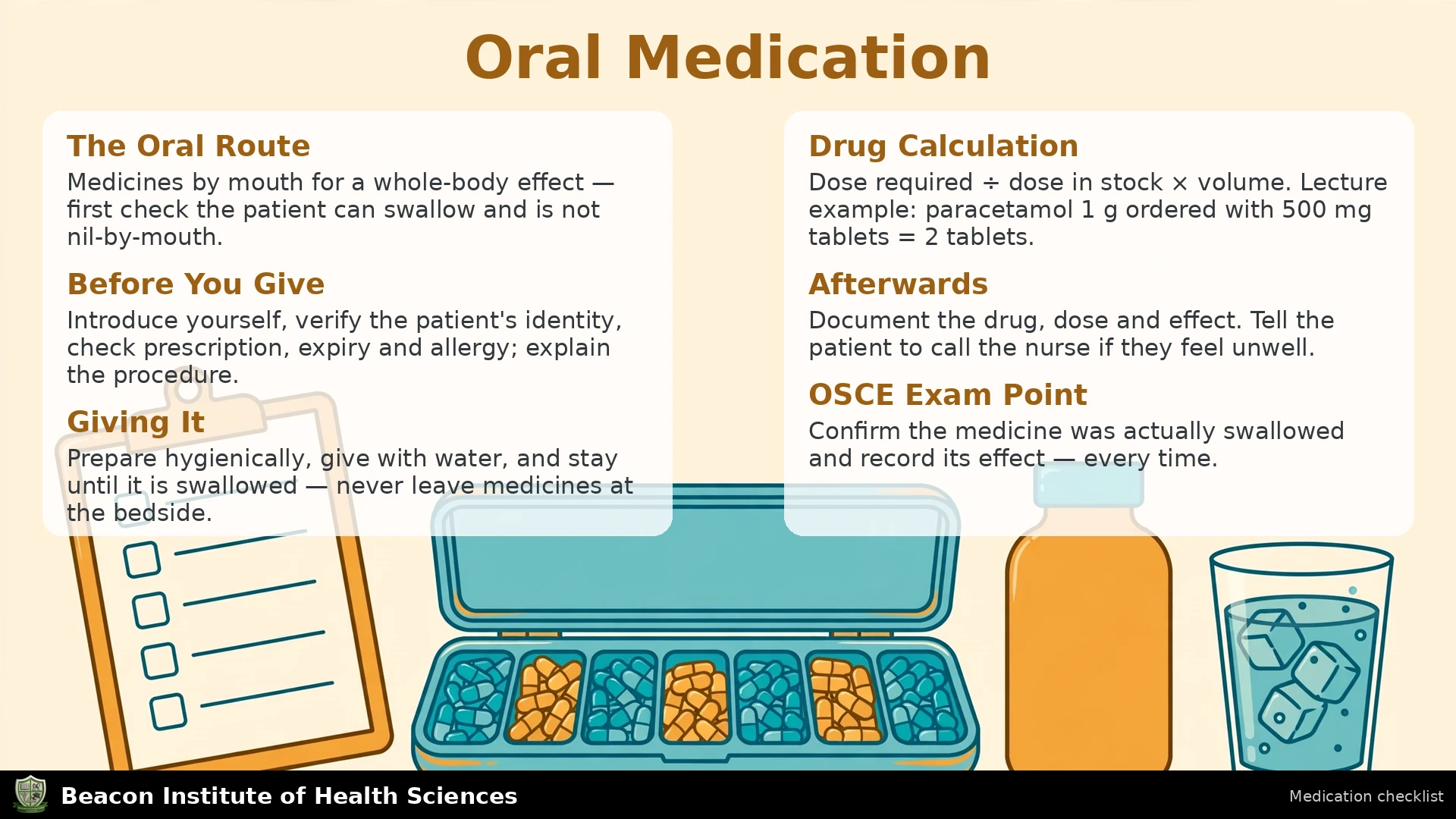
Oral medication is given by mouth according to an authorized order and product instructions. BSN students should identify common dosage forms, explain key safety checks, recognize when administration needs clarification and describe monitoring and documentation. This lesson is for supervised education. It does not authorize a student to administer medication independently, select a drug, change an order or use the fictional calculations as patient instructions. Local policy and current medicine-specific guidance govern clinical practice.
2. Route and absorption concepts
Swallowed medicines commonly pass into the gastrointestinal tract before absorption. Onset and absorption vary with the medicine, formulation, food and patient factors; there is no universal onset time for all oral drugs. Some absorbed drugs undergo first-pass metabolism before reaching systemic circulation. Sublingual and buccal products are designed for placement under the tongue or between cheek and gum. These routes are not interchangeable with swallowing a tablet. Follow the exact order and product directions.
3. Common dosage forms
Tablets, capsules and oral liquids are common preparations. A solution contains dissolved ingredients; a suspension contains dispersed particles and may require shaking as directed. Chewable, dispersible, enteric-coated and modified-release preparations have distinct instructions. A similar name or appearance does not establish interchangeability. Read the complete product label, including strength and concentration. Check expiration and integrity through the approved process. Ask a pharmacist about uncertain formulation details rather than guessing from appearance.
4. Orders, identity and allergies
Verify the authorized order, approved patient identifiers, medicine, dose, route and timing using the institution's medication process. Confirm recorded allergies and clarify their nature where appropriate. A familiar patient or bed number does not replace identity checking. Resolve incomplete, inconsistent or unclear information before administration. Barcode tools and electronic records assist checks but do not remove professional responsibility. Use the required independent checks for medicines designated high risk by local policy.
5. Assessment before administration
Assess whether the prescribed oral route is appropriate, including swallowing ability and relevant restrictions. A nothing-by-mouth order needs clarification about medicines rather than assumptions. Altered consciousness, dysphagia or vomiting can require review of the route. Check medicine-specific observations or laboratory requirements when ordered and within your role. Do not force a medicine on a person who cannot swallow safely, and do not improvise a feeding-tube route. Seek guidance from the responsible nurse, prescriber or pharmacist.
6. Preparation and interruption management
Prepare medication through the approved clean, organized workflow. Compare the product with the order at required stages and keep each patient's medicines clearly separated. Reduce unnecessary interruptions and return to the appropriate check after a disruption. Never use unlabelled or uncertain material. Maintain infection-prevention measures and required storage conditions. If you discover an inconsistency, pause and resolve it. Completing a task quickly is less important than establishing that the order and prepared product agree.
7. Crushing, splitting and formulation changes
Do not crush tablets, open capsules or split doses merely because swallowing is difficult. Enteric coatings and modified-release systems may be essential to the medicine's action. Verify the specific product with a current reference and pharmacist, then follow an authorized alternative. A score line alone does not answer every suitability question. Feeding-tube administration needs a separate approved order and procedure, including formulation compatibility. This lesson does not provide a universal crushing list or tube-flushing prescription.
8. Measuring oral liquids
Use an appropriate calibrated device and the prescribed unit, usually millilitres for liquid volume. Household teaspoons are unreliable measuring tools. Check the actual concentration rather than assuming all bottles of the same medicine have the same strength. An oral syringe should be clearly identified and should not be confused with equipment for injectable administration. The device must allow accurate measurement of the required amount. Clarify unsuitable volumes or ambiguous units before proceeding.
9. Fictional calculation exercise
For classroom arithmetic only, an order specifies 150 mg and a fictional product contains 50 mg in 5 mL. The concentration is 10 mg per mL, so 150 mg divided by 10 mg per mL equals 15 mL. Check the units and multiply 15 mL by 10 mg per mL to confirm 150 mg. This calculation checks arithmetic, not the clinical suitability of a dose. Real practice requires the complete order, product verification, patient assessment and local checking requirements.
10. Explanation, consent and administration
Explain the medicine and relevant instructions in language the person understands. Offer an opportunity for questions and follow consent and refusal procedures. Support a safe position and administration method appropriate to the assessed situation and local protocol. Remain attentive to whether the medicine was actually taken. Never record a dose as administered merely because it was prepared or left nearby. If administration is interrupted or uncertain, clarify what occurred before any further dose is considered.
11. Refusal, vomiting and adverse effects
If a person refuses, explore the reason respectfully, explain relevant information and notify the appropriate clinician. Document according to policy; do not coerce or conceal a medicine in food without a lawful, specifically authorized process. If vomiting follows a dose, do not automatically repeat it because the absorbed amount may be uncertain. Report the event and seek medicine-specific guidance. Suspected adverse effects require assessment and the appropriate urgent response when indicated.
12. Monitoring and documentation
Monitor the expected response and relevant adverse effects according to the medicine and care plan. Record actual administration, time, route and required details promptly in the approved record. Document refusal, omission, delay or uncertainty with the reason and communication required by policy. For as-needed medication, include the indication and reassessment. Accurate documentation supports continuity but never substitutes for observing the person. Follow the authorized correction process if an entry is wrong.
13. Fictional safety scenarios
A training patient cannot swallow a prescribed modified-release tablet. The correct learning response is to pause and request an approved alternative, not crush it. In another case, the bottle concentration differs from the practice worksheet; recalculate only after verifying the correct product and order. If a prepared dose is found unattended, do not assume it was taken. Reconcile the situation with the supervising nurse to prevent both omission and accidental duplication.
14. Answered review and recap
Can every tablet be crushed? No; the specific formulation must be checked. Does a correct calculation prove that a dose is appropriate? No. Should a vomited dose automatically be repeated? No; seek guidance. Why use a calibrated oral device? To measure volume reliably. When should administration be documented? After the actual event, according to policy. Recap: verify the order and person, assess the route, prepare accurately, explain, observe, monitor and document within supervised practice.