
1. Why carbohydrate metabolism matters
Carbohydrate metabolism includes the reactions that digest carbohydrate, distribute glucose, release its energy, store excess glucose and maintain glucose availability between meals. These processes connect nutrition with cellular work. A nurse encounters their consequences during meal planning, fasting, glucose monitoring, illness and diabetes care.
Glucose is an important fuel, but tissues differ in their needs. Red blood cells depend on glycolysis because they lack mitochondria. The brain normally uses substantial glucose; during prolonged fasting it can also use ketone bodies. Muscle can change its fuel use with activity and nutrient availability. Blood glucose therefore reflects a balance between glucose entering the circulation and glucose being used or stored.
- Catabolism breaks molecules down and captures some of their energy.
- Anabolism builds or stores molecules and requires energy.
- Metabolic regulation changes pathway activity to match the body's current needs.
2. Digestion, absorption and delivery of glucose
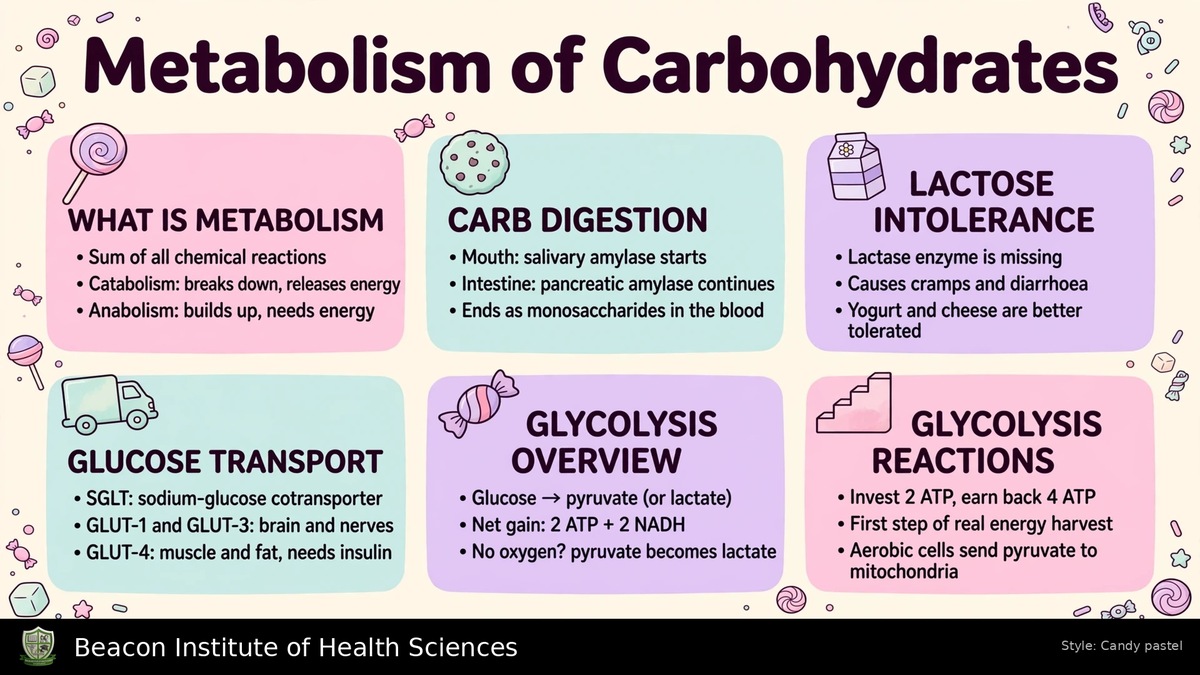
Digestion begins when salivary amylase acts on starch. Pancreatic amylase continues starch digestion in the small intestine. Enzymes at the intestinal brush border, including maltase, sucrase and lactase, complete digestion into absorbable monosaccharides. Glucose, galactose and fructose are absorbed and travel through portal blood to the liver.
The liver processes these nutrients and helps regulate their delivery to the rest of the body. Dietary glucose can be oxidized, stored as glycogen or used to make other compounds. Persistent energy surplus can support fat synthesis. Dietary carbohydrate does not pass directly into mitochondria as intact starch.
Nursing connection: poor intake, vomiting, malabsorption or delayed meals can change nutrient availability. Interpret glucose measurements alongside recent intake, symptoms, medications and the clinical situation.
3. Glucose entry into cells and the glucose-6-phosphate branch point
Glucose enters cells through membrane transport proteins. Insulin increases glucose uptake in skeletal muscle and adipose tissue partly by moving GLUT4 transporters to the cell surface. Glucose uptake by every tissue is not equally insulin dependent; red blood cells and the brain use other transport systems.
Inside many cells, hexokinase uses ATP to phosphorylate glucose. Liver cells also contain glucokinase. The resulting glucose-6-phosphate is retained within the cell and can enter several pathways.
Glucose + ATP → glucose-6-phosphate + ADP
- Glycolysis: glucose-6-phosphate contributes to energy production.
- Glycogenesis: it can contribute to glycogen storage.
- Pentose phosphate pathway: it supplies reducing power and sugar precursors.
4. Glycolysis: the cytosolic pathway
Glycolysis converts one six-carbon glucose into two three-carbon pyruvate molecules through ten enzyme-catalyzed reactions in the cytosol. The investment phase consumes two ATP. The payoff phase produces four ATP and two NADH. The net yield is therefore two ATP, not four.
Per glucose: 2 pyruvate + 2 net ATP + 2 NADH. ATP formed directly during glycolysis is produced by substrate-level phosphorylation.
Major effectively irreversible steps are catalyzed by hexokinase or glucokinase, phosphofructokinase-1 and pyruvate kinase. Phosphofructokinase-1 is a major regulatory point. Cellular energy status helps determine whether glucose breakdown should accelerate or slow.
Worked example: if five glucose molecules complete glycolysis, the investment is 10 ATP and gross production is 20 ATP. Net production is 20 − 10 = 10 ATP, with 10 pyruvate and 10 NADH. This calculation covers glycolysis only.
5. Pyruvate, lactate and regeneration of NAD+
Glycolysis does not directly consume oxygen. It nevertheless requires a continuing supply of NAD+ to accept electrons. When mitochondrial oxidation cannot keep pace with glycolytic demand, lactate dehydrogenase converts pyruvate to lactate while regenerating NAD+. This permits glycolysis to continue.
Pyruvate + NADH + H+ ⇌ lactate + NAD+
Lactate formation does not add extra ATP to the two net ATP from glycolysis. Red blood cells normally form lactate because they have no mitochondria. Lactate can also be transported and reused as a fuel or as a substrate for glucose production. An elevated blood lactate has several possible causes and must be interpreted clinically; it is not, by itself, a diagnosis.
6. Pyruvate oxidation and the citric acid cycle
In cells with functioning mitochondria, pyruvate can enter mitochondria and undergo oxidative decarboxylation by the pyruvate dehydrogenase complex. Each pyruvate produces one acetyl-CoA, one NADH and one carbon dioxide. For one glucose, these yields are doubled. This reaction connects glycolysis with the citric acid cycle.
Acetyl-CoA combines with oxaloacetate to begin the cycle. Oxaloacetate is regenerated rather than consumed overall. Most cycle reactions occur in the mitochondrial matrix; succinate dehydrogenase is associated with the inner mitochondrial membrane.
Two cycle turns per glucose yield 6 NADH, 2 FADH2, 2 GTP or ATP equivalents and 4 CO2. These values exclude the NADH and carbon dioxide produced before the cycle. The cycle also supplies intermediates for other biosynthetic processes.
7. Oxidative phosphorylation and ATP accounting
NADH and FADH2 transfer electrons to the mitochondrial electron transport system. Electron transfer helps create a proton gradient across the inner membrane. ATP synthase uses that gradient to form ATP. Oxygen accepts electrons at the end of the chain and contributes to water formation.
The ATP total from complete glucose oxidation is not a fixed universal number. Estimates depend on how cytosolic reducing equivalents enter mitochondria, proton transport costs and coupling efficiency. Modern teaching commonly estimates approximately 30–32 ATP per glucose in human cells. Always state the assumptions when comparing older totals.
- Glycolysis contributes 2 ATP directly.
- The citric acid cycle contributes 2 GTP or ATP equivalents directly per glucose.
- Most remaining ATP is associated with oxidative phosphorylation.
- When reporting a pathway's yield, distinguish direct ATP from reduced electron carriers.
8. Glycogenesis: storing glucose as glycogen
Glycogenesis is glycogen synthesis. Glucose-6-phosphate is converted to glucose-1-phosphate and then activated as UDP-glucose. Glycogen synthase extends chains, while a branching enzyme creates branches. The principal chain bonds are α-1,4 linkages and the branch bonds are α-1,6 linkages.
Glycogen is stored mainly in liver and skeletal muscle, but the stores serve different purposes. Liver glycogen helps sustain circulating glucose between meals. Muscle glycogen supplies fuel for the muscle itself. Insulin and nutrient availability favor storage after a meal. Glycogen storage is limited; it is not an unlimited reservoir for all dietary carbohydrate.
9. Glycogenolysis: mobilizing stored carbohydrate
Glycogenolysis releases glucose units from glycogen. Glycogen phosphorylase removes units mainly as glucose-1-phosphate, and a debranching enzyme handles branch points. Glucose-1-phosphate is converted to glucose-6-phosphate.
The liver contains glucose-6-phosphatase and can release free glucose into blood. Skeletal muscle lacks this enzyme for blood glucose export and uses its glucose-6-phosphate locally. This explains why muscle glycogen does not directly maintain blood glucose in the same way as liver glycogen.
Glucagon promotes hepatic glucose production during fasting. Epinephrine helps mobilize fuel during stress and activity, including glycogen breakdown in muscle. Do not describe glucagon as the main direct stimulus for skeletal muscle glycogenolysis.
10. Gluconeogenesis: forming glucose from other substrates
Gluconeogenesis forms glucose from non-carbohydrate precursors, including lactate, glycerol and glucogenic amino acids such as alanine. The liver is a major site; the kidneys can also contribute, especially during prolonged fasting. This pathway supports glucose-requiring tissues when intake and glycogen availability are insufficient.
Gluconeogenesis is not simply glycolysis run backward. Several glycolytic reactions are effectively irreversible, so different enzymes bypass them. Important bypass enzymes include pyruvate carboxylase, phosphoenolpyruvate carboxykinase, fructose-1,6-bisphosphatase and glucose-6-phosphatase.
Producing glucose requires energy. Formation of one glucose from two pyruvate requires four ATP, two GTP and two NADH. Even-chain fatty acid-derived acetyl-CoA does not provide net glucose in humans; glycerol from triglycerides can contribute to glucose synthesis. Avoid confusing glycerol with the fatty acid portion of a triglyceride.
11. The Cori cycle and cooperation between tissues
In the Cori cycle, lactate produced by tissues such as red blood cells or active muscle travels to the liver. The liver can convert lactate into glucose through gluconeogenesis. Glucose may then return through blood to other tissues.
The cycle redistributes metabolic work; it does not create free energy. Anaerobic glycolysis produces two ATP per glucose in the peripheral tissue, while hepatic conversion of two lactate to glucose requires six high-energy phosphate equivalents. The liver supplies the additional energy required for recycling.
Clinical reasoning example: during strenuous activity, increased glycolysis may increase lactate delivery to the circulation. Recovery involves lactate oxidation and recycling in several tissues, not merely waiting for all lactate to disappear as waste.
12. The pentose phosphate pathway
The pentose phosphate pathway branches from glucose-6-phosphate in the cytosol. It produces NADPH and pentose sugars, including precursors for ribose-5-phosphate. NADPH supports reductive synthesis and antioxidant defenses. Ribose sugars support nucleotide synthesis.
NADPH and NADH have different principal roles. NADH mainly carries electrons toward energy production, whereas NADPH commonly supports biosynthesis and protection against oxidative damage. They should not be used interchangeably in pathway summaries.
Glucose-6-phosphate dehydrogenase is important in the oxidative part of this pathway. Red blood cells depend on NADPH to help maintain reduced glutathione and protect against oxidative injury. G6PD deficiency can increase susceptibility to hemolysis under particular stresses. Nursing assessment includes relevant history, observation for hemolysis and medication review according to clinical guidance.
13. Coordination in the fed, fasting and stress states
After a meal, increased insulin favors glucose uptake in responsive tissues, glycogen synthesis and nutrient storage. During fasting, lower insulin and increased glucagon favor hepatic glycogen breakdown and gluconeogenesis. As fasting continues and liver glycogen declines, glucose production and alternative fuels become increasingly important.
Stress hormones can increase fuel availability and contribute to hyperglycemia during acute illness. The direction of a pathway also depends on substrate supply, enzyme regulation and the energy needs of each tissue. Opposing pathways are coordinated to reduce unnecessary simultaneous glucose breakdown and synthesis.
- Liver: processes incoming nutrients, stores glycogen and supports blood glucose.
- Skeletal muscle: uses glucose and its own glycogen for contraction.
- Adipose tissue: stores energy and supplies fatty acids and glycerol during mobilization.
- Red blood cells: obtain ATP from glycolysis and release lactate.
- Brain: normally relies heavily on glucose and adapts to increased ketone use during prolonged fasting.
14. Applying the pathways in nursing assessment
Glucose monitoring is most useful when measurements are related to meals, fasting, symptoms, medication timing and illness. A single reading and an HbA1c answer different questions: one reflects glucose at a particular time, while the other helps assess longer-term glycemic exposure. Clinical targets and action thresholds depend on the patient and setting.
Worked unit conversion: to convert glucose from mg/dL to mmol/L, divide by approximately 18. A value of 90 mg/dL is 90 ÷ 18 = 5.0 mmol/L. To convert back, multiply by 18. This is a unit conversion example, not a universal treatment target.
Scenario: delayed meal after glucose-lowering treatment. A patient becomes shaky and sweaty while waiting for food. Assess promptly, check glucose when available, follow the local hypoglycemia protocol and escalate as indicated. Ensure meal and treatment timing are communicated. Do not select a medication dose from pathway knowledge alone.
Scenario: fasting before a procedure. A patient with diabetes is instructed to fast. Clarify the prescribed medication and monitoring plan with the responsible team, assess intake and glucose, and follow procedural guidance. Do not assume every diabetes medicine should be stopped or continued unchanged.
Scenario: acute illness and elevated glucose. Stress responses may increase hepatic glucose output even when intake is reduced. Record trends, assess hydration and symptoms, communicate abnormal findings and follow the treatment plan. Stress-related hyperglycemia does not eliminate the need for clinical evaluation.
15. Revision checklist and common mistakes
- Identify the location, purpose and principal products of each pathway.
- Distinguish glycogenesis, glycogenolysis and gluconeogenesis.
- Explain why liver and muscle glycogen have different roles.
- Remember that glycolysis produces two net ATP and does not directly require oxygen.
- Explain how lactate formation regenerates NAD+ without adding ATP.
- Separate NADH-mediated energy transfer from NADPH-dependent biosynthesis and antioxidant defense.
- Explain why gluconeogenesis requires bypass reactions and energy.
- Distinguish a measured glucose concentration from an individualized clinical target.
Self-check: follow one dietary glucose molecule from intestinal absorption to ATP production. Then explain how the liver maintains glucose availability during fasting. Finally, connect each explanation to one nursing observation, such as meal timing, symptoms, glucose trends or a change in intake.