
1. Learning objectives and purpose
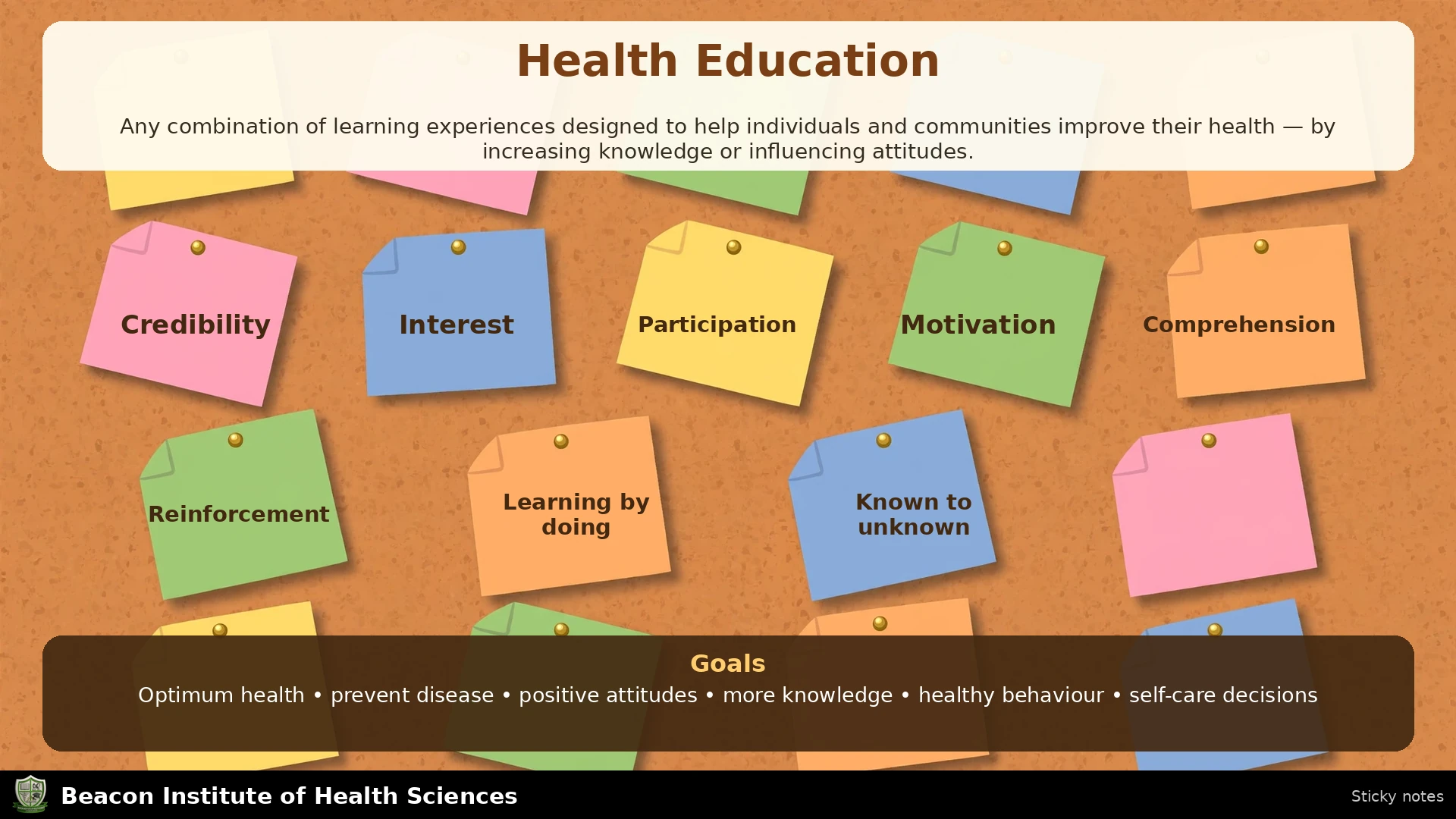
Health education uses planned learning to help people understand health and develop useful skills. By the end of this lesson, assess a learning need, write a measurable objective, choose a suitable teaching method and evaluate understanding. Education is a partnership rather than a one-way lecture. A person may know the recommended action but lack time, money or services to carry it out. Effective planning therefore considers both learning and the practical conditions surrounding it.
2. Education and health promotion
Health education focuses on learning; health promotion includes broader action that supports influence over health and its determinants. Teaching safe food handling is an educational activity. Improving access to suitable food storage is a related environmental action. The two can support each other, but a leaflet cannot replace a missing service. In an examination answer, explain the difference using one concrete example. Avoid describing every health programme as education simply because it distributes information.
3. Assessing learning needs
Ask what the person already knows, wants to learn and finds difficult. Check language, literacy, hearing, vision, readiness and the environment for teaching. An assessment should identify a specific gap rather than label someone as poorly informed. For example, a learner may understand why hand hygiene matters but be unsure about technique. That need is different from lacking access to water. Use questions and observation respectfully, and do not test people in a humiliating way.
4. Knowledge, skills and attitudes
Learning can involve understanding, performing a skill or considering beliefs and motivation. These outcomes need different teaching approaches. Explaining a purpose may support knowledge; supervised practice supports a skill; discussion can explore concerns. A single quiz score cannot establish that a person can safely perform a procedure. Identify the intended outcome before selecting a method. Respect personal values and distinguish informed choice from agreement with the educator's preferred answer.
5. Writing measurable objectives
An objective states who will do what, under which conditions and how achievement will be checked. Use observable verbs such as describe, demonstrate or identify. A fictional objective is: after a short session, each participant will identify two suitable places to obtain verified clinic information. Saying that participants will understand healthcare is too broad to evaluate. Keep objectives realistic for the available time and match them to the learning need rather than including every possible fact.
6. Planning a short lesson
A useful plan contains the audience, need, objective, key content, method, materials, time and evaluation. Begin with the most relevant action and organize the rest in a clear sequence. Leave room for questions and practice. A five-minute session should not contain the same volume as a full classroom lecture. In a student assignment, explain why each item is included. The plan should make it possible for another educator to deliver the intended lesson consistently.
7. Choosing teaching methods
Discussion, demonstration, pictures, small-group activities and written material have different strengths. Demonstration is useful when movement or technique matters; a picture can clarify a process; discussion can reveal misconceptions. Choose methods suited to the audience and available resources. Digital media may be convenient but can exclude people without devices or connectivity. Combine methods when helpful, and check whether the material is readable, understandable and appropriate for the specific learning goal.
8. Plain language and health literacy
Health literacy involves finding, understanding and using health information. Use familiar words, short explanations and clearly stated actions. Explain unavoidable technical terms and avoid unexplained abbreviations. Literacy should not be inferred from appearance, education or confidence. A person may read well but struggle with unfamiliar instructions. Test the clarity of the message, not the worth of the learner. Where numbers are necessary, use a relevant worked example and check how the learner interprets it.
9. Teach-back and return demonstration
Teach-back asks the learner to explain the information in their own words so the educator can check the explanation. Introduce it as a check on how clearly you taught, not as an examination. A return demonstration checks a practical skill after suitable teaching and supervision. The methods are related but not identical. If a step is missed, clarify and repeat the appropriate practice. Clinical procedures require current instructions, equipment and authorized supervision rather than a generic classroom demonstration.
10. Motivation and respectful discussion
Ask about concerns, preferences and previous experiences. A learner may hesitate because of fear, cost or a conflicting belief. Listening helps identify the issue without confrontation. Offer accurate information and support informed decisions while respecting autonomy. Avoid promising guaranteed outcomes or using shame to obtain agreement. A realistic next step may be smaller than the educator first expected. The plan should be useful to the person, not merely satisfy a checklist of facts delivered.
11. Culture, language and accessibility
Use the preferred language and an appropriate interpreter when required. Consider accessible formats, suitable lighting and opportunities for private questions. Invite people to explain their preferences rather than assuming that everyone in a community shares the same beliefs. Family involvement should follow the person's wishes and appropriate consent. Images should communicate the intended meaning without stereotypes. In a community group, check whether quieter participants can ask questions safely and whether the venue excludes people with mobility needs.
12. Evaluation and follow-up
Evaluation can examine reach, learning, practical use and longer-term outcomes. Attendance shows who was present, while a demonstration checks a skill. A health outcome may be influenced by many factors besides the lesson. Record the measure and review period clearly. If objectives were not achieved, reassess the explanation, method and barriers before blaming the learners. Follow-up can reinforce learning and identify difficulties that only become apparent when people try the action in everyday life.
13. Worked lesson and calculation
A fictional team teaches twenty participants how to locate verified clinic information. Sixteen can identify two appropriate sources afterward. The measured result is sixteen divided by twenty times one hundred, or eighty percent. The team should review why four participants could not complete the task and offer clearer practice. The result does not prove improved health outcomes. A second objective could check whether participants can use one source to find the correct clinic hours.
14. Answered review and practical task
Write a ten-minute lesson plan using fictional learners and one objective. Include a question, a practical activity and a method of checking achievement. Answers: learning needs come before method selection; objectives require observable actions; teach-back checks the explanation; return demonstration checks performance; attendance and learning are different measures; structural barriers may persist after good teaching. Explain why plain language helps confident readers too. Recap: assess, plan, teach with the learner and evaluate a meaningful result.