
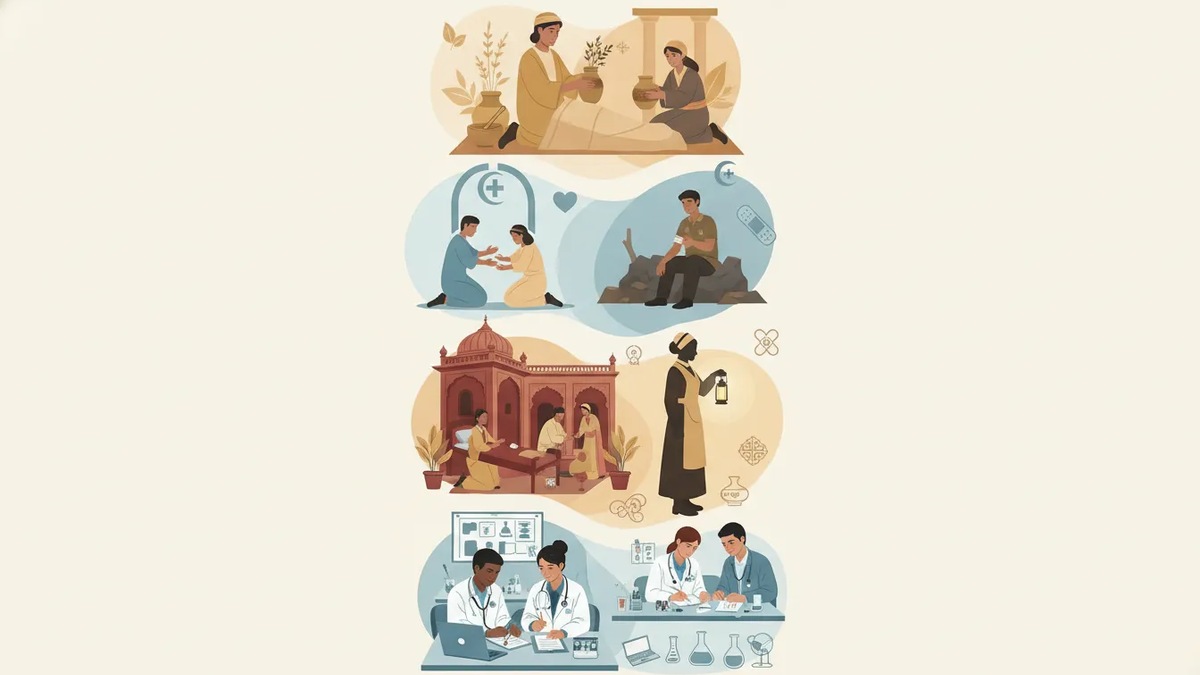
The history of health care and nursing explains how patient care moved from home remedies, religious service, and battlefield aid to an organized profession with formal education, ethics, and licensing. For BSN and nursing students, this topic is foundational because it shows why nursing is centered on care, recovery, prevention, dignity, and professional responsibility.
This guide covers the development of health care in ancient cultures, the role of Islam and Christianity in shaping nursing, the influence of Florence Nightingale, nursing during the Mughal period, major definitions of nursing, types of nursing educational programs, and the history of nursing education in Pakistan.
What is the history of health care and nursing?
The history of health care and nursing is the study of how societies cared for the sick, injured, pregnant women, infants, and vulnerable people across different time periods. It also explains how nursing developed from informal caregiving into a recognized profession.
In the earliest periods, care was usually provided by family members, traditional healers, religious figures, or attendants with practical experience. Over time, hospitals were established, scientific thinking became stronger, nursing roles became clearer, and education systems were created to prepare trained nurses.
Understanding this history helps explain several important facts:
- Nursing began with caregiving in homes, communities, and crisis settings.
- Religion strongly influenced early patient care and charity-based service.
- War and public crises accelerated nursing development by creating urgent need for organized care.
- Modern nursing became professionalized through training, ethics, discipline, and public respect.
How health care worked in ancient cultures
Indus Valley civilization
Early South Asian civilizations are often noted for advanced social organization, and health-related practices were part of that development. People recognized injuries and illnesses, including conditions such as internal disease and bone fractures, and they attempted treatment with the knowledge available at the time.
Another important point is the role of women in childbirth. In many communities, specific women assisted mothers during delivery. These attendants are often considered among the earliest recorded caregivers in maternal support.
Greek culture
In ancient Greece, illness was often linked to religious belief, prayer, and ideas about divine influence. Many people believed disease could result from moral or spiritual causes.
Later, a major shift occurred when thinkers such as Hippocrates argued that diseases have natural causes rather than magical ones. This was a turning point because it encouraged observation, reasoning, and a more systematic approach to health and illness.
Roman contribution
The Romans expanded on earlier medical ideas and are known for developing more organized health systems. They created structured places where care could be given and improved the practical side of treatment, especially in settings that required discipline and administration.
This was important because it moved care away from purely informal support and toward more defined institutions.
Where were patients treated before modern hospitals?
Before modern hospitals became common, patients were often treated in places that reflected the beliefs and resources of the time. These included:
- Homes, where family members gave basic care
- Temples and religious sites, where healing was associated with spiritual protection
- Military camps or field setups, where wounded people were treated during conflict
- Early hospitals that later developed under organized states and religious systems
This progression shows that health care did not begin in the modern hospital. It evolved gradually as societies developed better systems for treatment, sanitation, and patient management.
Health care in ancient India
India has a long healing tradition, including Ayurvedic medicine. Historical accounts also connect the period of King Ashoka with the establishment of hospitals.
What stands out in this history is that care was not always primitive. Systems of sanitation, treatment, and organized patient support existed in earlier forms than many people assume. This is one reason the history of health care is so important in nursing education. It challenges the idea that meaningful health systems are only modern creations.
Role of religion in the development of nursing
Christianity and organized care
Christianity played a major role in shaping the moral side of nursing. The values of compassion, service, sacrifice, and love for the suffering became closely linked to patient care.
During this period:
- Care of the sick became a moral responsibility.
- Hospitals and charitable care settings expanded.
- Helping the weak and ill gained social and spiritual importance.
This helped establish the idea that healing is not only about medicine. It is also about comfort, kindness, dignity, and emotional support.
Why this mattered for nursing
These values shaped the early public image of nursing. Care was increasingly seen as meaningful and honorable, even if the profession itself took much longer to gain structure, formal education, and social status.
Islam and nursing
In Islamic history, nursing is strongly associated with service, hygiene, battlefield care, health education, and ethical conduct. One of the most important early figures is Rufaida Al-Aslamia, who is widely recognized in nursing history as an early Muslim nurse.
Rufaida Al-Aslamia and early Islamic nursing
Rufaida is known for caring for wounded people, especially in battle-related settings. Her work is associated with:
- Field hospital care
- Hygiene and environmental attention
- Organized support by women helpers
- Health education and prevention
- Ethical patient care
Her contribution is important because it shows that nursing in Islamic civilization was not limited to bedside assistance. It also included organization, teaching, prevention, and moral standards.
Ethics in Islamic nursing
Islamic nursing history places strong emphasis on respectful behavior, service, responsibility, and proper conduct toward patients. This connects closely with what modern nursing now calls professional ethics.
For students studying professional conduct, this historical background is useful because it shows that ethics has always been central to good nursing care.
How war helped shape modern nursing
Wars created extreme conditions where large numbers of people needed urgent care. In these environments, organized nursing became essential.
Battlefield and military settings highlighted the need for:
- Immediate wound care
- Clean surroundings
- Food and hydration
- Observation of the sick and injured
- Orderly recordkeeping and teamwork
Florence Nightingale and the foundation of modern nursing
Florence Nightingale is widely regarded as the founder of modern nursing. Her work transformed nursing from loosely organized caretaking into a more respected and systematic profession.
Why Florence Nightingale is important
- She emphasized the patient’s environment as part of healing.
- She improved conditions in military hospitals.
- She showed that nursing required discipline, responsibility, and knowledge.
- She supported formal training for nurses.
Environmental theory in simple words
Nightingale’s most influential idea was that the environment affects recovery. If a patient is kept in better surroundings, healing can improve. This includes factors such as cleanliness, fresh air, order, comfort, and basic supportive services.
Why she was called the “Lady with the Lamp”
She became known by this title because of her dedication to checking on patients, including at night, especially during wartime care. The title reflects vigilance, compassion, and commitment to the sick.
How nursing became a profession
Nursing did not become professional overnight. It evolved through social, moral, and institutional changes including home-based caregiving, religious service, war crises, hospital development, formal education, and leadership by key reformers.
Nursing in the Mughal period
In the Mughal period, caregiving roles included attendants responsible for the care of royal children, especially wet nurses and child caregivers. These women held recognized positions in royal settings and were trusted in matters related to infant care and upbringing.
Definitions of nursing by major sources
Florence Nightingale’s definition
Nightingale’s view of nursing focuses on using the patient’s environment to support recovery.
American Nurses Association definition
This definition presents nursing as a direct, goal-oriented, and adaptable practice that serves individuals, families, and communities.
Virginia Henderson’s definition
Virginia Henderson described nursing as assisting a person, sick or well, in activities that contribute to health, recovery, or a peaceful death, especially when they lack strength or knowledge.
World Health Organization definition
The WHO describes nursing as including both autonomous and collaborative care for individuals of all ages, families, groups, and communities in all settings.
Types of nursing educational programs
- Nursing assistant level or assistant-focused training programs
- Practical nursing diploma (skill and practice oriented)
- Registered nurse preparation (diploma or degree routes)
- Bachelor-level nursing degree (BSN Generic)
- Master’s and Doctoral programs for advanced leadership and scholarship
History of nursing education in Pakistan
1947 to 1955: Limited number of schools offering basic nursing and midwifery diploma programs, lacking full standardization.
1956 to 1972: Postgraduate diploma areas began to develop (psychiatric, pediatric, community health) and structured research activity emerged.
1973 to 2002: Degree-level nursing education was initiated, teaching methods advanced, and research became firmly established.
2003 to the present: Tremendous expansion of nursing colleges, growth of Master’s and Doctoral pathways, with formalized national licensing standards.
Final takeaway
The history of health care and nursing is really the history of how societies learned to care more effectively for human life. From home-based support and spiritual healing to formal hospitals, field care, ethical practice, and university education, nursing has always developed around one central purpose: helping people maintain health, recover from illness, and live with dignity.