
Learning Objectives
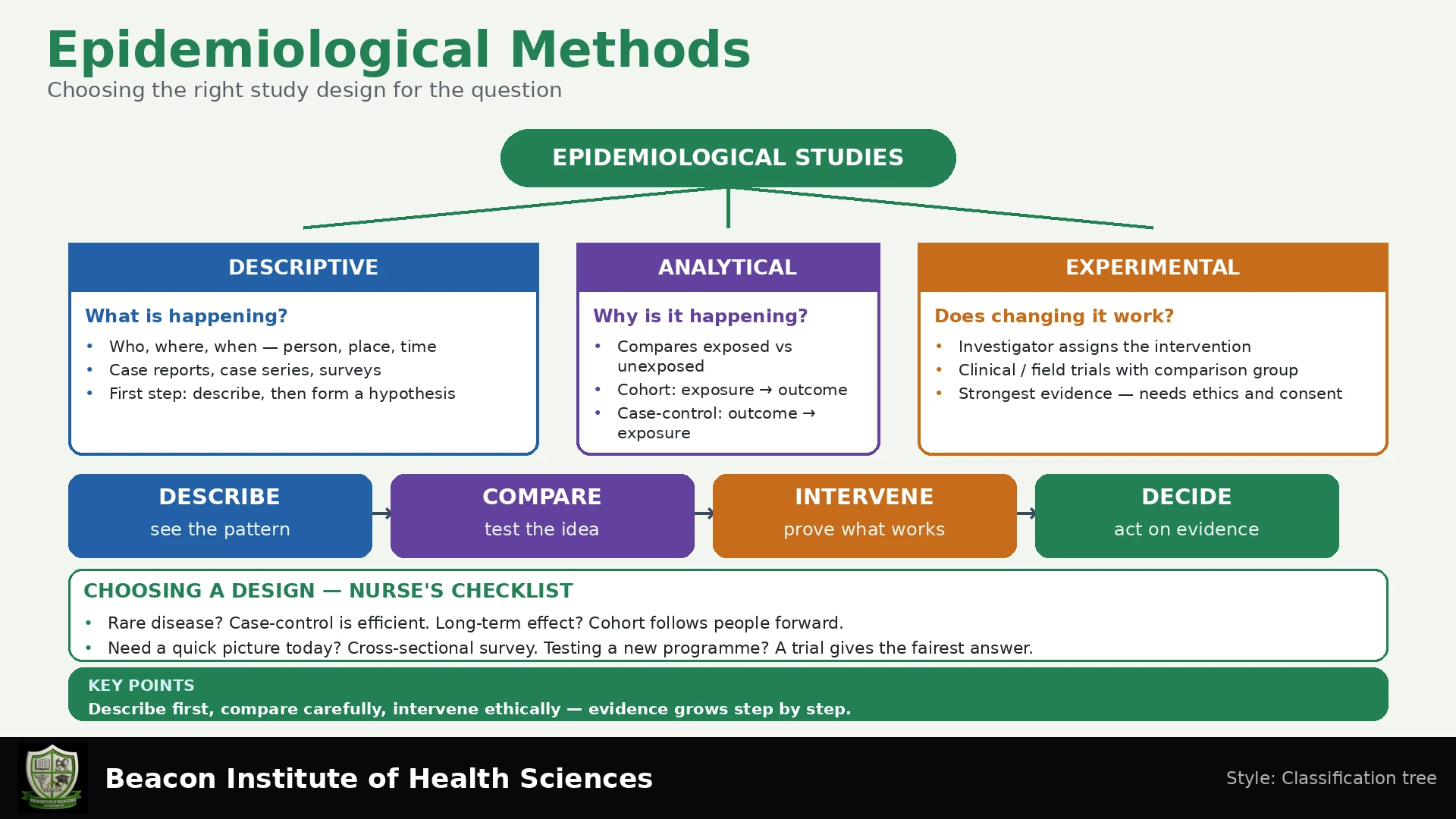
- Explain descriptive, analytical and experimental epidemiology.
- Choose a study design suited to a nursing or public-health question.
- Calculate and interpret a simple exposure comparison.
- Recognize bias, confounding, uncertainty and ethical responsibilities.
What Are Epidemiological Methods?
Epidemiological methods are systematic ways to investigate health events in populations and use the findings to improve health. They connect a clear question to a suitable design, accurate measurement, analysis and action. Nurses contribute through careful observation, consistent documentation, patient interviews, prevention work and interpretation of local data.
Begin by defining the population, exposure, outcome, comparison and time period. For example: among residents who attended a community meal, was eating a particular dish associated with illness during a specified period? This is more useful than asking vaguely why people became ill. Define illness and exposure before comparing groups whenever possible.
Descriptive Epidemiology
Descriptive studies show what happened, how much, when, where and among whom. Time may include symptom-onset date, season or long-term trends. Place may include residence, workplace or exposure location. Person characteristics may include age, occupation and relevant health conditions. Use these categories respectfully and avoid publishing identifiable details.
A case report describes one patient; a case series describes several patients. They can identify unusual events and generate hypotheses, but usually lack a suitable comparison group for estimating an exposure effect. A cluster in one neighbourhood may reflect population density, referral patterns or testing access rather than a local cause.
Study Designs at a Glance
| Design | Starting point | Main use | Important limitation |
|---|---|---|---|
| Ecological | Groups or geographical units | Compare population-level exposures and outcomes | Group associations may not hold for individuals |
| Cross-sectional | A population assessed at a time or short period | Estimate prevalence and describe associations | Exposure-outcome timing may be unclear |
| Case-control | People with and without the outcome | Study uncommon outcomes or long-latency conditions efficiently | Control selection and exposure recall can bias results |
| Cohort | People classified by exposure and followed through outcome occurrence | Estimate incidence and compare risks or rates | Confounding and loss to follow-up may affect findings |
| Randomized trial | Eligible participants assigned by chance to interventions | Estimate effects of ethically acceptable interventions | Feasibility, adherence and generalizability can limit usefulness |
| Quasi-experiment | An intervention without randomized assignment | Evaluate service or policy changes | Other time trends and group differences may explain change |
Analytical Observational Methods
Cross-Sectional and Ecological Studies
A cross-sectional survey might measure current blood pressure and activity in a sample of adults. It can estimate prevalence, but an association does not establish whether activity preceded blood-pressure changes. Reverse causation is possible: illness may itself reduce activity.
An ecological study might compare district air-pollution averages with hospital admission rates. It can guide further investigation, but cannot establish that the people admitted were those with the highest exposure. This error of moving from group evidence to individual conclusions is called the ecological fallacy.
Case-Control Studies
Investigators select cases with a defined outcome and controls representing the source population that produced the cases. Controls should provide information about exposure in that source population; they are not simply whoever is easiest to interview. Exposure history is compared between groups, commonly using an odds ratio.
Ordinary case-control sampling fixes the numbers of cases and controls, so disease risk generally cannot be calculated directly from their proportions in the study. Matching and other design features must be addressed in analysis. Recall differences, interviewer expectations and unsuitable controls can distort results.
Cohort Studies
Cohorts compare outcome occurrence in exposure groups. In a prospective cohort, outcomes occur after enrolment. A retrospective cohort reconstructs exposure and subsequent outcomes from existing records. Both follow the logical direction from exposure to outcome. Retrospective does not automatically mean case-control.
Cohorts can estimate risks when follow-up and denominators are suitable, or rates using person-time. They can study several outcomes of an exposure. Rare outcomes may require a very large cohort, while incomplete records or differential loss can undermine validity.
Experimental and Quasi-Experimental Methods
In a randomized trial, investigators assign an intervention by chance. Randomization helps balance measured and unmeasured baseline factors on average, but does not guarantee identical groups in every sample. Allocation concealment prevents foreknowledge of assignments. Blinding, where feasible, reduces differences in care or assessment. These are distinct procedures.
Participants must not be deliberately assigned harmful exposures merely to answer a question. Trials require ethical review, appropriate consent, safety monitoring and a justified comparison. An intention-to-treat analysis generally retains participants in their assigned groups to preserve the benefits of randomization.
A quasi-experiment could assess an interrupted time series before and after a service change. Repeated observations and a suitable comparison series may help distinguish intervention effects from background trends. A single before-and-after comparison is especially vulnerable to seasonal changes, changing case mix and regression to the mean.
Fictional Worked Outbreak Cohort
A nurse-led investigation identifies all 90 attendees at a fictional community meal and applies the same illness definition and follow-up window to everyone. Forty ate a dish and 50 did not. Twenty exposed attendees and five unexposed attendees became ill.
| Exposure | Ill | Not ill | Total |
|---|---|---|---|
| Ate dish | 20 | 20 | 40 |
| Did not eat dish | 5 | 45 | 50 |
| Total | 25 | 65 | 90 |
Exposed attack proportion = 20/40 = 50%. Unexposed attack proportion = 5/50 = 10%. Risk ratio = 0.50/0.10 = 5.0. Risk difference = 0.50 − 0.10 = 0.40, or 40 percentage points. The exposed group had five times the observed risk and 40 additional cases per 100 attendees over this outbreak window.
The odds ratio is (20 × 45)/(20 × 5) = 9.0, which is not the risk ratio. Because illness is common here, calling this nine times the risk would exaggerate the comparison. The association raises suspicion but does not prove the dish caused illness. Other foods, exposure timing, laboratory results, environmental findings, bias and uncertainty need assessment.
Sampling, Measurement and Validity
Define eligibility and the sampling frame. Probability sampling can support population inference when properly implemented; convenience samples may exclude people with different risks. A large biased sample does not automatically become representative. Record response rates and reasons for missing data.
An operational case definition specifies measurable clinical, laboratory, person, place and time criteria appropriate to the investigation. Apply it consistently to comparison groups. Distinguish a surveillance case definition from the clinician's individual diagnostic judgment. Use standard tools, trained interviewers and consistent exposure windows.
- Selection bias: participation or retention creates a misleading exposure-outcome comparison.
- Information bias: exposure or outcome is measured differently or inaccurately; examples include recall and interviewer bias.
- Confounding: another factor linked with exposure and outcome distorts the comparison. Design and analysis can address measured confounders, but residual confounding may remain.
- Effect modification: an effect differs across levels of another factor. This can be a meaningful finding to report, rather than an error to eliminate.
- Chance: random variation produces uncertainty. Report estimates and confidence intervals where appropriate; a p-value alone does not show clinical importance or prove causality.
Nursing Applications and Ethics
Nurses can identify unusual patterns, maintain accurate records, collect specimens within their scope, explain study procedures and support follow-up. Protect confidentiality by collecting only needed information and sharing through approved channels. Research needs appropriate review and consent; public-health surveillance may have a different legal basis. Confirm the applicable requirements rather than assuming that every activity follows the same process.
During an urgent investigation, reasonable protective measures may need to begin while evidence is still being gathered. Communicate what is known and uncertain, avoid public accusations, and work with clinical and public-health teams. Findings should lead to practical prevention and feedback to affected communities.
Practice Questions with Explained Answers
- Which design is useful for an uncommon disease?
A case-control study is often efficient because it starts with cases, although the choice also depends on the question and data.
- Does a retrospective design always mean case-control?
No. A retrospective cohort reconstructs exposure groups and subsequent outcomes.
- What did RR = 5 mean in the meal example?
The observed risk among those who ate the dish was five times the risk among those who did not, over the same window.
- Why is randomization different from blinding?
Randomization determines assignment; blinding limits knowledge of assignment during care or assessment.
- Can a cross-sectional association prove temporal order?
Usually not by itself. Exposure and outcome may be measured together, so earlier occurrence may be uncertain.
Conclusion
Good epidemiological work matches the method to the question. Descriptive evidence identifies patterns, analytical comparisons test explanations, and suitable intervention studies assess effects. Nurses strengthen every stage through clear definitions, accurate measurement, ethical practice and cautious interpretation that supports timely prevention.