
Learning Objectives
Upon completing this lesson, BSN students and nursing educators will be able to:
- Define counselling as a purposeful, collaborative helping relationship in the context of nursing practice.
- Distinguish between basic nursing supportive communication skills and formal counselling or psychotherapy.
- Identify and apply the core principles of effective counselling, including empathy, respect, genuineness, nonjudgment, autonomy, consent, and cultural humility.
- Describe the flexible stages of the counselling process, from engagement to planned ending.
- Utilize essential therapeutic communication skills such as active listening, open questions, clarification, paraphrasing, reflection, silence, and summarizing.
- Recognize and avoid common pitfalls in counselling communication, such as giving advice or making moral judgments.
- Understand the general principles of non-directive/person-centred, skills-based Cognitive Behavioural Therapy (CBT), and solution-focused approaches without engaging in direct treatment protocols.
- Identify situations requiring referral to specialized services, particularly when immediate safety concerns are present.
- Adhere to ethical and professional boundaries, including confidentiality, record-keeping, and the appropriate use of supervision.
Understanding Counselling in Nursing Practice
Defining Counselling and Its Scope
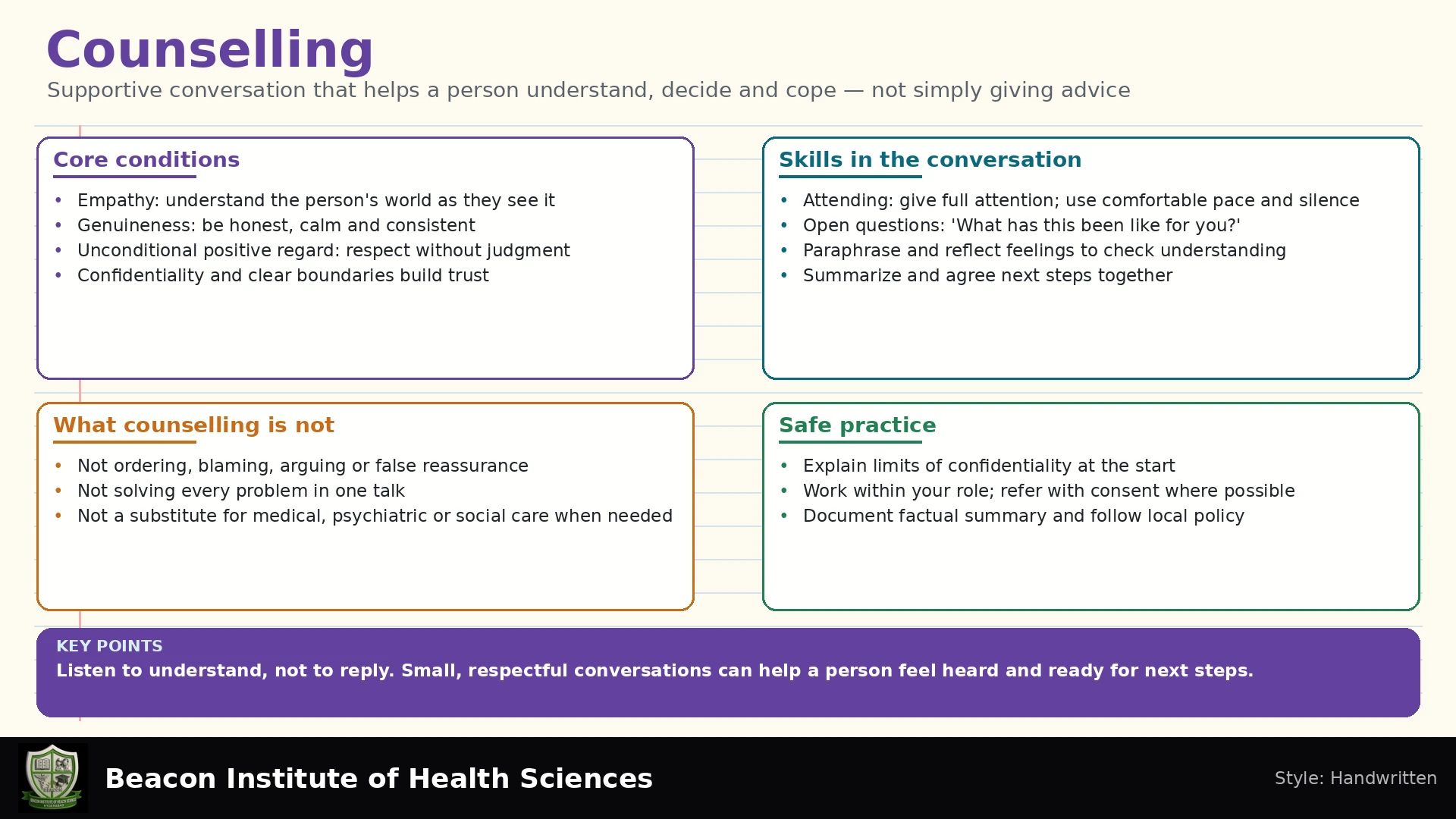
Counselling, within the nursing context, is understood as a purposeful, collaborative helping relationship designed to explore an individual's concerns, options, and coping strategies, ultimately aiding them in choosing and achieving their personal goals. It is fundamentally a process of empowerment and support, not merely advice-giving or a guaranteed cure for problems. Nurses often employ basic counselling skills as an integral part of their supportive communication, helping patients navigate health challenges, make informed decisions, and cope with illness.
It is crucial to distinguish between these basic nursing supportive communication skills and formal counselling or psychotherapy. While nurses utilize empathy, active listening, and other therapeutic communication techniques, formal counselling and psychotherapy require specific, appropriate training, demonstrated competence, and ongoing professional supervision. Nurses must operate within their scope of practice, recognizing when a patient's needs extend beyond basic supportive care and require referral to a specialist trained in formal counselling or psychotherapy.
Core Principles of Effective Counselling
Effective counselling is built upon a foundation of key principles that guide the interaction between the nurse and the individual:
- Empathy: The ability to understand and share the feelings of another. It involves perceiving the client's world as if it were your own, without losing the 'as if' quality.
- Respect (Unconditional Positive Regard): Valuing the client as a person of worth, regardless of their background, choices, or current situation. It involves accepting them without judgment.
- Genuineness (Congruence): Being authentic and consistent while maintaining professional boundaries. Genuineness does not require sharing personal experiences or expressing every feeling; self-disclosure must have a clear professional purpose.
- Nonjudgment: Approaching the client's experiences and perspectives without evaluation or moral assessment. This fosters a safe space for disclosure.
- Autonomy: Respecting the client's right to self-determination and their capacity to make their own choices. The nurse's role is to facilitate this, not to direct it.
- Consent: Ensuring that the individual voluntarily agrees to participate in the counselling process, fully understanding its purpose, limits, and implications. This includes both initial consent to engage and ongoing consent to explore specific topics.
- Cultural Humility: A lifelong commitment to self-reflection and self-critique, acknowledging power imbalances, and developing respectful relationships based on mutual trust. It involves recognizing one's own biases and continually learning about others' cultures.
- Privacy and Confidentiality: Protecting the individual's personal information shared during the counselling process. This is a cornerstone of trust. However, it is essential to clearly explain the limits of confidentiality. Absolute secrecy cannot be promised, where serious safety concerns or applicable legal and professional duties may require limited disclosure through the appropriate process. Explain foreseeable limits and follow local requirements and policy. The BACP resources are professional further reading, not a statement of Pakistani law.
The Counselling Process: A Flexible Framework
The counselling process is not a rigid sequence of steps but rather a flexible, dynamic flow that adapts to the individual's needs and pace. Key phases include:
- Engagement and Agreed Purpose: Establishing rapport and a trusting relationship. The nurse and individual mutually agree on the initial purpose or focus of their interaction, setting clear expectations.
- Explore Concern and Strengths: The individual is encouraged to openly discuss their concerns, feelings, and experiences. Concurrently, the nurse helps the individual identify their existing strengths, resources, and past successes that can be leveraged.
- Jointly Choose Goal/Options: Based on the exploration, the nurse and individual collaborate to identify potential goals and a range of possible options or strategies to address the concern. The focus is on what the individual wants to achieve.
- Agree Action/Referral: The individual selects the most feasible and desirable action plan or option. If the individual's needs exceed the nurse's scope or expertise, an appropriate referral to another professional or service is agreed upon.
- Review and Planned Ending: Progress towards the agreed-upon goals is regularly reviewed. As goals are met or the immediate need is addressed, the counselling relationship moves towards a planned ending. This is done thoughtfully, allowing the individual to integrate their learning and prepare for self-management, while also acknowledging the relationship.
Essential Communication Skills for Nurses
Therapeutic Techniques
Effective counselling hinges on the skillful application of specific communication techniques:
| Skill | Purpose | Original example phrase |
|---|---|---|
| Active listening | Attend to the person without preparing an immediate judgment. | “Please take your time; I am listening.” |
| Open question | Invite the person’s own account. | “What has been most difficult this week?” |
| Clarification | Check an uncertain meaning. | “When you say overwhelmed, what does that mean for you?” |
| Paraphrase | Check your understanding of the content. | “You are balancing study time with responsibilities at home.” |
| Reflection | Invite discussion of feelings without claiming certainty. | “It sounds frustrating; have I understood correctly?” |
| Silence | Allow time to think without withdrawing attention. | A quiet pause, followed by an invitation to continue if wanted. |
| Summary | Bring together the concerns and agreed next step. | “We identified two options, and you chose to ask about study support.” |
Adapt eye contact, posture and pace to the individual. No single gesture proves that someone is engaged or truthful. Ask about language, hearing, privacy or accessibility needs. Use an appropriate interpreter where necessary and avoid pressuring someone to disclose sensitive experiences.
Approaches and professional limits
Person-centred counselling emphasizes the relationship, empathy and the person’s own exploration. Cognitive behavioural approaches examine relationships among thoughts, emotions and actions and may involve structured skills practice. Solution-focused work explores goals, resources and useful exceptions to a difficulty. These are broad descriptions; selecting and delivering a formal intervention requires relevant training, assessment and supervision.
Supportive nursing communication can help clarify a concern, identify needs and arrange referral. It is not a substitute for specialist assessment. Giving orders, diagnosing from a short conversation or applying a therapy technique without competence can undermine autonomy and safety. The person may also decide not to continue a discussion; respect that choice while attending to any immediate safety duty.
Consent, privacy and confidentiality
| Situation | Appropriate principle |
|---|---|
| A person asks whether the discussion is private. | Explain the setting, record keeping, who may appropriately access information and relevant limits before inviting disclosure. |
| A relative requests details. | Check authorization and applicable duties; family interest does not automatically permit sharing. |
| A serious immediate safety concern emerges. | Follow the urgent assessment and escalation pathway. Share only what is necessary through the appropriate channels; routine discussion alone is insufficient. |
| A trainee needs supervision. | Use the approved confidential supervision arrangements, explain them as appropriate and avoid unnecessary identifiers. |
Do not promise absolute secrecy. Equally, a possible limit to confidentiality is not permission to disclose information indiscriminately. Follow applicable requirements, consult an appropriate senior when needed and document the reason for a necessary disclosure. Explain the action to the person where appropriate and safe.
Fictional supportive conversation
Nurse: “Would you like a private few minutes to discuss what is making study difficult?”
Student: “I am worried because I have responsibilities at home and cannot keep up.”
Nurse: “You are trying to meet both responsibilities, and it feels difficult. What has helped even a little?”
Student: “A written weekly plan helped before, but the timetable changed.”
Nurse: “What options would fit your situation now? We could discuss the available study-support service if you want.”
Student: “I would like to arrange a meeting and revise my plan.”
Nurse: “You have chosen that next step. When would you like us to review whether it helped?”
This fictional example shows permission, reflection, exploration of strengths, choice and review. It does not show formal treatment or guarantee improvement. A real discussion would begin with an appropriate explanation of purpose, confidentiality and professional role.
When to seek further help
Arrange assessment or referral when distress persists or worsens, daily functioning is affected, needs are complex or the concern exceeds your competence. Discuss the referral purpose, preferences and practical access barriers. An immediate risk to safety requires urgent assessment and the local escalation process rather than waiting for a routine counselling appointment.
A supportive conversation should not delay assessment of new physical symptoms, confusion or other acute problems. Avoid assuming that an emotional explanation excludes medical illness. Follow the relevant clinical pathway and work with the responsible team.
Boundaries, records and review
Agree the purpose, time and setting. Maintain appropriate boundaries around gifts, personal relationships and social media. Use authorized communication systems and factual, proportionate records. Separate the person’s account from your observations and assessment, record the agreed action, and protect access to the record.
Before ending, check what the person understood, what remains unresolved and what support is available. A planned ending acknowledges progress and outstanding needs without creating dependence or promising unlimited availability. Supervision and reflection help the practitioner identify bias, uncertainty and the limits of their competence.
Self-check with explained answers
1. Is “I will tell nobody whatever you say” an appropriate opening promise?
Answer: No. Explain privacy and foreseeable limits accurately. Absolute secrecy may conflict with a serious safety or other applicable duty.
2. Does learning active listening qualify a student to deliver formal psychotherapy?
Answer: No. Supportive skills are valuable, but formal therapy requires relevant preparation, competence and supervision within the professional role.
3. A person chooses a different feasible goal from the helper’s preferred one. What principle matters?
Answer: Autonomy and collaboration. Explore understanding and options respectfully rather than imposing the helper’s personal preference, while addressing any immediate safety needs.
Glossary and conclusion
Empathy: seeking to understand another’s experience. Autonomy: supported self-determination. Boundary: a limit that protects the professional relationship. Referral: arranging access to a suitable service. Supervision: structured professional support and review.
Counselling skills support nursing when they are purposeful, respectful and used within competence. Listen carefully, explain limits, support the person’s chosen goals, arrange appropriate help and review the agreed plan. The relationship should preserve dignity and agency rather than replace the person’s decisions.