
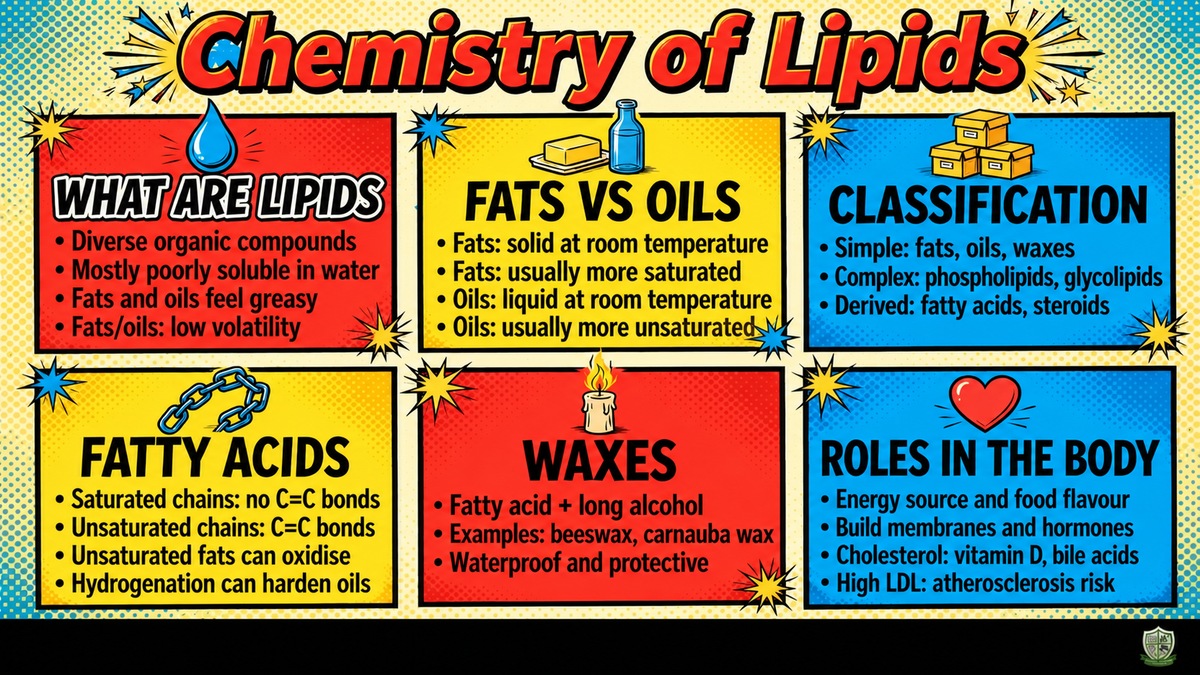
1. What Lipids Are
Lipids are a diverse group of organic substances with substantial hydrophobic regions and limited solubility in water. They include fats, oils, waxes, phospholipids, glycolipids, sterols and several types of signalling molecules. Their classification depends on structure, chemical behaviour and biological relationships; they do not all possess one common functional group.
Most familiar lipids contain large carbon-and-hydrogen regions. Carbon-carbon and carbon-hydrogen bonds are relatively nonpolar, whereas water is polar and forms extensive hydrogen bonds. A large hydrocarbon region does not interact favourably enough with water to become freely dissolved. Many lipids dissolve more readily in suitable organic solvents, although solubility depends on the particular lipid and solvent.
Lipids are not generally polymers assembled from one universal repeating monomer. A triglyceride is an important storage lipid, but it is not the basic building unit of every lipid. Steroids, for example, have a fused-ring framework rather than a glycerol molecule carrying three fatty acids.
This distinction prevents a common error: the words “lipid,” “fatty acid,” “triglyceride” and “cholesterol” identify related biochemical substances but are not interchangeable names.
2. Hydrophobic and Amphipathic Behaviour
A hydrophobic region has little affinity for water. An amphipathic molecule has both a hydrophilic region and a hydrophobic region. Many storage lipids are strongly hydrophobic overall; many membrane lipids are amphipathic.
A typical glycerophospholipid has a polar head containing phosphate and an attached head group, together with two nonpolar hydrocarbon tails. In water, its head can face the aqueous surroundings while the tails associate away from water. This organisation helps explain lipid bilayers.
In a bilayer, one set of heads faces extracellular fluid and another faces the aqueous cytoplasm. The tails form the hydrophobic interior between the two surfaces. Lipids therefore help establish a boundary between two water-rich environments without being freely soluble throughout either environment.
Amphipathic behaviour also supports emulsification and the formation of aggregates such as mixed micelles. A dispersion of lipid droplets is not the same as a true molecular solution. Shaking oil and water can temporarily distribute droplets, but stable dispersion usually needs an appropriate emulsifying system.
3. Major Biological Functions of Lipids
- Energy storage: triacylglycerols store a concentrated reserve that can be mobilised when fuel is needed.
- Membrane structure: phospholipids, glycolipids and cholesterol contribute to cell membranes and many organelle membranes.
- Protection and insulation: adipose tissue cushions structures and reduces heat loss; lipid-rich myelin supports electrical insulation of nerve fibres.
- Signalling: steroid hormones and locally acting lipid mediators regulate cellular responses.
- Transport and absorption: lipid-associated systems help the body absorb fat-soluble substances and carry poorly water-soluble molecules.
- Precursor roles: cholesterol supplies the starting framework for bile acids, steroid hormones and vitamin D synthesis.
- Essential nutrient supply: dietary fats provide essential fatty acids.
These functions are distributed among different lipid classes. A wax coating, a triglyceride droplet, a phospholipid bilayer and a steroid hormone illustrate distinct uses of lipid chemistry. It is misleading to assign every lipid function to every individual lipid.
For nursing study, connect each role with its structural basis: nonpolar storage molecules, amphipathic membrane molecules, and specialised signalling structures perform different tasks.
4. Energy Storage, Adipose Tissue and Heat
Dietary fat supplies approximately 9 kilocalories per gram, compared with approximately 4 kilocalories per gram for carbohydrate or protein. A food Calorie is a kilocalorie. As a simple comparison, 10 g of fat contributes approximately 90 kcal, whereas 10 g of carbohydrate contributes approximately 40 kcal. These values describe nutritional energy, not the ATP yield of a particular reaction.
Triacylglycerols are stored in adipocytes. Their hydrophobic character allows storage with relatively little associated water. Mobilisation releases fatty acids and glycerol, which follow different metabolic routes. Fatty acids can be oxidised to supply energy; glycerol can enter carbohydrate-related pathways.
White adipose tissue provides fuel storage, mechanical cushioning and thermal insulation. Subcutaneous fat reduces heat loss, while deposits around organs can provide protection. Brown adipose tissue has a different emphasis: its specialised metabolism contributes to heat production.
Storage does not mean that fat is metabolically inactive. Lipid reserves respond to energy needs and hormonal regulation. Conversely, the fact that fat is energy-dense does not mean that all body cells can use every lipid directly as fuel.
5. Glycerol and Fatty Acids as Structural Components
Glycerol is a three-carbon alcohol with three hydroxyl groups. Its systematic name is propane-1,2,3-triol, and a condensed formula is HOCH2-CH(OH)-CH2OH. Each hydroxyl provides a position that can be esterified.
A fatty acid contains a carboxyl group and a hydrocarbon chain. The general notation R-COOH separates the carboxyl group from the rest of the carbon chain, represented by R. A typical straight-chain saturated fatty acid can be written CH3-(CH2)n-COOH. Naturally occurring fatty acids vary in chain length, branching, unsaturation and other modifications.
The carboxyl end is chemically different from the terminal methyl end. Carbon numbering for conventional fatty-acid structural descriptions begins with the carboxyl carbon as C1. Omega notation instead refers to positions counted from the methyl end.
Glycerol and fatty acids must not be confused with a completed triglyceride. Before esterification, glycerol has free alcohol groups and the fatty acid has a carboxylic acid group. Their linkage produces a new ester functional group with different properties and reactivity.
6. Ester Bonds and Triacylglycerol Formation
An ester bond can form between the carboxyl group of a fatty acid and a hydroxyl group of an alcohol. The resulting linkage has the pattern R-C(=O)-O-R′. The carbonyl C=O is part of the ester group; it is not the carbon-carbon double bond used to classify a fatty-acid chain as unsaturated.
For glycerol, esterification at all three hydroxyl positions gives a triacylglycerol, also called a triglyceride. The simplified overall relationship is:
Glycerol + three fatty acids → triacylglycerol + three water molecules.
One water equivalent is removed for each ester linkage in this schematic condensation. In cells, synthesis uses activated intermediates and enzymes; the equation expresses the overall structural relationship rather than every biochemical step.
The three fatty-acid residues need not be identical. A simple triglyceride has the same fatty-acid residue at all three positions; a mixed triglyceride has different residues. Natural fats and oils commonly contain mixtures of mixed triglycerides, so a whole sample of oil cannot be represented by one universal molecular formula.
7. Monoacylglycerols, Diacylglycerols and Triacylglycerols
- Monoacylglycerol: one fatty-acid residue esterified to glycerol; two glycerol hydroxyl groups remain unesterified.
- Diacylglycerol: two fatty-acid residues esterified to glycerol; one glycerol hydroxyl remains unesterified.
- Triacylglycerol: three fatty-acid residues esterified to glycerol; all three original hydroxyl positions are esterified.
The prefixes mono-, di- and tri- refer to the number of acyl residues. They do not refer to the number of double bonds in those residues. A triacylglycerol can contain saturated, monounsaturated or polyunsaturated chains in different combinations.
Monoacylglycerols occur among the products of fat digestion. Diacylglycerols have roles in lipid synthesis and cellular signalling. Triacylglycerols are especially important in dietary fat and energy storage.
Removing an acyl residue exposes a glycerol hydroxyl position, changing the molecule's polarity and chemical possibilities. Replacing a triglyceride acyl position with a phosphate-containing structure is a useful introductory comparison with glycerophospholipids, but it is not the complete biosynthetic mechanism for every phospholipid.
8. Fats and Oils: Structure and Physical State
Fats and oils are both predominantly mixtures of triacylglycerols. The everyday distinction is physical: a fat is solid or semisolid at the reference room temperature, while an oil is liquid. Temperature must be stated or understood because the same material can melt or solidify as conditions change.
Fatty-acid composition affects melting behaviour. Longer chains generally interact more strongly, and chains without cis double-bond bends can pack more closely. A larger proportion of cis-unsaturated chains commonly lowers the melting range.
Animal fats such as butter or ghee are familiar solid or semisolid examples, while many vegetable oils are liquid. These are tendencies rather than universal source rules. Fish provide oils, and some plant fats have a substantial saturated-fatty-acid content. Coconut oil is an important example of a highly saturated plant oil.
“Fat” does not mean that every fatty-acid residue is saturated, and “oil” does not mean that every residue is unsaturated. Natural samples contain mixtures. Physical state, chain composition and biological source are three related but separate descriptions.
9. Physical Properties of Fats and Oils
Neutral fats and oils generally have low water solubility and a greasy or lubricating texture. Many have a density below that of water and can form a separate upper layer. These observations apply well to familiar bulk fats and oils; they are not universal tests for every lipid.
Pure triglycerides are generally colourless. The characteristic colour, aroma and flavour of a natural fat can come from pigments and other associated substances, as well as from chemical changes during processing or storage. Fat also influences the texture and palatability of food.
Most triglycerides are nonvolatile under ordinary storage conditions. Heating can melt a solid fat, but melting is not evaporation. Severe heating can cause decomposition; describing all lipids as having a low boiling point is therefore unreliable.
Likewise, “all lipids burn without ash” is too broad. Residues depend on the substance, impurities, additional elements and combustion conditions. Solubility, melting behaviour and chemical structure give more useful information than an absolute statement about burning. Laboratory solvent handling or combustion requires the prescribed laboratory precautions.
10. Saturated and Unsaturated Fatty Acids
A saturated fatty acid has no carbon-carbon double bond in its hydrocarbon chain. An unsaturated fatty acid has one or more such bonds. The carbonyl double bond of its carboxyl group does not make the chain an unsaturated fatty-acid chain.
- Saturated: palmitic acid is 16:0; stearic acid is 18:0.
- Monounsaturated: oleic acid is 18:1, with one carbon-carbon double bond.
- Polyunsaturated: linoleic acid is 18:2 and α-linolenic acid is 18:3.
In this shorthand, the first number is the total carbon count, including the carboxyl carbon. The number after the colon is the number of carbon-carbon double bonds. Thus, 18:0 and 18:2 have the same chain length but different degrees of unsaturation.
Common dietary unsaturated fatty acids have double bonds, not the triple bonds sometimes suggested by faulty captions. A structure must be inspected before assigning its class. Counting ester carbonyl bonds or counting attached fatty-acid chains answers a different question.
11. Cis and Trans Configuration
A carbon-carbon double bond restricts rotation. In a cis configuration, the relevant chain segments lie on the same side of the double bond; in a trans configuration, they lie on opposite sides. The cis arrangement commonly introduces a bend in a fatty-acid chain.
Cis bends interfere with close packing. When comparing otherwise similar chains, this often lowers the melting point and contributes to membrane fluidity. A trans-unsaturated chain can be more extended and pack more closely, despite still containing a double bond.
Degree of unsaturation and cis/trans configuration are different descriptions. Both cis- and trans-18:1 chains are monounsaturated; their shapes and some properties differ. A trans chain must not be classified as saturated merely because it packs relatively well.
Many naturally occurring membrane fatty acids have cis double bonds. Some industrial partial-hydrogenation processes can produce trans isomers. The nutritional significance of a fat depends on its composition and dietary context, rather than simply whether it is solid, liquid, plant-derived or animal-derived.
12. Essential Fatty Acids and Omega Notation
Linoleic acid and α-linolenic acid are essential fatty acids: humans require them but cannot synthesise them adequately from other nutrients, so they must be supplied by the diet. “Essential” refers to this nutritional requirement, not to the claim that other fatty acids are biologically unimportant.
Omega notation locates the first carbon-carbon double bond from the methyl end. An omega-3 fatty acid has that bond three carbons from the methyl end; an omega-6 fatty acid has it six carbons away. Linoleic acid is 18:2 n-6; α-linolenic acid is 18:3 n-3.
EPA and DHA are longer-chain omega-3 fatty acids. Humans can convert some α-linolenic acid into these products, but the conversion is limited. Fatty acids also supply precursors for specialised lipid mediators.
For structural interpretation, retain all parts of the notation: carbon count, double-bond count and omega family. An omega label alone does not state chain length, total unsaturation, the amount present in a food or an appropriate clinical dose.
13. Traditional Classification of Lipids
A common teaching classification groups lipids as simple, complex or compound, and derived. This scheme is useful for learning, but terminology varies between textbooks.
- Simple lipids: fatty-acid esters of alcohols, including fats, oils and waxes. Triacylglycerols use glycerol; typical wax esters use long-chain monohydric alcohols.
- Complex or compound lipids: lipids with additional components, such as phosphate-containing head groups in phospholipids or carbohydrate groups in glycolipids.
- Derived lipids: substances obtained from lipid breakdown or grouped with lipids because of their biochemical relationships, such as fatty acids and certain alcohols; traditional accounts often include sterols.
Some teaching schemes discuss lipoproteins among compound lipid systems. A lipoprotein is a particle containing both lipids and proteins, rather than one pure lipid molecule.
The word “derived” does not mean that every member is produced by ordinary triglyceride hydrolysis. Free cholesterol, for example, is not one of the fatty-acid or glycerol products obtained by hydrolysing a triglyceride. Use the structural explanation together with the category name.
14. Modern Structural Classification
The LIPID MAPS classification recognises eight major categories. This is a more detailed structural framework than the traditional simple/compound/derived scheme.
- Fatty acyls: fatty acids and related structures, including many fatty-acid-derived mediators and wax esters.
- Glycerolipids: substituted glycerol-based lipids, including mono-, di- and triacylglycerols.
- Glycerophospholipids: glycerol-based lipids with phosphate-containing polar groups.
- Sphingolipids: structures based on a sphingoid backbone, rather than glycerol.
- Sterol lipids: cholesterol and related sterol structures.
- Prenol lipids: structures related to isoprenoid building units.
- Saccharolipids: structures in which fatty-acyl groups are associated directly with a sugar backbone.
- Polyketides: a diverse group defined by related biosynthetic and structural features.
A molecule can be described differently under different classification systems. For example, a triglyceride is a simple lipid in the traditional scheme and a glycerolipid in the structural scheme. These descriptions do not contradict one another; each identifies a different organising principle.
15. Waxes
A typical biological wax ester consists of a long-chain fatty acid esterified to a long-chain monohydric alcohol. Monohydric means that the alcohol has one hydroxyl group. This differs from a triglyceride, which has three ester linkages on a glycerol backbone.
Cetyl palmitate illustrates the wax-ester relationship: palmitic acid provides the fatty-acid component and cetyl alcohol provides the long-chain alcohol component. The ester bond joins them, while the long hydrocarbon regions account for strong hydrophobic behaviour.
Wax-containing coatings occur on plant leaves and fruits and on animal surfaces. They help limit water loss or provide water-repellent protection. Beeswax and carnauba wax are familiar natural wax materials; such materials may contain mixtures rather than only one molecular species.
Waxes are often relatively firm and resistant to water, but their composition and melting behaviour vary. They should not be defined simply as “saturated triglycerides.” Their alcohol backbone is different. Hydrolysis of a wax ester yields its fatty-acid and alcohol components, whereas complete triglyceride hydrolysis yields glycerol and three fatty-acid equivalents.
16. Glycerophospholipids
A typical diacyl glycerophospholipid contains glycerol, two fatty-acid residues and a phosphate-containing polar head group. The tails are largely hydrophobic and the head is hydrophilic, producing an amphipathic molecule.
Different head groups give different phospholipid names and properties. Examples include phosphatidylcholine, phosphatidylethanolamine, phosphatidylserine and phosphatidylinositol. These are not all the same molecule with different labels. Their head-group chemistry affects charge, interactions and biological roles.
Glycerophospholipids are major constituents of cell and organelle membranes. They also participate in signalling and provide precursors for other biologically active compounds. Their two-tail architecture is particularly suited to bilayer organisation.
The common introductory comparison with triglycerides is structural: two acyl chains remain, while another glycerol position carries a phosphate-containing structure. However, not every phospholipid contains glycerol. Sphingomyelin is a phospholipid with a sphingoid backbone. Likewise, some glycerophospholipids have ether-linked chains, so the typical two-ester description is a starting model rather than a universal definition.
17. Sphingolipids and Glycolipids
Sphingolipids use a sphingoid base, commonly sphingosine, rather than glycerol as their principal backbone. Sphingosine contains a long hydrophobic region and functional groups that support further attachment.
When a fatty acid is joined to the amino group of sphingosine through an amide bond, the product is a ceramide. This amide linkage differs chemically from the ester bonds of a triglyceride. Adding different head groups produces different sphingolipid classes.
- Sphingomyelin: a phosphate-containing sphingolipid, important in membranes including myelin.
- Cerebrosides: glycosphingolipids with a single sugar head group.
- Gangliosides: glycosphingolipids with more complex sugar groups that include sialic acid.
Glycolipids have carbohydrate-containing head groups and participate in membrane organisation and recognition. Not all glycolipids are glycerol-based, and not all sugar groups are glucose. Structural descriptions should specify the backbone and head group rather than assume that every lipid is a modified triglyceride. Sugar-bearing membrane surfaces also contribute to the distinctive molecular identities of cells.
18. Membrane Fluidity and Myelin
Membranes are organised assemblies of lipids, proteins and associated carbohydrates. A lipid bilayer supplies a hydrophobic barrier, while proteins provide channels, carriers, receptors and other functions. Lipids alone do not explain every feature of selective permeability.
Fatty-acid chain length, unsaturation, temperature and cholesterol content influence membrane behaviour. Cis-unsaturated chains commonly prevent tight packing. Cholesterol interacts with surrounding chains and helps moderate membrane order and fluidity. Its effect depends on conditions; it is too simple to say that it always makes a membrane more fluid or always makes it more rigid.
Myelin consists of specialised membrane layers wrapped around many nerve axons. Its lipid-rich organisation helps electrically insulate the axon and supports efficient conduction. The lecture's comparison with insulation around an electrical wire is useful as an analogy, but myelin is living cellular material with a more complex structure and function.
A membrane's lipid composition therefore contributes both to the physical barrier surrounding a cell and to specialised tissue functions. Lipid damage or altered organisation can affect these functions without every membrane component being chemically identical.
19. Cholesterol, Steroids and Bile Acids
Steroids have a characteristic framework of four fused rings: three six-membered rings and one five-membered ring. Their attached groups determine the identity and activity of individual molecules. Cholesterol is a sterol, a steroid-related molecule with a hydroxyl group.
Cholesterol is an essential component of animal cell membranes. It is also a precursor for steroid hormones, bile acids and vitamin D synthesis. Steroid hormones include cortisol, aldosterone, progesterone, oestrogens and testosterone. Bile acids arise from cholesterol metabolism in the liver and help the intestine handle dietary lipids.
Free cholesterol and a cholesteryl ester are chemically different. Esterification joins a fatty acid to cholesterol's hydroxyl group. A cholesteryl ester is more hydrophobic and is important in lipid storage and lipoprotein cores.
Cholesterol's useful functions do not imply that every blood cholesterol concentration is harmless. Equally, calling cholesterol an unwanted substance overlooks its normal roles. Atherosclerotic risk concerns lipoprotein transport, concentration and other biological factors, rather than the mere existence of cholesterol in a normal membrane.
20. Lipid Signalling and Eicosanoids
Lipids participate in communication as well as energy storage. Steroid hormones act through specific cellular mechanisms, and some membrane-derived lipids function as intracellular messengers. Eicosanoids are another important group of lipid mediators, many derived from twenty-carbon polyunsaturated fatty acids such as arachidonic acid.
- Prostaglandins: diverse local mediators involved in processes such as pain, inflammation, vascular responses and smooth-muscle activity.
- Thromboxanes: mediators with roles in platelet aggregation and vascular tone.
- Leukotrienes: mediators involved in inflammatory and immune responses, including some airway responses.
These compounds often act locally and briefly rather than travelling like a long-lived circulating nutrient store. Their effects depend on the molecule, receptor, tissue and physiological state.
Inflammation can follow infection or tissue injury; it is not limited to infection. Different lipid mediators can promote or regulate different aspects of a response. Therefore, it is inaccurate to say that every prostaglandin simply causes blood clotting or that all lipid mediators have the same effect.
21. Hydrolysis and Saponification
Hydrolysis breaks a bond using water. Complete hydrolysis of a triglyceride separates the glycerol backbone from its three fatty-acid residues:
Triacylglycerol + three water molecules → glycerol + three fatty acids.
Appropriate enzymes, acidic conditions or alkaline conditions can promote ester cleavage, but the products' ionisation and the extent of cleavage depend on the conditions. Biological digestion commonly produces monoacylglycerols and fatty acids rather than requiring complete conversion of every molecule to free glycerol.
Saponification is alkaline hydrolysis of suitable ester-containing lipids. With sodium hydroxide, the overall products are glycerol and sodium fatty-acid salts; potassium hydroxide yields potassium salts. These fatty-acid salts are soap components.
A soap molecule has a hydrophobic chain and an ionic, water-facing carboxylate head. Such molecules can disperse grease in water-associated aggregates. The structural explanation resembles the amphipathic principle used in other lipid systems, but soap is not the same substance as a membrane phospholipid.
Free cholesterol lacks the fatty-acid ester linkage that triglycerides possess and does not undergo the same saponification reaction. A cholesteryl ester, however, contains a hydrolysable ester bond.
22. Hydrogenation
Hydrogenation adds hydrogen across a carbon-carbon double bond. The simplified reaction pattern is:
-CH=CH- + H2 → -CH2-CH2-.
Under suitable catalytic conditions, hydrogenation reduces unsaturation in fatty-acid chains. In an oil containing many cis-unsaturated residues, this can increase the melting range and produce a firmer or semisolid material. It does not create the triglyceride ester bonds; those bonds may already be present.
Complete hydrogenation and partial hydrogenation are different. Complete hydrogenation removes the targeted double bonds. Partial hydrogenation leaves some double bonds and can also cause cis/trans isomerisation. Thus, a partly hydrogenated sample can contain both newly saturated chains and trans-unsaturated chains.
Historically, hydrogenation has been used to alter food texture and improve resistance to some oxidative changes. Increased firmness or storage stability does not automatically establish nutritional benefit. The composition of the resulting fat must be considered.
Do not confuse hydrogenation with hydrolysis: hydrogenation changes chain unsaturation, while hydrolysis breaks an ester linkage. The two processes involve different bonds and yield different kinds of products.
23. Oxidation, Rancidity and Antioxidants
Rancidity describes deterioration of fats or oils with undesirable changes in odour, flavour or other qualities. It can arise through more than one chemical process.
- Hydrolytic rancidity: ester cleavage releases fatty acids. Moisture and lipase activity can contribute; some released acids have strong odours.
- Oxidative rancidity: lipid oxidation produces primary oxidation products and subsequent compounds, including volatile substances that contribute to unpleasant odours.
Polyunsaturated chains are particularly susceptible to oxidation. Oxygen exposure, light, heat and some trace metals can accelerate deterioration. The presence of a double bond does not mean that an oil immediately reacts with every nearby substance; the reaction pathway and conditions matter.
Antioxidants can interrupt or reduce oxidation processes. Tocopherols, including forms of vitamin E, are important examples. Suitable packaging, reduced exposure to air and light, and appropriate storage conditions also influence stability.
Butter and cream illustrate why a changed smell may reflect lipid deterioration, but moisture-related hydrolysis and oxygen-related oxidation should not be treated as one identical mechanism. An antioxidant does not reverse spoilage that has already occurred.
24. Digestion, Emulsification and Absorption
Much dietary fat is present as triglycerides. Mechanical mixing and lipid-digesting enzymes begin its processing, while the small intestine is central to digestion and absorption.
- Bile-associated amphipathic substances help disperse large fat droplets, increasing the surface available to enzymes.
- Pancreatic lipase, assisted by its associated system including colipase, hydrolyses triglyceride ester bonds, commonly producing two fatty acids and a 2-monoacylglycerol.
- Mixed micelles help carry poorly water-soluble digestion products through the aqueous environment towards intestinal cells.
- Absorbed long-chain fatty acids and monoacylglycerols are commonly reassembled into triglycerides in enterocytes.
- These lipids are packaged into chylomicrons, which enter intestinal lymph and subsequently the blood.
Bile is not a lipase. Emulsification changes the distribution of droplets; enzymatic hydrolysis changes chemical bonds. A mixed micelle is also different from a chylomicron: the former helps intestinal absorption, while the latter is a lipid-transport particle produced by intestinal cells.
Shorter-chain fatty acids can follow different transport routes, so the long-chain chylomicron pathway should not be applied universally to every absorbed lipid.
25. Lipoproteins and Transport in Blood
Blood plasma is water-rich, so triglycerides and cholesteryl esters cannot simply circulate as freely dissolved molecules. Lipoproteins package them in a hydrophobic core surrounded by phospholipids, free cholesterol and apolipoproteins. The surface supports interaction with the aqueous environment.
- Chylomicrons: carry much of the dietary triglyceride absorbed by the intestine.
- VLDL: carries triglyceride-rich material exported by the liver.
- IDL and LDL: arise during processing of triglyceride-rich particles; LDL is an important cholesterol carrier.
- HDL: participates in cholesterol transport, including movement of cholesterol from peripheral tissues towards routes for hepatic handling.
Apolipoproteins contribute to particle structure, receptor recognition and regulation of lipid-processing enzymes. They are not merely an inert outer coating.
LDL and HDL are particles, not different chemical forms of the cholesterol molecule. The everyday phrases “bad cholesterol” and “good cholesterol” refer to transport contexts. Nonesterified fatty acids also circulate bound largely to albumin, which is a different transport arrangement from the triglyceride-rich lipoprotein core.
26. Fat-Soluble Vitamins
Vitamins A, D, E and K are fat-soluble vitamins. Their absorption is connected with normal intestinal lipid handling. Impaired fat digestion or absorption can therefore affect the availability of these vitamins, although the consequences depend on the specific condition and nutrient.
- Vitamin A: contributes to normal vision and other cellular functions.
- Vitamin D: contributes to calcium-related physiology and bone health.
- Vitamin E: has antioxidant functions, including protection of susceptible lipid structures.
- Vitamin K: supports activation of proteins involved in normal blood coagulation and other functions.
Lipids help with absorption and transport, but fat alone does not independently determine or regulate every vitamin concentration. The vitamins differ in their handling and biological roles.
In nursing assessment, consider dietary intake and conditions that affect fat absorption alongside the broader clinical picture. Do not infer that a patient needs a supplement solely because a vitamin is fat-soluble. The relevant point for this chemistry chapter is the relationship between solubility, intestinal handling and physiological availability.
27. Lipid Tests and Nursing Documentation
A clinical lipid panel commonly reports total cholesterol, LDL cholesterol, HDL cholesterol and triglycerides. These are different measurements: a triglyceride result is not a cholesterol result, and total cholesterol is not interchangeable with LDL cholesterol.
Record the test name, numerical result, unit and relevant collection conditions. Fasting instructions depend on the test request and local laboratory procedure; a fasting requirement should not be assumed for every lipid measurement. Interpretation also considers other clinical risk factors and the patient's history.
Laboratory teaching tests answer narrower chemical questions. An emulsion test demonstrates behaviour in a solvent/water system; it does not identify every lipid species. A test for unsaturation examines reactive carbon-carbon bonds, while saponification demonstrates cleavage of suitable ester linkages. None is a stand-alone cardiovascular diagnosis.
When explaining findings, connect terminology to structure: triglycerides are glycerol-based storage esters; cholesterol is a sterol; lipoproteins are transport particles; and phospholipids support membrane organisation. This makes the laboratory vocabulary precise without turning a chemistry observation into an unsupported treatment recommendation.