
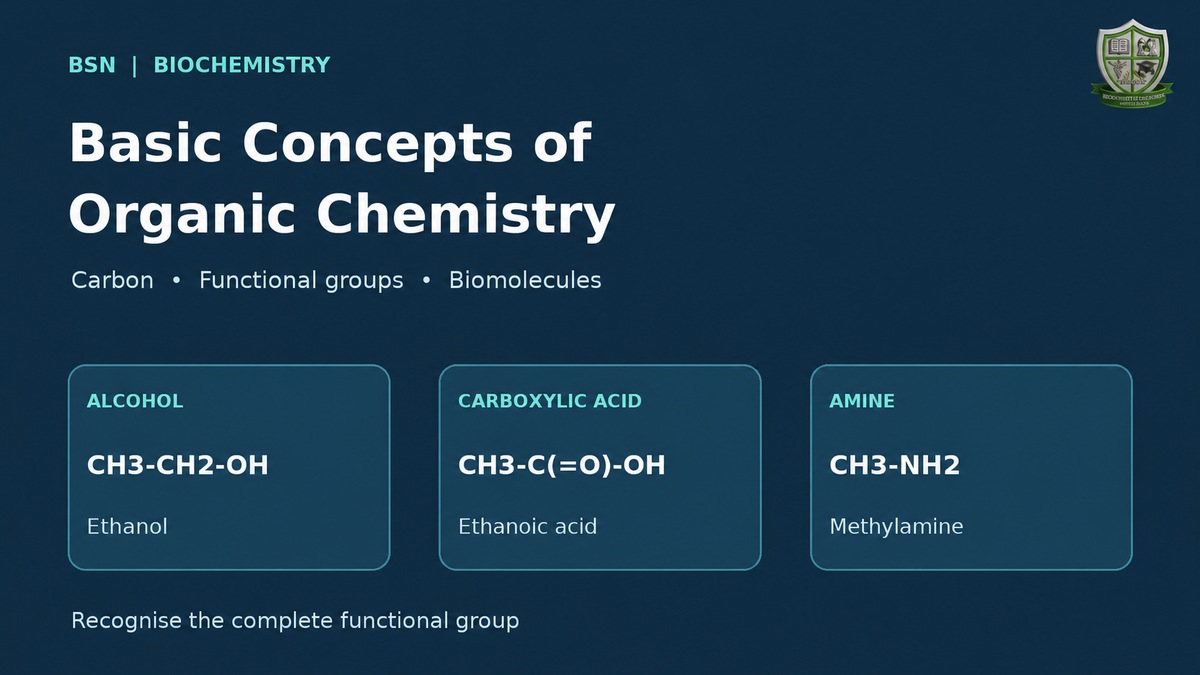
1. Organic chemistry and its relevance to nursing
Organic chemistry examines the structures, properties and reactions of carbon compounds. It provides the chemical language for understanding nutrients, medicines, hormones, enzymes, cell membranes and genetic material. Biochemistry studies how these compounds participate in living systems. For BSN students, the aim is to connect molecular structure with biological behaviour, rather than memorise a separate list of formulas without meaning.
Organic does not mean that a substance must come from a living organism. Organic compounds can be obtained from biological sources, petroleum or laboratory synthesis. The word also does not mean natural, nutritious or safe. Many essential body substances are organic, but so are many toxic chemicals. Conversely, inorganic substances such as water and electrolytes are indispensable to life.
Historical development
Early classification separated substances obtained from organisms from those obtained from minerals. The vital-force idea proposed that a special influence of living things was required to make organic substances. In 1828, Friedrich Wohler prepared urea from ammonium cyanate. This experiment contributed to the rejection of the idea that an organic compound could only be produced inside an organism. Urea has the structure NH2-C(=O)-NH2 and is an organic nitrogen-containing compound, even though it can be synthesised without a living organism.
The boundary between organic and inorganic chemistry
Carbon is the defining element in organic chemistry, but not every carbon-containing substance is conventionally classified as organic. Carbon monoxide, carbon dioxide, carbonates and bicarbonates are usually treated in inorganic chemistry. Calcium carbonate in mineralised material and bicarbonate in an acid-base buffer therefore should not automatically be labelled organic simply because their formulas contain carbon. Most familiar organic compounds contain carbon-hydrogen bonds, but the presence of such a bond is not an absolute requirement for every organic compound.
In nursing study, distinguishing the chemical class helps explain a substance's role. Glucose is an organic energy substrate; sodium chloride is an inorganic electrolyte source. Both can be present in aqueous preparations, but their chemical behaviour differs. Classification alone does not determine the correct route, dose, compatibility or clinical use of a preparation.
2. Why carbon forms so many compounds
Tetravalency and covalent bonding
Carbon has atomic number six. A neutral carbon atom has six electrons, with four in its outer shell. In the common neutral structures encountered in introductory organic chemistry, carbon forms four covalent bonds. Tetravalency refers to this combining capacity. A bond is counted by its order: a single bond contributes one, a double bond two and a triple bond three. Carbon in methane, CH4, has four single bonds; each carbon in ethene, CH2=CH2, has two single bonds to hydrogen and a double bond to the other carbon.
Covalent bonding involves shared electron pairs. Hydrogen normally forms one bond, oxygen two, and neutral nitrogen commonly three with a lone pair. These patterns help students check a structural formula. They are introductory patterns rather than rules excluding charged atoms, radicals or unusual structures. Formal charge and the surrounding bonds must be considered when a structure differs from the usual neutral pattern.
Catenation and molecular diversity
Catenation is the ability of atoms of an element to bond to one another. Carbon-carbon bonding permits straight chains, branched chains and rings. Carbon also bonds with hydrogen, oxygen, nitrogen, sulfur, phosphorus and halogens. Different chain lengths, branching patterns, bond orders and attached groups create a large variety of compounds.
A straight-chain drawing does not mean a molecule is a rigid straight rod. Carbon atoms connected by single bonds usually adopt three-dimensional arrangements, and rotation can change the molecular conformation. A branch is a group attached to a parent chain; a ring joins atoms into a closed path. These arrangements influence how a molecule fits into an enzyme or receptor and how it interacts with neighbouring molecules.
Bond geometry and hybridisation
- sp3 carbon: four bonding directions are approximately tetrahedral, with an ideal angle of 109.5 degrees. Methane is the standard example.
- sp2 carbon: three directions lie approximately in a plane, with angles near 120 degrees. The carbons in a carbon-carbon double bond are common examples.
- sp carbon: two directions are approximately linear, with an angle near 180 degrees. The carbons in a carbon-carbon triple bond illustrate this arrangement.
Hybridisation is a bonding model used to describe these arrangements. It should not be imagined as a sequence of visible mechanical movements inside the atom. Actual bond angles can differ from the ideal values because of the surrounding groups and molecular constraints.
A single covalent bond contains a sigma bond. A double bond contains one sigma and one pi bond; a triple bond contains one sigma and two pi bonds. Rotation around many single bonds is possible, whereas rotation around a double bond is restricted without disrupting its pi interaction. This restriction is important in geometrical isomerism.
3. Reading organic formulas and structures
A molecular formula gives the number of each kind of atom in a molecule. For example, C2H6O does not by itself distinguish ethanol from dimethyl ether. An empirical formula gives the simplest whole-number ratio of the elements; glucose has molecular formula C6H12O6 and empirical formula CH2O. The empirical formula does not show a molecule's actual size or arrangement.
A displayed structural formula shows atoms and bonds. A condensed formula groups connected atoms to make the structure shorter while preserving useful connectivity. CH3CH2OH represents ethanol: a methyl group is connected to a CH2 group, which is connected to OH. CH3OCH3 represents dimethyl ether, with oxygen between two carbon groups. Both contain the same total numbers of carbon, hydrogen and oxygen atoms, but their bonds are arranged differently.
In a skeletal or bond-line formula, an unlabelled line end or corner normally represents carbon. Hydrogen atoms attached to carbon are omitted and are inferred from carbon's usual valence. Other atoms, such as oxygen and nitrogen, are written explicitly. Multiple bonds are shown by multiple lines. Before interpreting a structure, count the carbons, identify heteroatoms, inspect the bond orders and supply any implied hydrogens.
The symbol R represents a carbon-containing group whose detailed structure is not being specified. R and R' may be the same or different. Thus R-OH describes an alcohol family, not one exact molecule. A functional-group formula is useful for recognising a common chemical pattern, but it cannot supply the molecular mass or clinical properties of an unspecified substance.
Checking a formula systematically
- Identify every explicitly written atom and every carbon implied by a line end or corner.
- Count the bond order around each carbon and determine the hydrogens needed for the ordinary neutral valence pattern.
- Identify charges, rings, double bonds and triple bonds.
- Locate the functional groups and distinguish them from nearby but unrelated bonds.
- Check that the total atom count agrees with any molecular formula supplied.
4. Classification of hydrocarbons
A hydrocarbon contains only carbon and hydrogen. Compounds containing oxygen, nitrogen or another element can have a hydrocarbon portion, but the whole compound is not a hydrocarbon. Hydrocarbons are classified by their carbon framework and bonding.
Alkanes and cycloalkanes
Alkanes contain only carbon-carbon single bonds and are saturated with hydrogen. An acyclic alkane has the general formula CnH2n+2. Methane is CH4, ethane C2H6, propane C3H8 and butane C4H10. Branching does not change this general formula for an acyclic saturated hydrocarbon.
Cycloalkanes contain carbon rings with single bonds. A simple monocyclic saturated hydrocarbon has formula CnH2n. Cyclohexane is C6H12. Its ring accounts for the two fewer hydrogens compared with acyclic hexane, C6H14. A formula of CnH2n therefore does not prove that a substance is an alkene: a ring can give the same hydrogen count.
Alkenes and alkynes
Alkenes contain at least one carbon-carbon double bond. An acyclic hydrocarbon with exactly one double bond and no other unsaturation has formula CnH2n. Ethene is C2H4 and propene is C3H6. Alkynes contain at least one carbon-carbon triple bond. An acyclic hydrocarbon with exactly one triple bond and no other unsaturation has formula CnH2n-2. Ethyne is C2H2 and propyne is C3H4.
Unsaturated describes the presence of carbon-carbon multiple bonding in this context. It does not mean that the substance is automatically harmful, nutritious or deficient in another nutrient. Compounds with several rings or multiple bonds require additional structural information; simple one-ring or one-multiple-bond formulas must not be applied indiscriminately.
Aromatic and aliphatic compounds
Benzene, C6H6, has a six-carbon aromatic ring with delocalised pi electrons. Its bonds are not best understood as three isolated double bonds behaving independently. Aromaticity describes a particular electronic arrangement and stability, not merely a pleasant smell. Aromatic rings occur in many biological molecules and medicines, but their presence does not make every compound behave like benzene.
Aliphatic hydrocarbons lack an aromatic ring and may be open-chain or nonaromatic cyclic compounds. Heterocyclic compounds have rings containing atoms other than carbon, such as nitrogen or oxygen. Some heterocycles are aromatic; others are not. The categories ring-containing and aromatic are therefore not interchangeable.
5. Homologous series and introductory naming
A homologous series is a family with a shared structural pattern and related chemical behaviour. Successive members commonly differ by CH2. The alkane sequence methane, ethane, propane and butane illustrates this relationship. As molecular size increases, physical properties often change gradually. Similar chemical behaviour does not mean identical boiling point, solubility, biological activity or safety.
Common names are useful but may not describe a structure systematically. IUPAC nomenclature provides rules for identifying the parent structure, substituents, positions and major functional group. Introductory naming builds the habit of reading structure precisely; it is not a substitute for checking the exact medicine name and formulation on a clinical label.
Carbon-chain roots
- One carbon: meth-; two: eth-; three: prop-; four: but-; five: pent-.
- Six carbons: hex-; seven: hept-; eight: oct-; nine: non-; ten: dec-.
The endings -ane, -ene and -yne indicate the corresponding hydrocarbon families. Alcohol names commonly end in -ol, aldehydes in -al, ketones in -one and carboxylic acids in -oic acid. The position of a group or multiple bond may require a number, called a locant. Different functional groups have naming priorities; the following examples address simple compounds rather than the full rules for complex molecules.
Worked naming examples
A branched alkane: CH3CH(CH3)CH3 has a longest continuous chain of three carbons, so the parent is propane. The extra CH3 group is methyl and is attached to carbon two. The name is 2-methylpropane. Counting all four carbons and calling the substance butane would overlook the branching.
An alkene: CH3CH=CHCH3 has four carbons and a double bond beginning at carbon two. It is but-2-ene. The formula alone does not specify whether the groups lie in a cis or trans arrangement.
An alcohol: CH3CH(OH)CH3 has three carbons and an OH group on carbon two. It is propan-2-ol, also called isopropyl alcohol. CH3CH2CH2OH is propan-1-ol; moving the OH group changes the compound.
A carboxylic acid: CH3COOH is ethanoic acid, commonly called acetic acid. The carboxyl carbon is included in the two-carbon total. CH3CH2COOH is propanoic acid, with three carbons.
6. Functional groups containing oxygen
A functional group is an identifiable structural unit associated with characteristic reactions and properties. A molecule can contain several functional groups. Their combined influence, together with molecular size and shape, determines the compound's behaviour. Recognise the complete group instead of labelling each bond independently.
Alcohols, phenols and ethers
An alcohol has an OH group attached to a saturated carbon. Ethanol, CH3CH2OH, is a simple example. A primary, secondary or tertiary alcohol is classified by whether the carbon bearing OH is attached to one, two or three other carbons. This classification concerns the OH-bearing carbon, not the total number of OH groups. Glycerol contains three OH groups and is a polyhydric alcohol.
A phenol has OH directly attached to an aromatic ring. Phenol and an ordinary alcohol are related but distinct chemical classes. They should not be assigned identical acid-base behaviour simply because both contain OH. An ether has an oxygen atom between two carbon-containing groups, R-O-R'. Dimethyl ether is CH3-O-CH3. It has no O-H bond and therefore differs from ethanol in hydrogen-bond donation and other properties.
Aldehydes and ketones
The carbonyl group is C=O. In an aldehyde, its carbon is bonded to at least one hydrogen; the typical shorthand is R-CHO. Methanal is HCHO and ethanal is CH3CHO. In a ketone, the carbonyl carbon is bonded to two carbon groups, R-C(=O)-R'. Propanone, CH3COCH3, is commonly called acetone.
The arrangement around the carbonyl affects reactivity. An aldehyde is not merely an alcohol with a different name, and acetone is not an alcohol because it contains oxygen. Carbohydrate structures can contain aldehyde or ketone groups in their open-chain forms, although many sugars predominantly adopt rings in aqueous solution.
Carboxylic acids and esters
A carboxylic acid contains the complete COOH group, R-C(=O)-OH. The carbonyl and OH act together as one carboxyl functional group. Loss of its acidic proton produces a carboxylate, R-COO-. This change alters charge and can influence interactions with water, proteins and membranes.
An ester has the pattern R-C(=O)-O-R'. The oxygen is bonded to a carbon group in place of the acid's OH hydrogen. Ethyl ethanoate is CH3-C(=O)-O-CH2CH3. The name identifies the alcohol-derived ethyl group and the acid-derived ethanoate portion. The ester group should not be counted as a separate ketone plus ether.
Triacylglycerols contain three ester linkages formed from glycerol and fatty acids. Hydrolysis can break ester linkages, with water participating in the reaction. In the digestive system, enzyme-catalysed reactions act on dietary lipids; the chemical grouping helps explain why a fat is more than an arbitrary collection of carbon atoms.
7. Nitrogen, sulfur and phosphorus groups
Amines and amides
Amines are related to ammonia, NH3, with one or more hydrogens replaced by carbon-containing groups. A primary amine is R-NH2, a secondary amine R-NH-R', and a tertiary amine has three carbon groups bonded to nitrogen. Here primary, secondary and tertiary count the carbon groups attached to nitrogen. This differs from the rule used for classifying alcohols.
Many amines can accept a proton using the nitrogen lone pair. For example, R-NH2 + H+ produces R-NH3+. The charged form often interacts more strongly with water than the corresponding neutral form. A quaternary ammonium ion has four carbon groups attached to positively charged nitrogen; it is not simply a neutral tertiary amine.
An amide has nitrogen directly attached to a carbonyl carbon, such as R-C(=O)-NH2. The nitrogen lone pair participates in delocalisation with the carbonyl, so an amide nitrogen is much less basic than a typical amine nitrogen. Do not infer basicity from the presence of nitrogen alone. Peptide bonds in proteins are amide linkages.
Other biologically important groups
A thiol has an S-H group, R-SH. The amino acid cysteine contains a thiol. Oxidation can join two thiol-containing groups into a disulfide linkage, R-S-S-R', which can help stabilise protein structure. Sulfur in a thiol should not be confused with sulfate, an inorganic oxyanion.
Organic phosphate groups connect phosphate-containing units to organic structures. They occur in nucleotides, phospholipids and phosphorylated metabolic intermediates. Their charge and bonding influence interactions and enzyme recognition. ATP contains phosphate linkages involved in energy transfer, but energy release belongs to the net reaction and must not be explained as energy appearing simply because a bond is broken.
Halogen-containing organic compounds have elements such as fluorine, chlorine, bromine or iodine bonded within the organic structure. Halogen substitution can change physical and biological properties. Chlorine covalently attached to an organic molecule is chemically different from a freely dissolved chloride ion.
8. Isomerism and molecular shape
Constitutional isomers
Isomers have the same molecular formula but different structures. Constitutional, or structural, isomers differ in which atoms are connected. Butane and 2-methylpropane both have formula C4H10 but different carbon skeletons. Propan-1-ol and propan-2-ol share formula C3H8O but differ in the position of OH. Ethanol and dimethyl ether share C2H6O but belong to different functional-group classes.
These examples show why molecular formula alone cannot predict all properties. Two compounds with the same atom count can have different intermolecular attractions, reaction patterns and biological effects. Rotating a whole molecule on paper does not create an isomer; connectivity or a relevant spatial arrangement must actually differ.
Geometrical isomerism
Restricted rotation around a double bond can allow different spatial arrangements. In but-2-ene, the methyl groups may be on the same side, cis, or opposite sides, trans. Each carbon of the double bond must have two different attached groups for this kind of geometrical isomerism. Ethene, CH2=CH2, does not have a cis-trans pair because each double-bond carbon has two identical hydrogens.
The E/Z system uses substituent-priority rules and is applicable more widely than simple cis-trans terminology. At BSN foundation level, the main point is that identical connectivity can still permit different arrangements that do not interconvert by ordinary free rotation. Cis double bonds in many fatty-acid chains introduce bends and influence how lipid chains pack.
Chirality and enantiomers
A chiral molecule cannot be superimposed on its mirror image. A common source of chirality is a tetrahedral carbon attached to four different groups. A pair of nonsuperimposable mirror-image forms are enantiomers. Lactic acid, CH3-CH(OH)-COOH, has a carbon attached to hydrogen, OH, CH3 and COOH, illustrating the four-different-groups pattern.
Biological receptors and enzymes are three-dimensional, so they can distinguish molecular forms. Enantiomers can differ in biological activity or handling even when many ordinary physical properties are alike. A racemic mixture contains equal amounts of two enantiomers. R/S configuration describes arrangement using priority rules; it does not by itself specify the direction of optical rotation or the safety of a medicine. Nurses must use the exact prescribed product rather than assume related molecular names are interchangeable.
9. Physical properties, solubility and ionisation
Organic compounds are not all insoluble in water. Hydrocarbon regions are relatively nonpolar, whereas groups containing oxygen or nitrogen may create polarity and hydrogen-bonding interactions. Ethanol mixes with water, while a long hydrocarbon chain tends to reduce water affinity. The number, location and charge of polar groups must be considered alongside the size of the nonpolar region.
Hydrogen-bond donation normally requires a suitable O-H or N-H bond in these introductory examples. Oxygen in an ether can accept hydrogen bonds from water, even though the ether cannot donate an O-H hydrogen bond. A molecule can therefore interact with water in different ways depending on its complete structure.
Intermolecular attractions influence melting and boiling behaviour. Larger nonpolar molecules often have stronger dispersion attractions, and hydrogen bonding can raise boiling points relative to otherwise comparable structures. Branching and packing also matter. These trends are guides for comparison, not a rule that all compounds in one family have the same physical state.
Acid-base changes in organic molecules
A carboxylic acid can lose H+ and become negatively charged; an amine can accept H+ and become positively charged. The balance between neutral and ionised forms depends on pH and the group's pKa. For a simple weak acid, pH equal to pKa gives equal amounts of its protonated and deprotonated forms. Below its pKa, the protonated acid predominates; above its pKa, the deprotonated form predominates.
For a basic amine, interpret pKa as the value for its conjugate acid. Below that pKa, the protonated, charged form predominates; above it, more of the neutral base is present. The word protonated does not universally mean uncharged: protonating a carboxylate can produce a neutral acid, whereas protonating a neutral amine produces a cation.
Ionisation can affect aqueous solubility and passage through lipid membranes. Drug absorption and distribution also depend on formulation, transporters, binding and physiological conditions, so a simple polarity rule cannot predict the whole clinical response. A salt form and a free acid or base must not be substituted solely because their names appear related.
10. Major types of organic reactions
A reaction changes bonding and produces different substances. An equation must conserve atoms and, where relevant, electrical charge. The same general reaction class can occur under very different conditions; a classroom equation does not imply that a comparable conversion can be carried out safely at a bedside.
- Addition: atoms or groups add across a multiple bond. Hydrogenation of ethene can be written CH2=CH2 + H2 producing CH3CH3, with appropriate catalytic conditions.
- Substitution: one attached atom or group is replaced by another. The detailed mechanism depends on the substrate, reagent and conditions.
- Elimination: groups are removed and a multiple bond forms. Dehydration of ethanol can produce ethene and water under suitable reaction conditions.
- Oxidation and reduction: electron redistribution changes oxidation state. In introductory organic examples, oxidation often increases bonding to oxygen or decreases bonding to hydrogen; reduction often has the reverse pattern.
- Condensation: components combine with loss of a small molecule in common teaching examples. An acid and an alcohol can form an ester with water as a product.
- Hydrolysis: water participates in breaking a linkage. Ester and peptide-bond hydrolysis are important connections to digestion and biochemistry.
Oxidation of alcohols
A primary alcohol can be oxidised to an aldehyde and, under suitable further oxidation conditions, to a carboxylic acid. Ethanol, ethanal and ethanoic acid illustrate this sequence. A secondary alcohol can be oxidised to a ketone; propan-2-ol can produce propanone. Tertiary alcohols do not follow the same simple carbonyl-forming pathway without changes to the carbon skeleton. Classification helps predict a reaction pattern but does not specify a biological rate or clinical outcome.
Enzymes and energy
Enzymes help reactions proceed by lowering activation barriers. Their selectivity depends on molecular recognition and the chemical conditions around them. They do not change the overall equilibrium constant merely by being catalysts. Temperature and pH can affect enzyme function and protein structure.
Breaking a bond requires energy; forming bonds releases energy. The overall reaction's energy change depends on all bonds and interactions involved. A favourable reaction may still proceed slowly without a suitable pathway. Metabolism links many reactions so that nutrient breakdown can support synthesis, transport and other cellular work.
11. Connecting organic chemistry with biomolecules
Carbohydrates
Carbohydrates include sugars and their larger derivatives. Glucose contains multiple OH groups and has formula C6H12O6. Many monosaccharides can be described through an open-chain aldehyde or ketone form as well as cyclic forms. The common formula pattern resembling hydrated carbon is an introductory guide, not a definition that fits every carbohydrate.
Monosaccharides can be linked through glycosidic bonds. Disaccharides contain two sugar units; polysaccharides contain many. Starch and glycogen are glucose-containing storage polymers, whereas cellulose has a different linkage pattern and a structural role in plants. Differences in linkage explain why sharing the same building block does not make polymers biologically identical.
Lipids
Lipids are a diverse group characterised largely by their hydrophobic or amphipathic behaviour. Fatty acids have a carboxyl group and a hydrocarbon chain. Saturated fatty acids lack carbon-carbon double bonds in the chain; unsaturated fatty acids contain one or more. Chain length and double-bond arrangement influence physical properties.
Triacylglycerols are important storage lipids. Phospholipids have water-interacting and hydrophobic regions that support membrane organisation. Steroids have a characteristic fused-ring framework; cholesterol is a sterol and contributes to membranes and serves as a precursor for several biological products. Lipids should not all be described as one single repeating-unit polymer family.
Proteins
Amino acids contain amino and carboxyl groups together with side chains. In the common alpha-amino acids, these groups are associated with the same central carbon. At appropriate pH, an amino acid can carry positive and negative groups simultaneously, a zwitterionic arrangement. The side chain helps determine polarity, charge and interactions.
Peptide bonds join amino-acid residues through amide linkages. A protein's sequence and three-dimensional folding influence its function. Hydrogen bonds, hydrophobic interactions, ionic interactions and, in some proteins, disulfide linkages contribute to structure. Denaturation disrupts the native organisation; it is not automatically the same process as hydrolysing every peptide bond into separate amino acids.
Nucleic acids and nucleotides
A nucleotide contains a nitrogenous base, a sugar and phosphate. A nucleoside contains the base and sugar without phosphate. DNA and RNA contain nucleotide chains joined through phosphodiester linkages. Their structures connect organic rings, oxygen-containing sugars and phosphate chemistry with storage and expression of genetic information. ATP is also a nucleotide, illustrating that nucleotides have functions beyond being units of DNA or RNA.
12. Nursing applications and worked structure interpretation
From molecular structure to medication study
When studying a medicine, identify its exact name, formulation, route and clinical instructions. Organic structure can help explain solubility, ionisation and interactions, but safe administration requires the prescribed product and approved procedures. Similar suffixes or shared functional groups do not establish identical pharmacological action.
Absorption, distribution, metabolism and excretion describe how the body handles a drug. Chemical changes during metabolism can alter activity and elimination. A metabolite is not necessarily inactive or harmless. Nursing assessment connects the prescribed medicine with patient response, adverse effects, relevant organ function and monitoring requirements rather than relying on a structure alone.
Worked interpretation: ethanol and dimethyl ether
Both have formula C2H6O. Writing ethanol as CH3CH2OH reveals an OH group attached to carbon, so it is an alcohol. Writing dimethyl ether as CH3OCH3 reveals oxygen between carbon groups, so it is an ether. They are functional-group constitutional isomers. The alcohol has an O-H bond; the ether does not. This difference helps explain why identical molecular formulas need not give identical intermolecular behaviour.
Worked interpretation: an amino acid
The neutral structural shorthand for alanine is NH2-CH(CH3)-COOH. Its central carbon connects to an amino group, a carboxyl group, hydrogen and a methyl side chain. Recognising these groups predicts that its charge can change with pH. In a zwitterionic representation, the groups are NH3+ and COO-. The change is an acid-base redistribution of protons, not the conversion of the molecule into a different amino-acid side chain.
Worked interpretation: ester hydrolysis
Ethyl ethanoate contains CH3-C(=O)-O-CH2CH3. Hydrolysis can give ethanoic acid and ethanol under suitable conditions. The ester linkage is the part being transformed, while the atom count must remain balanced with the participating water. In alkaline hydrolysis, the acid-derived product is obtained as a carboxylate salt. This distinction prevents treating every hydrolysis condition as if it gave exactly the same final ionic form.
A sequence for studying an unfamiliar organic compound
- Read the complete name and formula, distinguishing the actual compound from a general family.
- Identify the carbon skeleton, rings and multiple bonds.
- Identify whole functional groups, especially carbonyl-containing groups.
- Consider charge, hydrogen-bonding possibilities and the balance of polar and nonpolar regions.
- Check whether constitutional isomers or stereochemical information could change the interpretation.
- Connect the structure with the relevant biochemical or pharmacological concept, then use the clinical reference and prescribed instructions for patient care.