
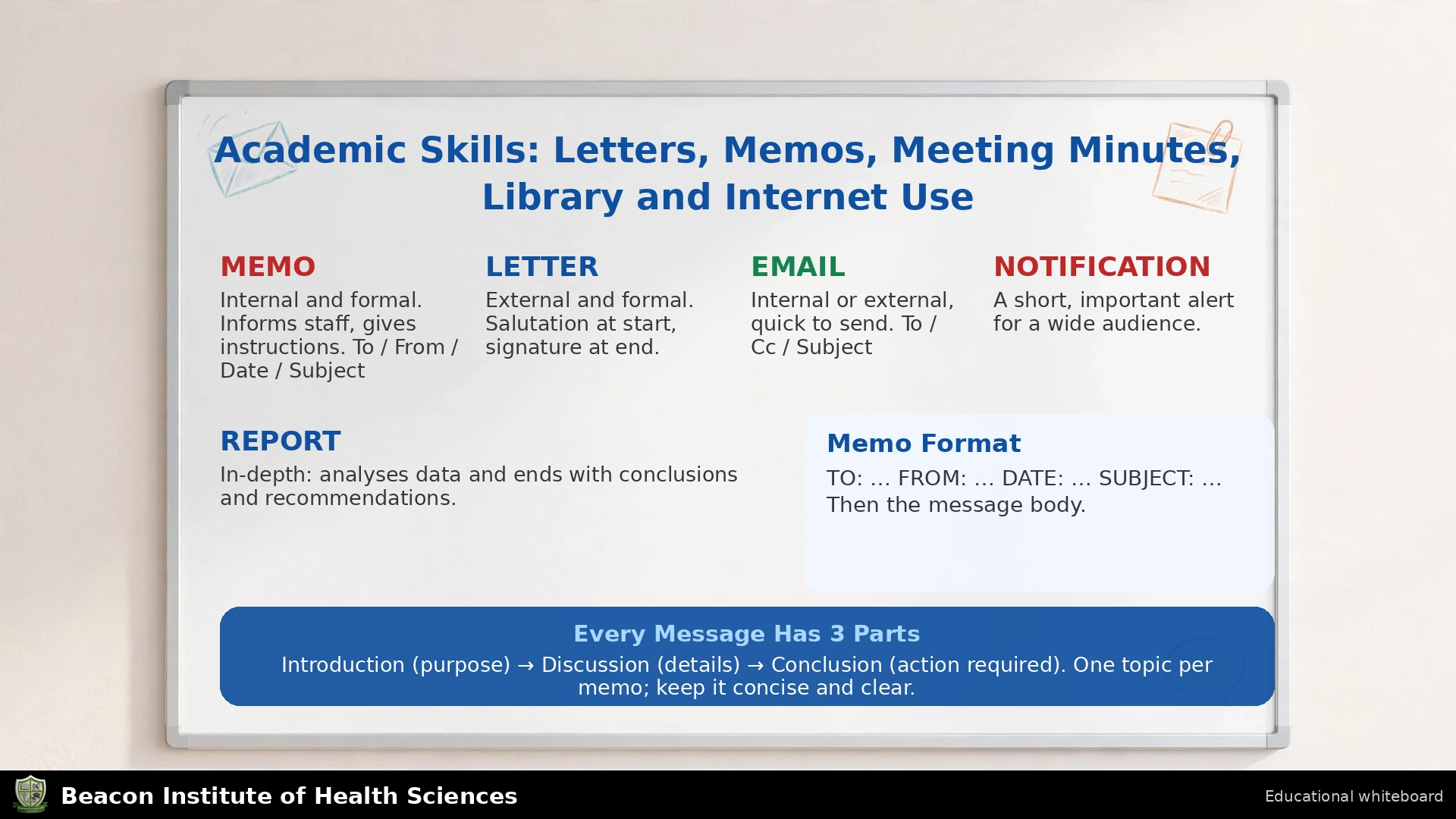
Introduction to Essential Academic Skills for BSN Students
Success in nursing education and professional practice hinges on a robust set of academic and communication skills. For BSN students, mastering formal correspondence, effective meeting documentation, diligent research methods, and responsible digital citizenship is paramount. This lesson provides a comprehensive guide to these critical areas, equipping you with the tools necessary for clear communication, accurate information retrieval, and ethical conduct in your academic and clinical journey.
Teaching examples: All people, institutions, meetings and opportunities in the following models are fictional. They do not describe actual BIHS events or vacancies.
Formal Letter Writing
Formal letters are essential for professional communication, such as applying for internships, requesting information, or corresponding with academic institutions or healthcare organizations. Adhering to a standard structure ensures clarity and professionalism.
Standard Formal Letter Structure
- Sender's Address: Your full address, followed by the date.
- Date: The full date, e.g., October 26, 2023.
- Recipient's Address: The full address of the person or organization you are writing to.
- Salutation: Formal greeting, e.g., "Dear Dr. Smith," or "Dear Hiring Manager,"
- Body Paragraphs:
- Opening: State the purpose of the letter clearly and concisely.
- Middle: Provide details, explanations, and supporting information.
- Closing: Summarize your main point, state any requested action, and express gratitude.
- Closing: Professional closing, e.g., "Sincerely," "Respectfully yours,"
- Signature: Your handwritten signature.
- Typed Name: Your full typed name below your signature.
- Enclosures (optional): Indicate if you are including other documents, e.g., "Encl: Resume."
Example of a Formal Letter
[Your Name]
[Your Street Address]
[Your City, Postal Code]
[Your Email Address]
[Your Phone Number]October 26, 2023
Dr. Eleanor Vance
Director of Nursing Education
City General Hospital
123 Healthcare Drive
Metropolis, 12345Dear Dr. Vance,
I am writing to express my keen interest in the Summer Nursing Internship Program at City General Hospital, in this fictional training example. As a third-year Bachelor of Science in Nursing student at Beacon Institute, I am eager to apply my theoretical knowledge in a practical, high-acuity clinical setting.
During my studies, I have gained hands-on experience in medical-surgical and pediatric nursing rotations, developing proficiency in patient assessment, medication administration, and electronic health record documentation. My academic performance, particularly in advanced pathophysiology and pharmacology, reflects my commitment to excellence and my strong foundational understanding of patient care principles. I am particularly drawn to City General's reputation for innovative patient-centered care and its robust mentorship programs.
I am confident that my dedication, strong work ethic, and passion for nursing would make me a valuable addition to your team. I am available for an interview at your earliest convenience to discuss how my skills and aspirations align with the goals of your esteemed program. Thank you for considering my application.
Sincerely,
[Your Signature]
Sarah Chen
Encl: Resume, Academic Transcript
Common Errors in Formal Letter Writing
- Using informal language, contractions, or slang.
- Incorrect formatting or inconsistent spacing.
- Grammatical errors, typos, or punctuation mistakes.
- Failing to state the purpose clearly in the opening.
- Omitting necessary contact information or recipient details.
- Not proofreading before sending.
Internal Memo Writing
Memos (memoranda) are used for internal communication within an organization or institution. They are concise, direct, and serve to inform, request, or announce.
Standard Memo Format
- TO: Name(s) and title(s) of recipient(s).
- FROM: Your name and title.
- DATE: The full date.
- SUBJECT: A clear, concise statement of the memo's topic.
- Body: Clear and brief paragraphs conveying the message.
Example of an Internal Memo
MEMORANDUM
TO: All BSN Program Faculty and Clinical Instructors
FROM: Dr. Amelia Jones, Head of Nursing Department
DATE: October 26, 2023
SUBJECT: Upcoming Simulation Lab Protocol Review MeetingThis memo is to inform you of an upcoming meeting to review and finalize the updated Simulation Lab protocols for the Spring 2024 semester. Your input is crucial to ensure these protocols align with current best practices and educational objectives.
The meeting will be held on Friday, November 10, 2023, from 10:00 AM to 12:00 PM in Conference Room 301. A digital copy of the proposed protocol revisions has been shared via the faculty shared drive for your review prior to the meeting.
Please come prepared to discuss any suggested modifications or clarifications. Your active participation is highly valued to ensure the successful implementation of these critical updates. If you are unable to attend, please send your feedback to my office by November 8th.
Thank you for your cooperation.
Meeting Minutes: Agenda vs. Minutes
Understanding the distinction between an agenda and meeting minutes is crucial for effective administrative communication.
- Agenda: A list of items to be discussed or acted upon at a meeting, distributed before the meeting. It outlines the meeting's purpose and structure.
- Minutes: A written record of what transpired during a meeting, distributed after the meeting. They document decisions made, actions agreed upon, and key discussions.
Sample Meeting Minutes
BEACON INSTITUTE SCHOOL OF NURSING
STUDENT ADVISORY COMMITTEE MEETING MINUTESDate: October 20, 2023
Time: 2:00 PM - 3:15 PM
Location: Dean's Conference Room (Room 405)Attendees:
Dr. Evelyn Reed (Chair, Dean of Nursing)
Professor Mark Jensen (Faculty Advisor)
Sarah Chen (BSN Year 3 Representative)
David Lee (BSN Year 2 Representative)
Maria Rodriguez (BSN Year 1 Representative)Absentees: None
Recorder: David Lee
1. Call to Order
The meeting was called to order by Dr. Reed at 2:00 PM.2. Approval of Previous Meeting Minutes
The minutes from the September 15, 2023 meeting were reviewed. Sarah Chen moved to approve the minutes; Maria Rodriguez seconded the motion. Minutes approved as circulated.3. Dean's Report (Dr. Reed)
Dr. Reed provided an update on the new clinical rotation partnership with Metropolitan Medical Center, highlighting the increased opportunities for specialty placements. She encouraged students to review the new placement guidelines.4. Student Feedback on Clinical Placements
Sarah Chen reported feedback from Year 3 students regarding challenges with inconsistent preceptor availability at some sites. David Lee noted Year 2 students are seeking more diverse simulation lab scenarios.5. Discussion on Mentorship Program
Professor Jensen outlined a proposal for a peer-mentorship program, pairing senior BSN students with junior students. Committee discussed potential benefits and logistical challenges.6. Action Items
(See Action Table below)7. Next Meeting
Scheduled for November 17, 2023, 2:00 PM, Room 405.8. Adjournment
Dr. Reed adjourned the meeting at 3:15 PM.
Meeting Action Table Example
| Action Item | Responsible Person(s) | Deadline | Status |
|---|---|---|---|
| Draft survey for preceptor availability feedback | Sarah Chen | November 3, 2023 | In Progress |
| Research simulation lab scenario best practices | David Lee | November 10, 2023 | Not Started |
| Develop detailed proposal for peer mentorship program | Professor Jensen | November 17, 2023 | In Progress |
Effective Library and Internet Research
Strong research skills are foundational for evidence-based nursing practice and academic success. Utilizing library resources and the internet effectively requires specific strategies.
Library Catalogue and Keyword Searching
Library catalogues provide access to a vast array of resources, including books, journals, databases, and multimedia. Effective searching relies on strategic keyword selection:
- Identify key concepts from your research question.
- Use specific, relevant terms (e.g., instead of "heart problems," use "myocardial infarction" or "cardiovascular disease").
- Consider synonyms and related terms to broaden your search.
Boolean Operators (AND, OR, NOT)
Boolean operators are powerful tools for refining your search queries in library databases and search engines.
AND: Narrows Results
Combine different concepts: nursing AND education retrieves records matching both concepts.
OR: Broadens Results
Combine alternatives: adolescent OR teenager retrieves either term. Group synonyms before combining concepts: (adolescent OR teenager) AND education.
NOT: Excludes Results
education NOT veterinary excludes records containing the unwanted term. Use exclusions carefully because useful records can be removed. Search syntax and phrase handling vary by database; consult its search help.
Library Use: A Practical Sequence
- Define the question and its main concepts.
- Search the catalogue by title, author or subject.
- Check edition, publication details, availability and location.
- Use relevant databases for journal articles; record the search date and terms.
- Read the full source and keep accurate citation details.
Evaluating Internet Sources
Check the author and qualifications, publisher, supporting evidence, date and purpose. Separate advertisements and personal opinions from supported claims. Compare important statements with reliable sources, and examine whether the information answers your question. A professional design alone does not establish credibility.
Citations and Academic Integrity
Cite borrowed ideas, including paraphrases and summaries. Put exact quotations in quotation marks and provide the required citation. Record author, date, title and publication details while reading. Follow the citation style assigned by your teacher; do not fabricate references or claim to have read a source you have not consulted.
Safe Internet Use and Confidentiality
Use approved systems for academic and clinical work. Do not place identifiable patient records in public searches, personal messaging services or unapproved online tools. Use fictional or properly deidentified classroom examples. Check links and senders before opening attachments, and keep account credentials private.
Practice With Explained Answers
- You need to notify classmates about a room change. Which format fits? A concise internal memo, with recipients, date, subject and the required action.
- When are minutes written? After the meeting, using accurate notes about decisions, responsibilities and deadlines.
- Which search broadens synonyms?
student OR learner, because either term can match. - What is missing from “Arrange training soon”? A named responsible person and a clear deadline.
- Can a copied paragraph be submitted after changing a few words? No. Write from understanding and acknowledge the source.
Final Review Checklist
Before sending or submitting, check the audience, purpose, format, facts, dates, action requested, grammar and source credits. Make sure private information is protected and attachments are correct.
Related Practice Quiz
The combined Academic Skills gallery quiz is currently unavailable. Practice the memo-writing part of this topic using the working related gallery quiz: Attempt Memo Writing Quiz.