
Introduction to Human Sexuality
Sexuality is a fundamental, multi-dimensional, and lifelong aspect of human personality, self-concept, and overall health. Academically, it is defined as the state or quality of being sexual, encompassing the collective biological, psychological, and behavioral characteristics that differentiate male and female individuals. It is an intrinsic part of being human, shaping how individuals experience and express themselves as sexual beings.
A common misconception in healthcare is that sexuality is limited strictly to the act of sexual intercourse. However, in professional nursing, sexuality is understood as a much broader concept that includes anatomical sex, gender roles, sexual identity, orientation, physical intimacy, personal relationships, affection, and self-concept. Understanding these components is vital for nurses to address various personal, physiological, and social problems related to sexuality, such as sexually transmitted infections (STIs), unwanted pregnancies, sexual harassment, and sexual abuse, to promote holistic patient health.
Anatomy & Endocrinology of Sexual Development
Sexual development and function are rooted in the anatomy of the reproductive systems and regulated by endocrine hormones. Nurses must have a comprehensive understanding of these systems to accurately evaluate physical health and assess alterations in normal sexual patterns.
The Male Reproductive System & Endocrinology
The male reproductive system consists of external organs (penis and urethra, which serve for urinary elimination and semen excretion) and internal organs (testes, seminal vesicles, and prostate gland). An adult male can produce approximately 100 million sperm cells daily.
The primary male sex hormone is testosterone, synthesized in the testes. Testosterone is responsible for the development and maintenance of male secondary sexual characteristics during puberty, including:
- Growth of facial, mustaches, and body hair.
- A decrease in voice pitch, leading to a deeper, more masculine voice.
- Marked development of skeletal muscles and physical strength.
- An increase in the size of the genital and reproductive organs.
- The initiation and maintenance of spermatogenesis (sperm cell production).
The Female Reproductive System & Endocrinology
The female reproductive system includes external organs (collectively known as the vulva) and internal organs (ovaries, fallopian tubes, uterus, and vagina). The ovaries contain a lifetime supply of immature eggs (oocytes). Female sexual development and reproductive cycles are regulated by two primary hormones: estrogen and progesterone.
Estrogen, primarily synthesized in the ovaries, is responsible for the development of female secondary sexual characteristics during puberty, which include:
- The growth and development of breast tissue.
- The initiation of menstrual periods (menarche) and the regulation of the menstrual cycle.
- The stimulation of egg (ovum) production and maturation in the ovaries.
Clinical Nursing Core Principle: In academic nursing and clinical practice, it is crucial to emphasize that reproduction is only one component of being a sexually active human being. While sexual reproduction is the physical union that increases genetic diversity and allows for the continuation of the species, sexuality itself is a much larger concept that encompasses psychological identity, social roles, and emotional intimacy.
The Four Components of Human Sexuality
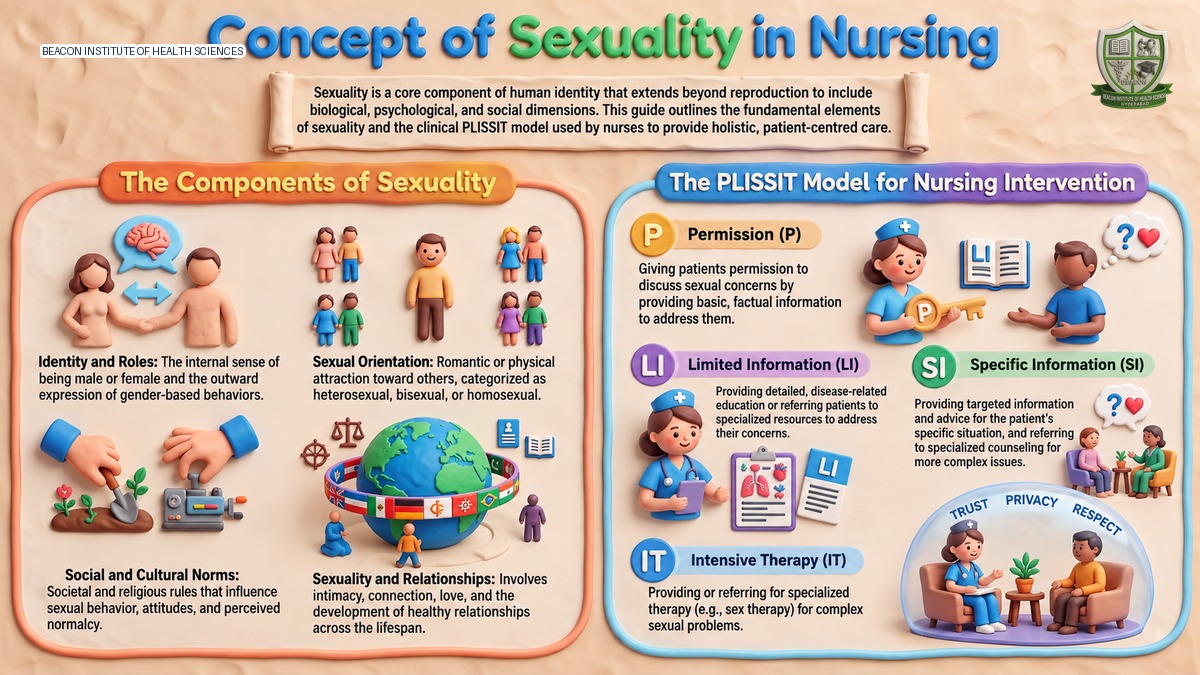
To effectively analyze a patient's sexual health and identify potential alterations in human sexuality, nurses must evaluate four core components: Sexual Identity, Sex Role, Sexual Orientation, and Social Norms.
A. Sexual Identity (Gender Identity)
Sexual Identity, often called Gender Identity, refers to an individual's deep, internal sense of self as being male or female. This is determined by a combination of anatomical structures, genetic factors (such as XX chromosomes for female or XY for male), and hormonal influences. Sexual identity addresses the core internal question: 'Who do I perceive myself to be?' in terms of gender. In normal development, this cognitive self-concept typically emerges between 1 and 3 years of age, as the child begins to recognize physical differences and acknowledge their own gender.
B. Sex Role (Gender Role)
Sex Role (or Gender Role) refers to the outward expression of an individual's gender-related behaviors, feelings, and attitudes. It represents how an individual presents themselves to others in accordance with societal and cultural expectations of masculinity or femininity. Sex roles are culturally defined, prescribing how a male or female is expected to behave, speak, dress, and work in a given society.
- For example, in maternal care, a female expresses her sex role after delivery by initiating breastfeeding to feed and nurture her newborn child.
- In traditional labor, males are often expected to perform heavy, muscular work and act as primary family breadwinners due to high testosterone levels.
C. Sexual Orientation
Sexual Orientation describes an individual's persistent pattern of physical, romantic, or sexual attraction toward a partner. The BSN curriculum outlines three primary classifications:
- Heterosexual: A romantic, emotional, or physical attraction directed toward persons of the opposite sex (e.g., a male attracted to a female, or a female attracted to a male).
- Bisexual: A physical, emotional, or romantic attraction directed toward persons of both sexes (males and females).
- Homosexual: A persistent pattern of experiencing romantic or sexual attraction to people of the same sex (e.g., a male attracted to males, clinically termed a 'gay' male; or a female attracted to females, termed a 'lesbian').
D. Social Norms (Cultural and Religious Influences)
Social Norms are the structured rules, principles, values, and codes of conduct defined by each specific society and community regarding sexual behaviors. Every culture possesses its own defined and expected norms concerning pre-marital sex, marital fidelity, and general sexual conduct. These social norms are heavily influenced by religion and culture:
- The Pakistani and Islamic Context: In Pakistani culture and Muslim societies, pre-marital sexual relations are strictly prohibited, considered morally wrong, and unacceptable. These religious and cultural principles dictate that sexual intimacy must be confined entirely within the legal bounds of marriage.
- Polygyny Rules in Islam: In accordance with Islamic jurisprudence and social codes, a male is legally permitted to marry up to four wives concurrently, provided he fulfills strict requirements of equal physical, emotional, and financial support. Conversely, a female is legally and socially restricted to being married to only one husband at a given time.
The Normal Sexual Response Cycle
When a healthy individual experiences sexual arousal, their body undergoes a series of systematic cardiovascular, muscular, and neurological changes. This physiological process is cyclical and progresses through four sequential phases. Understanding these phases is crucial for assessing patients presenting with sexual dysfunction or altered response patterns.
The Four Sequential Phases of the Sexual Response Cycle:
- Excitement Phase: This initial phase is triggered by either physical stimulation (touch, warmth) or mental stimulation (thoughts, visual cues). It leads to immediate sexual arousal, marked by increased blood flow to the genital organs (vasocongestion), elevated heart rate, and rising muscle tension.
- Plateau Phase: This phase represents the period of intense excitement immediately preceding orgasm. Physiological arousal, heart rate, respiration, and genital vasocongestion are further intensified and sustained at a high level, preparing the body for the peak of sexual release.
- Orgasm Phase: This is the peak and conclusion of the sexual response cycle, representing the brief moment of maximum physical and emotional pleasure. Physiologically, orgasm is characterized by a series of rapid, rhythmic, and involuntary muscle contractions occurring in the pelvic and genital muscles in both males and females.
- Resolution Phase: Following orgasm, the body enters the resolution phase, returning to its normal, unexcited state. Blood pressure drops, breathing returns to normal, heart rate slows down, and engorged genital tissues return to their normal size. Muscular tension is completely relaxed, bringing a sense of physical relief.
| Response Cycle Phase | Primary Trigger / Stimulus | Key Physiological Manifestations |
|---|---|---|
| 1. Excitement | Physical or mental stimulation. | Vasocongestion (blood pooling in genitals), elevated heart rate, muscle tension. |
| 2. Plateau | Sustained, progressive stimulation. | Arousal and heart rate reach maximum sustained levels; preparing for release. |
| 3. Orgasm | Peak stimulation threshold. | Brief, involuntary, rhythmic muscle contractions in pelvic and genital zones. |
| 4. Resolution | Discontinuation of stimulation. | Muscles relax completely, blood pressure and heart rate drop to baseline. |
Lifespan Development of Sexuality
Human sexuality is not a static characteristic that suddenly appears at adulthood; it is a continuous, evolving developmental process that begins at conception, progresses through childhood and adolescence, and continues through adulthood until death.
A. Conception & Intrauterine Life
Development of sexuality starts as early as intrauterine life following conception. The gender of the fetus is determined genetically at fertilization by chromosomes: double X chromosomes (XX) result in a female baby, while an X and a Y chromosome (XY) result in a male baby. By the sixth month of gestation, external physical reproductive organs are sufficiently developed to be clearly identifiable via medical ultrasound, allowing verification of the fetus's sex.
B. Infancy (Birth to 18 Months)
During infancy, there is no conscious awareness of gender, and the infant has no cognitive concept of sexuality. Infants experience the world purely through sensory comfort, warmth, and touch provided by their primary caregivers.
C. Early Childhood (18 Months to 3 Years and Beyond)
As the child grows, gender self-awareness develops rapidly. By three years of age, the child actively recognizes and acknowledges their own gender, clearly stating whether they are a boy or a girl. Following this recognition, they begin to show gender-specific behaviors, learning and displaying gender roles, behaviors, and identity expected within their family and cultural environment. Potential risks include over-criticism during toilet training, which can lead to shame, self-doubt, or fixation. Nurses should support parents with toilet training guidance and reassure them about normal child exploratory behaviors.
D. Adolescence & Puberty
Adolescence represents a highly critical, turbulent transitional phase marked by the onset of puberty. This brings rapid physiological, hormonal, and anatomical changes:
- In males, sperm production begins (often manifesting as nocturnal emissions or wet dreams).
- In females, menstruation (menarche) begins.
This development is best explained through the Bio-Psycho-Social Model:
- Biological Factors: Rapid physical changes, organ maturation, and hormonal surges.
- Psychological Factors: Emotional shifts, cognitive self-appraisal, and searching for personal identity.
- Social Factors: Changing relationships with peers, dating or romantic interests, and conforming to or resisting social expectations.
Other major forces shaping adolescent sexuality include political, legal, ethical, spiritual, and moral values within their community.
Clinical Risk Warning for Adolescents: Due to high impulsivity and a lack of cognitive maturity, adolescents and young adults are highly vulnerable to engaging in risky sexual practices, including early sexual intercourse, multiple sexual partners, and unprotected sex. Consequently, this young population is most heavily impacted by Sexually Transmitted Infections (STIs), such as Human Immunodeficiency Virus (HIV) and Papillomavirus. Nurses must prioritize non-judgmental counseling and health education for this demographic. Targeted nursing interventions include providing non-judgmental sexual health counseling and educating on the risks of STIs and safe sex.
Freud's Psychosexual Stages of Development
To understand the psychological and emotional development of sexuality during childhood, the BSN curriculum focuses on Sigmund Freud's landmark theory. Freud hypothesized that an individual's adult personality is deeply shaped by how they manage and resolve their sexual and aggressive drives during childhood. He proposed that pleasure is concentrated on different body parts—termed erogenous zones—at different ages, dividing development into five distinct stages:
| Psychosexual Stage | Age Range | Focus of Pleasure & Behavioral Characteristics |
|---|---|---|
| 1. Oral Stage | 0 to 18 Months | Primary focus of pleasure is centered on the mouth. The infant achieves gratification, explores the world, and reduces stress through oral activities, including sucking, biting, and chewing. |
| 2. Anal Stage | 18 to 36 Months (3 Years) | Focus of pleasure shifts to bowel and bladder control. The child's major developmental task is learning toilet training. Developing voluntary control over bowel elimination builds autonomy and self-esteem. |
| 3. Phallic Stage | 3 to 6 Years | Focus of pleasure shifts to the genital organs. Children explore their bodies and experience romantic attraction to family members of the opposite sex (e.g., a young girl displaying attraction to her father, a boy attracted to his mother). |
| 4. Latency Stage | 6 Years to Puberty | Sexual feelings and desires become completely inactive, quiet, or suppressed. The child's psychological energy is redirected entirely toward schoolwork, developing social play, and hobbies with same-sex peers. |
| 5. Genital Stage | Puberty through Adulthood | Represents the maturation of sexual interests. The adolescent experiences the reawakening of sexual desires, directed toward developing healthy, adult romantic and sexual relationships outside the family. |
Clinical Significance: Freud asserted that if a child is over-indulged or severely restricted at any of these stages, they may become fixated, carrying those psychological conflicts and emotional insecurities into their adult personality and sexual behavior patterns. Nurses must understand these developmental milestones to identify if a patient's sexual or behavioral difficulties are rooted in childhood development.
Adulthood and Older Adulthood Sexuality
As individuals transition out of adolescence, their sexuality matures, and they establish more stable, self-directed sexual behaviors. However, aging brings distinct physiological changes and socio-cultural challenges that nursing professionals must navigate with clinical empathy.
A. Adulthood (Young & Middle Adulthood)
Adulthood is characterized by exploration, experimentation, and stabilization of sexual behavior. Adults develop a mature understanding of their sexual identity and orient their desires toward building stable, intimate relationships. They acquire a clear cognitive boundary regarding what is healthy, safe, and socially appropriate in their sexual interactions, reducing impulsive risk-taking behaviors. Potential risks include stress, career demands, or relationship conflicts that can alter sexual patterns. Nurses should assess relationship quality and self-concept, and help patients develop healthy stress coping skills.
B. Older Adulthood (Aging & Elderly Sexuality)
A major clinical misconception in healthcare and society is that the elderly lose all sexual desire, interest, and need for intimacy. In reality, the desire for physical touch, romantic connection, and intimacy does not disappear with age. Older people continue to experience sexual desires and engage in intimate acts, but face both physiological limitations and strong cultural taboos.
1. Physiological Limitations of Aging:
- In Females: Between the ages of 45 and 50, females experience menopause (the cessation of menstrual periods and reproductive capability). This is accompanied by a sharp decline in estrogen levels, which can cause physical changes such as vaginal dryness and mucosal thinning.
- In Males: While sperm production continues into old age, testosterone levels decline gradually, which can lead to decreased sperm production, softer erections, and longer refractory periods.
- General Physical Changes: Muscle weakness, joint pain, and chronic illnesses can physically restrict movement and limit the physical expression of sexuality.
Potential risks include vaginal dryness, erectile dysfunction, or chronic physical illness. Targeted nursing interventions involve providing education on age-related physical changes and offering clinical solutions (e.g., lubricants).
2. Socio-Cultural Taboos & Restrictions:
In many societies, elderly sexuality is treated as a major taboo. Cultural and social norms often discourage the expression of sexual needs or remarriage in older adults:
- If an older adult expresses a desire to marry or seek a partner, society and family members often laugh at them or view it as inappropriate and shameful.
- These negative social perceptions often cause older adults to suppress their normal emotional and intimate needs, which can lead to isolation, depression, and severe psychological distress.
Clinical Nursing Principle: The nurse must always advocate for the emotional and intimate rights of older adults. Intimacy is a natural human need that supports mental health and life satisfaction in old age. Nurses must respect the client's desire for companionship, support late-life marriages, and help families understand that intimacy in the elderly is a healthy, normal aspect of aging. Social taboos and family discouragement of remarriage are significant potential risks for this demographic. Nurses should advocate for the intimate rights of the elderly.
Factors Influencing & Altering Sexuality
An individual's normal sexuality and sexual response pattern are highly sensitive and influenced by multiple variables. Nurses must assess these factors when evaluating patients presenting with alterations or distress:
- Quality of the Relationship: A healthy, satisfying, and mutually respectful relationship with an intimate partner supports healthy sexual function. Conversely, a forced, abusive, or conflict-ridden relationship severely degrades desire and arousal.
- Cognitive Perception & Beliefs: Personal values, moral convictions, and religious or cultural beliefs directly shape what an individual considers acceptable, influencing their comfort with sexual expression.
- Self-Concept & Previous Experiences: A positive self-concept builds confidence. Conversely, a history of negative, traumatic, or abusive sexual experiences in the past can cause anxiety and inhibit future relationships.
- Environment & Privacy: The immediate physical environment is critical; a lack of privacy, especially in crowded living spaces or hospital wards, can inhibit and prevent normal sexual intimacy.
- Pregnancy and Family Planning: The fear of an unwanted or unplanned pregnancy can cause severe anxiety and restrict sexual activity. The use of effective family planning methods can help reduce this anxiety.
- Illness and Chronic Diseases: Chronic illnesses (e.g., cardiovascular disease, diabetes mellitus, neurological disorders) directly impair vascular flow, nerve transmission, and hormonal balance, leading to reduced desire, erectile dysfunction, or pain.
- Life Circumstances, Personality, and Biological Factors: Work-related stress, financial worry, depressive personality traits, and normal biological aging processes all influence sexual patterns.
Pathological Alterations and Dysfunctions
Pathological changes can lead to clinical dysfunctions, causing distress and requiring focused nursing and medical intervention:
- General Health Decline: Overall poor health and chronic physical weakness decrease energy reserves, suppressing sexual desire and capacity.
- Sexual Abuse & Harassment: Traumatic events (such as physical harassment, emotional abuse, or sexual assault) cause profound psychological trauma, resulting in long-term fear, depression, and anxiety regarding intimacy.
- Erectile Dysfunction (Impotence): The inability to achieve or maintain an erection of the penis sufficient for satisfactory sexual performance in males, commonly caused by vascular disease, diabetes, or stress.
- Ejaculatory Dysfunction: Problems with the timing of ejaculation (e.g., premature ejaculation or delayed ejaculation) in males, which can cause severe frustration and relationship strain.
- Dyspareunia: Painful or difficult sexual intercourse. In females, this can be caused by infections, vaginal dryness, or anatomical abnormalities, leading to avoidance of intimacy due to pain.
- Rape Trauma Syndrome: A severe, long-term psychological syndrome that occurs following sexual assault, characterized by persistent anxiety, depression, nightmares, physical pain, and a complete dread of intimate contact.
Clinical Application of the Nursing Process (ADPIE)
Nurses must manage patients with altered sexuality patterns systematically, applying the five steps of the ADPIE framework. This requires combining clinical skill with high sensitivity and absolute professional ethics.
A. Assessment: Guidelines for History Taking
To gather accurate, sensitive information regarding a patient's sexual health, the nurse must combine objective clinical metrics with a structured, non-judgmental history interview:
- Ask Focused Questions: Inquire about existing sexual problems, relationship quality, knowledge levels regarding safe sex, and the use of medications or drugs that can affect sexual function.
- Establish a Trusting Relationship: Patients are often highly hesitant, embarrassed, or fearful when discussing private sexual concerns. The nurse must build trust first through a polite and professional manner.
- Ensure Absolute Privacy: Conduct the interview in a private room with no other patients or family members listening. If privacy is compromised, the patient will withhold critical health details.
- Maintain Meticulous Confidentiality: Assure the patient that all shared information is kept private and secure, documented only within the confidential medical record.
B. NANDA Nursing Diagnoses
Based on the validated assessment data, the nurse formulates specific nursing diagnoses:
- Ineffective Sexuality Pattern: Related to illness, high stress, relationship conflict, or a lack of accurate knowledge regarding sexual health.
- Sexual Dysfunction: Related to physiological barriers (such as chronic disease or nerve injury) or psychological blocks (anxiety, depression, or past trauma).
- Rape Trauma Syndrome: Related to the psychological and physical aftermath of sexual assault, manifesting as long-term distress, depression, and pain.
C. Planning & Goals
The nurse collaborates with the patient to develop realistic, attainable, and measurable goals:
- To restore the patient's previous normal level of sexual functioning and satisfaction.
- To identify and provide alternative methods or adaptations of intimacy when permanent physical limitations exist, helping to reduce stress and depression.
D. Key Nursing Interventions
- Active Listening: Actively listen to the patient's concerns word-by-word without judgment, showing that their feelings are respected and valued.
- Provide Reassurance & Support: Reassure patients that sexual concerns are normal medical and nursing issues that can be addressed constructively.
- Educate on a Broader View: Help the patient understand that sexuality is not limited to sexual intercourse; it encompasses self-concept, affection, personal touch, and identity, which can be expressed in various ways.
- Discuss Alternative Methods: Help the patient explore alternative methods of expressing intimacy to maintain relationship satisfaction and reduce anxiety or depression.
The PLISSIT Model of Sexual Counseling
To help nurses manage patient concerns regarding sexuality effectively, the curriculum establishes the PLISSIT Model. Created in 1976 by clinical psychologist Jack S. Annon, this model provides a structured, four-level framework that guides nurses, case managers, or consultants in addressing patient distress and planning appropriate clinical interventions.
| PLISSIT Level | Operational Meaning | Clinical Action & Nursing Role |
|---|---|---|
| P – Permission | Giving the patient permission to speak. | The nurse initiates a supportive environment, giving the patient explicit permission to discuss their sexual concerns openly. The nurse reassures the patient that their worries and feelings are normal, helping to reduce embarrassment. |
| LI – Limited Information | Providing basic, limited facts. | The nurse provides basic, focused information to address simple questions or correct common myths. This includes explaining normal anatomy, physiology, and general sexual health facts, helping the patient understand their body's basic functions. |
| SS – Specific Suggestions | Offering tailored recommendations. | The nurse offers specific, tailored suggestions to help the patient manage a particular problem or accommodate physical limitations caused by an illness (e.g., suggesting comfortable physical positions or timing intimacy after pain medications). |
| IT – Intensive Therapy | Referring for specialized treatment. | Required for patients with deep-seated psychological trauma, severe dysfunctions, or complex medical conditions. Nursing Rule: The nurse does not try to provide this advanced therapy themselves. Instead, they refer the patient to a specialized therapist, protecting the patient from redundant or ineffective basic counseling. |
Crucial Clinical Note for Intensive Therapy (IT): The PLISSIT model emphasizes that if a patient already has basic knowledge but suffers from deep, complex dysfunctions or trauma (such as Rape Trauma Syndrome), the nurse must avoid giving repetitive, basic information. Providing redundant, simplistic explanations can be frustrating and annoying to the patient. Instead, the nurse must coordinate direct referral to a qualified sex therapist or clinical psychologist for intensive, focused therapy.