
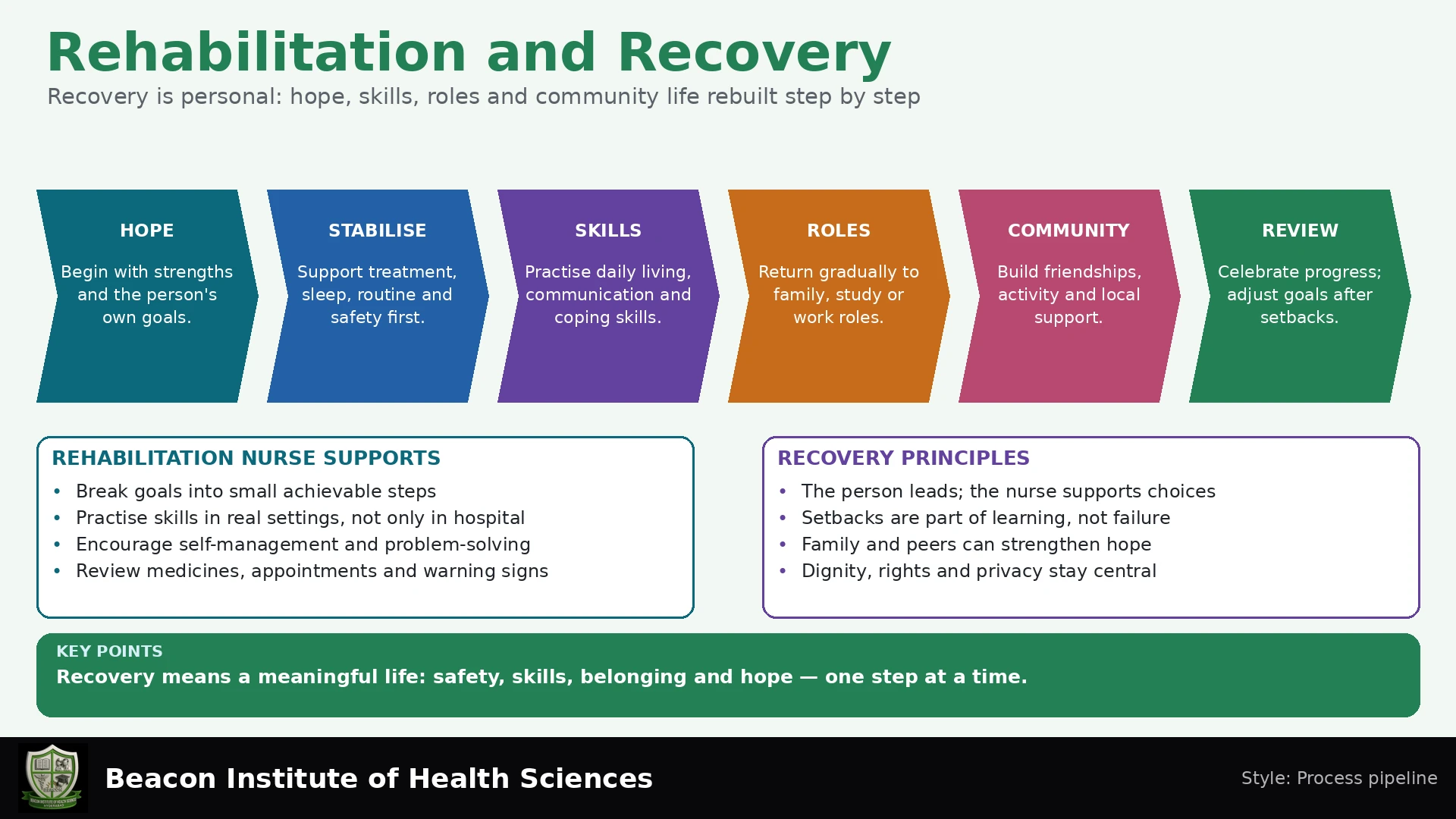
Understanding Rehabilitation and Recovery in Nursing
In the comprehensive field of nursing, particularly for BSN students and educators, understanding the core concepts of rehabilitation and recovery is paramount. These terms signify more than just the absence of illness or the management of symptoms; they encompass a holistic, person-centered approach that guides individuals toward achieving a meaningful life. The focus extends beyond clinical remission to embrace a broader perspective that prioritizes the individual's personal journey and capabilities.
Defining Recovery: Beyond Clinical Remission
The distinction between personal meaningful life hope identity agency connection and clinical remission is a foundational concept in contemporary rehabilitation. Clinical remission traditionally refers to the reduction or absence of symptoms of a disease or condition, often measured by objective clinical criteria. While essential for physical well-being, clinical remission alone does not always signify a full return to a fulfilling life for the individual.
In contrast, recovery, as understood in rehabilitation, centers on the individual's ability to achieve a personal meaningful life. This involves fostering a sense of hope for the future, helping individuals reclaim or redefine their identity beyond their health condition, promoting their sense of agency or control over their own lives and decisions, and facilitating genuine connection with others and their community. This perspective acknowledges that true recovery is deeply individual and extends to all aspects of a person's existence, including their values, purpose, and social roles.
Focusing on Daily Skills and Environmental Supports
Rehabilitation is fundamentally about equipping individuals with daily skills and providing appropriate environment supports. This approach diverges from the concept of compulsory normalization, which might pressure individuals to conform to societal norms that may not be suitable or desired for them. Instead, the goal is to empower individuals to live as independently and authentically as possible within their personal context.
The emphasis on daily skills involves developing or redeveloping the abilities necessary for self-care, independent living, and participation in chosen activities. This includes fundamental activities of daily living (ADLs) and instrumental activities of daily living (IADLs). Furthermore, providing tailored environment supports, such as adaptive equipment, accessible living spaces, and community resources, plays a critical role in facilitating independence and participation. The objective is to create an environment that supports the individual's chosen way of life, rather than imposing a standardized path.
| Aspect | Focus of Clinical Remission | Focus of Recovery (Rehabilitation) |
|---|---|---|
| Goal | Symptom reduction, disease management | Personal meaningful life, hope, identity, agency, connection |
| Approach | Medical, often clinician-driven | Person-centered, collaborative, individual-driven |
| Success Metric | Absence/reduction of symptoms | Quality of life, functional independence, self-defined well-being |
| Intervention | Treatments targeting pathology | Daily skills development, environmental supports, holistic well-being |
| Expectation | Return to baseline (if possible) | Growth, adaptation, self-determination, not compulsory normalization |
Core Principles of Recovery-Oriented Care
Effective rehabilitation and recovery are guided by several core principles that emphasize collaboration, individualized support, and a realistic understanding of progress.
Collaborative Goal Setting and Comprehensive Support Systems
A cornerstone of recovery-oriented care is the establishment of shared goals. These goals are developed collaboratively between the individual, their family (with consent), and the healthcare team, ensuring they align with the individual's aspirations. These goals often encompass various domains crucial for a full life, including:
- Daily living: Enhancing abilities for self-care, household management, and community participation.
- Supported education: Facilitating access to educational opportunities with necessary accommodations.
- Employment: Assisting with job seeking, retention, and workplace adaptations.
- Housing: Ensuring stable, safe, and appropriate living arrangements.
- Peer support: Connecting individuals with others who have lived experience for mutual encouragement and understanding.
- Family support with consent: Involving family members in the recovery process, respecting the individual's autonomy and privacy.
- Physical health: Addressing co-occurring physical health needs as an integral part of holistic recovery.
- Relapse signs: Identifying early indicators of a potential worsening condition to enable timely intervention.
- Crisis plan: Developing a proactive strategy to manage acute challenges, outlining steps for support and intervention.
Embracing Nonlinear Progress and Person-Centered Approaches
The journey of recovery is rarely a straightforward path; it is characterized by nonlinear progress. This means acknowledging that setbacks, plateaus, and periods of slower advancement are natural parts of the process. Understanding this helps manage expectations and fosters resilience.
Central to person-centered care are principles that uphold the individual's intrinsic worth and autonomy:
- Dignity: Upholding the individual's self-respect and worth in all interactions and decisions.
- Supported decisions: Empowering individuals to make informed choices about their care and life, with appropriate support and information.
- Strengths assessment: Focusing on identifying and building upon the individual's existing capabilities, resources, and resilience, rather than solely on deficits.
- Measurable goals: Setting clear, observable, and quantifiable objectives that allow for tracking progress and demonstrating achievements.
- Team coordination: Ensuring seamless collaboration among all members of the interdisciplinary healthcare team to provide integrated and consistent care.
- Evaluation: Regularly assessing the effectiveness of interventions and the individual's progress towards their goals, adjusting the recovery plan as needed.
Nursing's Role in Fostering Rehabilitation and Recovery
Nurses, particularly those with a BSN foundation, play a pivotal role in implementing recovery-oriented care. They are instrumental in conducting holistic assessments that go beyond physical symptoms to identify personal meanings, hopes, and existing strengths. Nurses facilitate the development of shared goals, acting as advocates for the patient's supported decisions and ensuring their dignity is always respected. They educate patients and families on daily skills and environmental supports, helping to adapt the home and community to meet individual needs rather than enforcing normalization. Furthermore, nurses are key in monitoring physical health, recognizing relapse signs, and collaborating with the team to activate crisis plans. Through ongoing evaluation and coordination, nurses ensure that the recovery plan remains dynamic and responsive to the individual's nonlinear progress, truly embodying the principles of person-centered care.
Fictional Mental Health Recovery Plan
Farah, 30, is recovering after an episode of psychosis. Symptoms have improved, but she has left college, feels isolated and fears that her diagnosis will define her future. She wants to resume a course, live more independently and reconnect with a trusted friend. She reports troublesome sedation from her prescribed medicine.
| Chosen goal | Agreed activity | Review |
|---|---|---|
| Return to study | With consent, explore a gradual return and available learning support with her college. | Review attendance, workload and Farah's sense of confidence after the agreed trial. |
| Improve daily routine | Choose a manageable morning routine, meals and sleep schedule; obtain occupational support if available. | Discuss which tasks feel easier and which need support. |
| Manage treatment concerns | Arrange prescriber review of sedation; discuss benefits, adverse effects and preferences without changing medicines independently. | Monitor alertness, symptoms and the agreed treatment plan. |
| Build connection | Invite contact with a chosen friend and consider an accessible peer-support group. | Ask whether the contact is helpful, comfortable and sustainable. |
Crisis Planning and Coordination
Farah and the nurse identify her personal warning signs, such as major sleep change and increasing distress. They record preferred coping actions, trusted supporters, professional contacts and when urgent assessment is needed. The team coordinates appointments and checks transport and cost barriers. Family involvement follows Farah's consent and privacy preferences, subject to necessary safety and legal procedures.
At an agreed review, Farah has attended some classes but finds a full workload exhausting. The team adjusts the pace and acknowledges her progress. A setback does not erase recovery or prove failure. Support can be increased, reduced or changed as needs evolve.
Explained Answers
- Why is symptom improvement not the only outcome? Farah values education, choice and relationships. Personal recovery concerns a meaningful life, and these goals can matter even while symptoms require treatment.
- How does the plan support autonomy? Farah chooses priorities and supporters. The nurse provides accessible information, explores options and coordinates help rather than imposing a standard lifestyle.
- What makes a goal measurable? An agreed activity, review point and personally relevant outcome make progress observable. The plan can be revised when barriers emerge.
- Why is physical health included? Sleep, nutrition, activity and medicine effects influence wellbeing and participation. Recovery care includes regular physical health monitoring appropriate to the treatment.
Review Questions
Is rehabilitation compulsory normalization? No: it supports chosen skills and participation with suitable environmental help. Can progress be uneven? Yes: recovery may involve changes and setbacks, requiring hope, continuity and practical support.