
Learning Objectives
- Define admission, transfer, and discharge.
- Describe the procedures for admission, transfer, and discharge.
- Identify nursing responsibilities at each stage.
- Explain how nurses prepare patients and families for care after discharge.
- Recognize emotional and behavioral reactions to hospitalization.
1. Core Terms
Admission is defined as the acceptance of a patient into a hospital or another health facility to receive medical and nursing care. Inpatient care involves admission and continued care within the facility, whereas outpatient care involves assessment or treatment without inpatient admission, exemplified by services in an outpatient department (OPD).
Transfer signifies moving a patient between locations, care units, or facilities. This also includes physical transfers such as moving from a bed to a stretcher, from a bed to a wheelchair, and from a wheelchair to a toilet. The selection of assistance and equipment for transfer is determined by the patient's condition and functional ability.
Discharge is the organized process of leaving inpatient care when that specific level of care is no longer required. Patients may return home or continue care in another setting; discharge does not necessarily imply that all treatment has concluded.
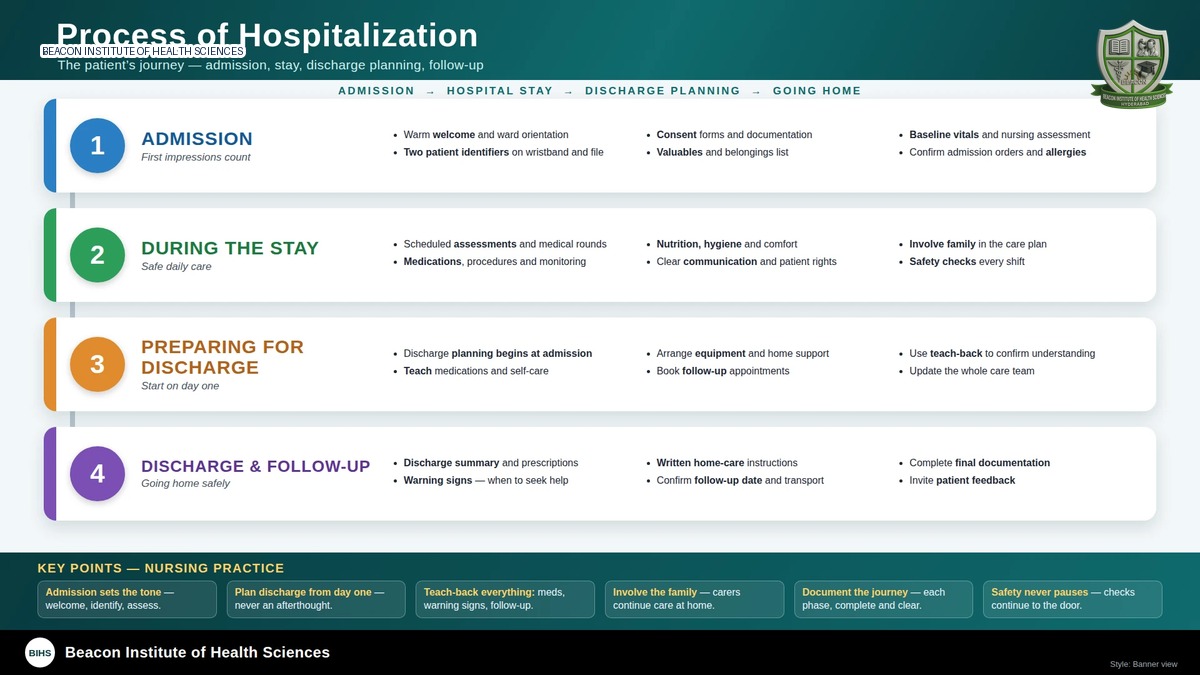
2. Admission: Preparation and Procedure
Preparation for admission involves getting the receiving unit and the admission bed ready before the patient's arrival. Essential equipment must also be prepared to meet anticipated needs.
Routine Admission
Routine admission involves registration at the admission counter, a clinical assessment by a physician, necessary investigations, and a decision regarding inpatient care. Key steps include collecting identifying and contact information, assigning a registration number, and identifying the assigned ward and bed. Routine admissions are arranged for investigation, diagnosis, or medical or surgical treatment. Examples include hypertension and diabetes; the urgency of admission depends on the actual patient presentation and any complications, not solely on the diagnostic label.
Emergency Admission
Patients presenting with acute, serious conditions require prompt assessment and treatment. Examples include accidents, poisoning, burns, and respiratory emergencies. Urgent care takes priority, and administrative requirements may be completed by relatives or support persons while treatment proceeds.
Special Considerations
Medicolegal cases, such as injuries resulting from violence or suspected self-harm, require special handling. The specific documentation and reporting procedures are dictated by the institution and jurisdiction, as the lecture does not detail a complete legal protocol.
Admission Sequence for Revision
- Prepare the unit, bed, and required equipment.
- Receive the patient and verify their identifying information against the record.
- Assist the patient to the assigned area and orient them to the unit.
- Obtain a nursing history, baseline observations, and conduct a physical assessment.
- Coordinate initial prescribed care with the clinical team.
- Explain routines, safeguard personal belongings, and complete admission documentation.
3. Nursing Responsibilities During Admission
Reception and Assessment
- Welcome the patient courteously, introduce relevant staff, and assist the patient to the treatment area.
- When appropriate, assist with changing into hospital clothing, ensuring dignity and privacy.
- Verify records and collect a patient history. Assess the patient's current physical and emotional condition, including any distress, anxiety, or pain.
- Record baseline vital signs and physical findings, specifically pulse, respiration, and temperature, and check for bruising or infection.
- Collaborate with the physician to implement initial orders and prepare equipment for planned care.
Patient and Family Orientation
- Explain the call system, telephone access, and how to request help.
- Describe the treatment schedule and medication routines, clarifying that an identical schedule cannot be promised for every patient.
- Explain visiting times, staff roles, ward rules, and any movement restrictions.
- Orient relatives to policies regarding staying in the ward and using the patient's bed.
- Use friendly, clear communication as hospitalization can be a stressful experience for both patients and families.
Belongings, Infection Prevention, and Documentation
Inventory valuable belongings such as jewelry and phones. Document the custody or return of items and obtain acknowledgments per facility policy, including when items are given to relatives. Record the admission date, reason for admission, registration details, and required contact information.
Employ appropriate infection-prevention measures and precautions for communicable conditions. This may involve separation or isolation when indicated, applying precautions specific to the suspected or confirmed infection and institutional policy.
4. Patient Transfer and Continuity of Care
Two organizational transfer types exist: transfer between units within the same hospital and transfer from one hospital to another.
Preparation and Communication
- Obtain the required written transfer order.
- Explain the reason for transfer to the patient and family, address concerns, and involve the patient in decisions as appropriate.
- Notify the receiving ward, unit, or facility to allow staff, space, bed, and equipment to be prepared.
- Communicate with other departments to ensure pending information and reports reach the correct destination.
Records and Handover
Prepare a concise written transfer summary detailing the reason for transfer, the current problem and condition, and care already provided. Send all required records and investigation reports. The receiving team requires an accessible overview rather than needing to rely solely on a lengthy file. Provide record copies when necessary for transfer to another institution. Thorough documentation supports continuity of care, helps the receiving team understand previous treatment, and avoids unnecessary duplication. Receiving staff should formally assume care.
Transport and Personal Property
- Select transport appropriate to the patient's condition: assisted movement, wheelchair, stretcher, or a suitable vehicle/ambulance.
- Arrange assistance and equipment before moving the patient.
- Carefully collect, check, and transfer the patient's belongings, recording the handover to prevent loss.
- Ensure the receiving unit is ready to accept the patient and document the transfer after handover.
Revision Distinction
Physical transfer refers to movement between surfaces or locations. Unit/facility transfer changes the place or team delivering care. Both types of transfers necessitate preparation, communication, and careful attention to the patient's needs.
5. Discharge Planning and Patient Education
Discharge planning involves the patient, family, medical and nursing teams, and other relevant professionals such as social workers and dietitians.
Planning Before Departure
Discharge planning should begin during admission, not at the point of discharge. Confirm the discharge order, inform the patient of the anticipated timing, and notify relatives to arrange transport. Assess the patient's ability to continue care at home and identify any required help, supplies, or home-care services.
Address practical concerns such as who will assist with wound care and how treatment will proceed. Provide verbal teaching and written instructions that are specific, readable, concise yet complete, and understandable in the patient's language.
Topics to Cover with the Patient and Family
- Medicines: Prescribed medicine, dosage, schedule, and adherence to the actual discharge prescription.
- Activity and Exercise: Relevant restrictions and the advised duration and frequency of activity.
- Physical Therapy: Prescribed movements or rehabilitation needs.
- Wound Care: Instructions for dressing and bandage changes and methods to protect the wound.
- Ongoing Treatments: Patient-specific instructions and any arrangements for home healthcare.
- Follow-up: When and where to return for appointments, with the date recorded on the discharge information.
Discharge Documentation
Record the discharge date and time, the patient's manner of departure (e.g., wheelchair or stretcher), instructions given, and confirmation that all belongings were returned. Complete required records according to facility policy.
Supplementary Patient-Safety Guidance
The AHRQ's IDEAL approach supports including the patient and family, discussing home life, medicines, warning signs, results, and follow-up, using plain language, assessing understanding through teach-back, and actively listening to concerns. This is supplementary guidance.
6. Reactions to Hospitalization and Revision
Why Hospitalization Causes Stress
- Changes in body image or physical function, and awareness of illness or mortality.
- Changes in relationships, including isolation associated with illness.
- Dependence on others and reduced control over everyday activities.
- Adjustment to physical changes or loss, such as the example of an amputation.
- Disruption of usual lifestyle, fear about procedures, and concern about the illness.
- Stress caused by the hospital environment and exposure to seriously ill patients.
Behavioral Responses Described
Anger: Feelings of powerlessness and dependence may manifest as anger towards staff or others. It is important to consider the underlying distress rather than treating anger as an isolated character trait.
Agitation or Hypervigilance: Anxiety and loss of control can lead to restlessness, irritability, and increased attention to symptoms or care. Discomfort and anxiety can reinforce each other.
Withdrawal: A quiet or withdrawn patient may be overlooked in a busy ward. Limited social support or a previously isolated lifestyle may contribute. However, quiet behavior does not indicate an absence of unmet needs; ongoing assessment and attention remain necessary.