
Learning Objectives
- Distinguish health, disease, illness and sickness.
- Compare major ways of understanding health and healing.
- Explore a patient's explanation of illness without stereotyping.
- Apply evidence, consent and safety to a shared nursing care plan.
Why Perceptions Matter in Nursing
A clinical diagnosis does not describe everything a person experiences. A patient may worry about lost income, pain, family responsibilities or a spiritual concern while the team focuses on a laboratory result. Nursing connects clinical assessment with the person's daily life. Understanding a belief does not require accepting an unsupported medical claim; it helps the nurse explain evidence and plan care respectfully.
People within a cultural or religious community differ. Ask what matters to this patient rather than assume a shared language, background or name predicts every preference. Practical conditions such as cost, transport, service quality and previous discrimination also influence care-seeking.
Health, Disease, Illness and Sickness
| Concept | Meaning in this lecture | Nursing example |
|---|---|---|
| Health | Well-being and the ability to live meaningfully, considered across physical, mental and social life | Ask about function, relationships and goals as well as symptoms. |
| Disease | A condition described through professional clinical knowledge about abnormal structure or function | Hypertension can exist without noticeable symptoms. |
| Illness | The person's lived experience of being unwell | Fatigue and worry can be important even before their cause is established. |
| Sickness | The social recognition and roles associated with being unwell | Work leave, caregiving expectations or stigma may affect daily life. |
These distinctions are useful in medical anthropology; terminology varies between disciplines. Disease and illness overlap but are not identical. Absence of a confirmed diagnosis does not mean that symptoms are imaginary. Conversely, feeling well does not exclude a condition that needs assessment. Avoid using a normal test as a reason to dismiss persistent concerns.
The WHO constitutional definition emphasizes physical, mental and social well-being beyond absence of disease. Its ideal of complete well-being is broad, not a clinical test that classifies everyone with a chronic condition as incapable of health. People living with disability or long-term disease can pursue meaningful goals and experience well-being.
Models of Health and Illness
| Perspective | Contribution | Limitation if used alone |
|---|---|---|
| Biomedical | Explains biological mechanisms and supports diagnosis and treatment. | May miss personal meaning and social barriers when narrowly applied. |
| Biopsychosocial | Examines interactions among bodily, psychological and social influences. | Needs a focused assessment rather than an unfocused list of factors. |
| Holistic | Considers the whole person, including relationships and spiritual preferences. | The word does not prove that a particular treatment is effective or safe. |
These perspectives can complement one another. A nurse can monitor physiological changes, address anxiety, arrange language support and explore the patient's goals within the same plan. Social explanations should not replace assessment of urgent clinical needs.
Exploring the Patient's Explanatory Model
An explanatory model is how someone understands a problem, why it began, what course it may take and which help seems appropriate. Ask open questions: What do you call the problem? What do you think caused it? What worries you most? What have you already tried? What do you hope treatment will achieve? Listen before correcting misunderstandings.
Then explain the clinical understanding in plain language, including uncertainty. Ask permission to discuss differences. Check understanding through teach-back: ask the person to describe the agreed next steps in their own words. Teach-back evaluates the clarity of the explanation, not the intelligence of the patient.
Healing Systems and Medical Pluralism
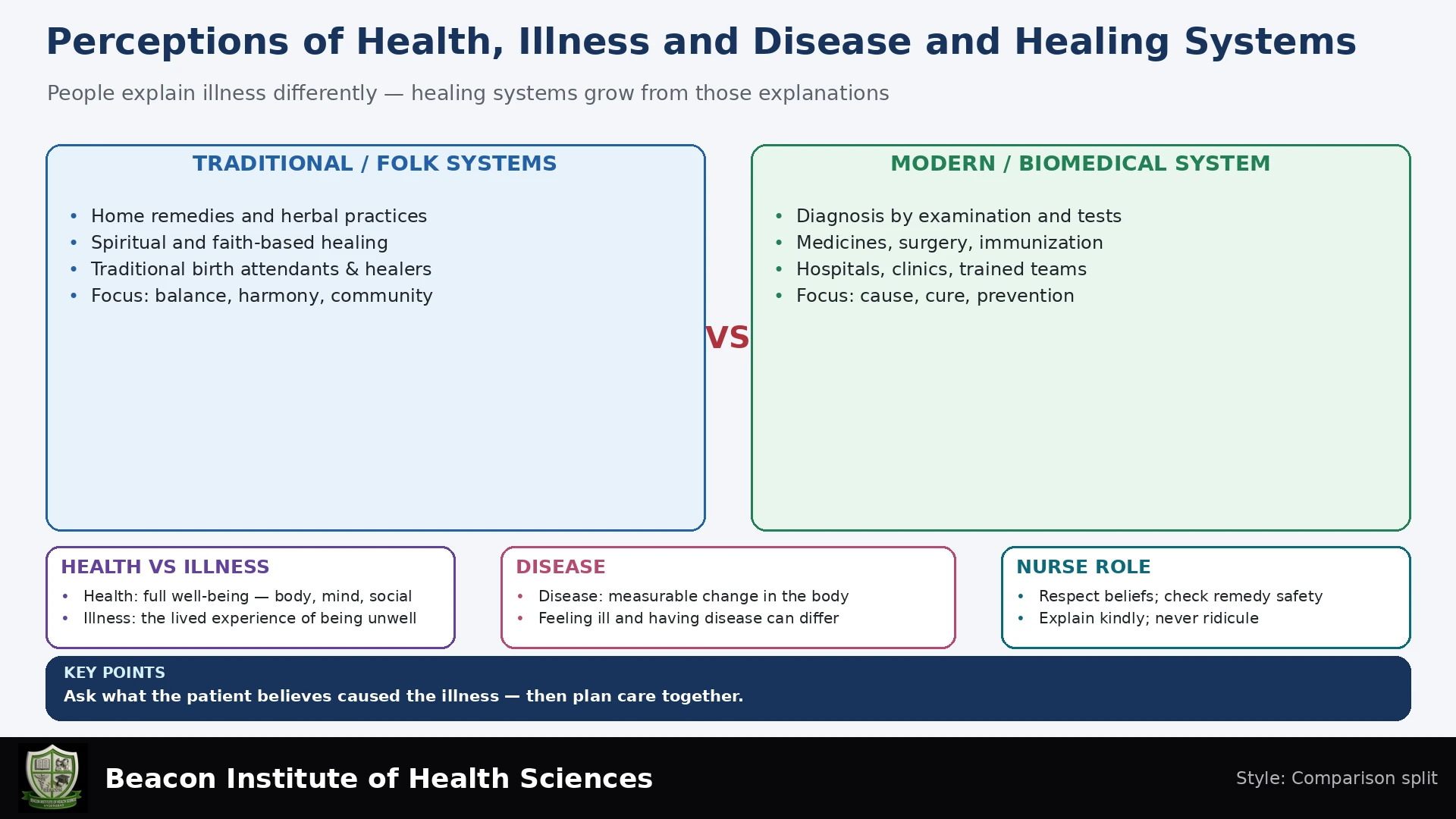
Medical pluralism means that people may use several sources of help. The popular sector includes personal, family and community advice and self-care. The folk sector includes local or traditional healers and practices. The professional sector includes formally organized health professions. These are descriptive categories with overlapping boundaries, not rankings of a person's worth or guarantees of treatment quality.
In Pakistan, a patient may consult a clinic, obtain pharmacy advice, use a home remedy and seek spiritual support. Unani and Ayurvedic traditions are examples of organized traditional systems with distinctive histories and concepts. Describing them does not establish that every associated intervention works. Evidence must be evaluated for the particular product, procedure, condition and outcome.
Spiritual practices may offer meaning or comfort when desired by the patient. They can accompany necessary clinical treatment. Neither spiritual explanations nor the use of a traditional remedy should automatically lead to assumptions about a person's education, decision-making capacity or willingness to receive care.
Complementary, Alternative and Integrative Approaches
Complementary approaches are used alongside conventional care; alternative approaches are used in place of it. Integrative care seeks coordinated, evidence-informed use of appropriate approaches while considering the whole person. The label integrative does not remove the need to establish benefit, safety, quality and professional responsibility.
Long use and personal testimonials are not sufficient proof of effectiveness. Natural products can cause adverse effects, contain uncertain ingredients or interact with medicines. Risks can also arise when an unproven treatment delays effective care. Avoid both blanket rejection of every unfamiliar practice and blanket reassurance about all traditional treatments.
A Safe Nursing Assessment
- Assess symptoms, severity and immediate clinical needs first.
- Ask about prescribed medicines, non-prescription products, herbs, supplements and other treatments.
- Record names, ingredients where known, amounts, frequency and the reason for use.
- Discuss uncertain products or possible interactions with the appropriate clinician or pharmacist.
- Explain benefits, risks and uncertainty without ridicule or promises of cure.
- Agree on safe next steps, follow-up and when to seek urgent help, following local clinical guidance.
Do not assume that separating doses makes an interaction safe. Do not independently stop or alter prescribed treatment beyond professional authority. Support informed decisions and document the discussion accurately. Involve relatives only with appropriate permission and arrange trained language assistance where available.
Fictional Worked Example: Feeling Well with Disease
A fictional patient, Imran, has repeated elevated blood-pressure readings assessed by his clinician but says, “I cannot be ill because I feel normal.” The nurse distinguishes the absence of a felt illness from the clinical finding. She asks about his understanding and concerns, explains the planned review and agreed treatment, and checks understanding. She also asks whether cost or working hours make follow-up difficult.
The lesson is not to frighten Imran or diagnose from a single reading. It is to connect accurate clinical information with his explanatory model and practical circumstances. His goals and understanding guide education while the clinical team confirms diagnosis and management.
Fictional Worked Example: A Remedy Concern
A fictional patient, Nadia, takes prescribed medicine and an unlabeled herbal mixture. She hesitates to mention it because she expects criticism. The nurse thanks her for the information, records available details and seeks pharmacy and clinical review. No one assumes the mixture is safe or identifies its contents by appearance. The care plan addresses uncertainty and monitoring, and preserves any harmless comfort practice Nadia wishes to continue.
Evaluation includes whether Nadia understands the agreed plan, feels able to disclose other treatments and can access follow-up. A respectful conversation supports safety; it does not prove that the mixture has a therapeutic effect.
Practice Questions with Explained Answers
- Can disease exist without felt illness?
Yes. Some conditions, including hypertension, may initially cause no noticeable symptoms.
- Does an unexplained symptom mean that nothing is wrong?
No. Take the experience seriously, assess it and arrange appropriate review.
- What is medical pluralism?
Using or having access to more than one system or source of health care.
- Does natural mean safe?
No. Ingredients, dose, contamination, adverse effects and interactions still require assessment.
- How should the nurse respond to a different illness explanation?
Explore it respectfully, explain clinical evidence and uncertainty, and negotiate safe next steps.
Conclusion
Perceptions of health and healing influence how people interpret symptoms and seek help. Nurses provide stronger care when they combine clinical evidence with listening, clear communication and assessment of real barriers. Respect for meaning and culture belongs alongside careful evaluation of safety and effectiveness.