
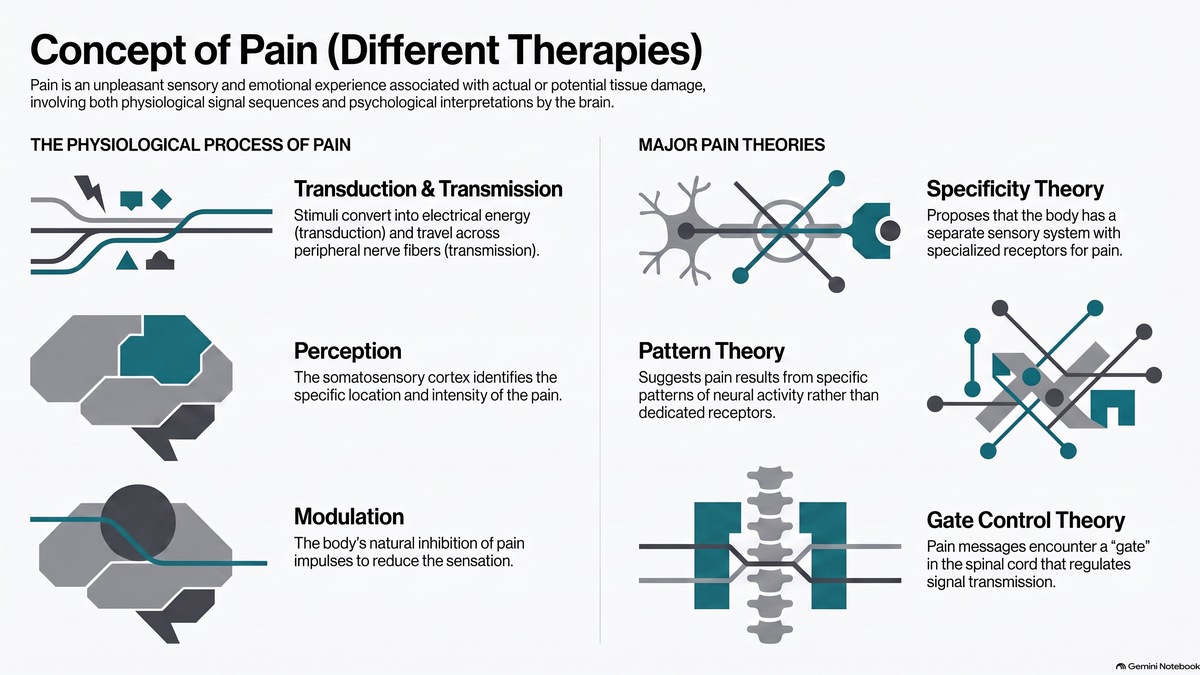
This reference study guide details the clinical, physiological, and theoretical frameworks governing the concept of pain, as presented in Unit 4 of the Fundamentals of Nursing II (FON II) BSN curriculum. Pain is a highly complex, multi-dimensional phenomenon that directly alters a patient's cognitive focus, daily activities, and psychosocial well-being. By establishing standard clinical pathways for the nociceptive process and exploring the six core pain theories, this guide provides nursing students with an evidence-based roadmap to assess, understand, and therapeutically manage patient pain.
Clinical Definition and Impact of Pain
Pain is not merely a localized physical sensation; it is a profound, systemic experience that influences a patient's entire being. In clinical nursing, pain is defined and recognized through two major frameworks
Cognitive and Behavioral Domination
Pain possesses the clinical capacity to occupy all of a person's thinking, direct and restrict all of their physical and social activities, and fundamentally change their personal, professional, and family lives.
The Standard Clinical Definition
Pain is formally defined as an unpleasant sensory and emotional experience associated with actual or potential tissue damage, or described in terms of such damage. It represents the individual's reaction to potential or actual physiological problems, indicating that pain is always subjective and unique to the person experiencing it.
The Physiological (Nociceptive) Process of Pain
The transmission and experience of pain follow a highly organized, four-phase physiological (nociceptive) path within the nervous system. These phases must occur in sequence:
Phase 1: Transduction
This phase involves the conversion of noxious, damaging stimuli (which can be mechanical, thermal, or chemical) into electrical energy. When tissue damage occurs, local peripheral nerve endings are stimulated, generating this electrical energy.
Phase 2: Transmission
This phase describes the movement and propagation of the generated electrical stimulus impulse across peripheral nerve fibers toward the spinal cord and onward to the higher brain centers.
Phase 3: Perception
This is the phase in which the individual becomes consciously aware of the pain. The somatosensory cortex of the brain acts to identify the precise location and intensity of the pain, causing the pain experience to unfold fully in the person's consciousness.
Phase 4: Modulation
This phase involves the active inhibition or dampening of the pain impulse by the nervous system. During modulation, the body releases inhibitory substances or signals to limit, block, or decrease the transmission of the pain impulse.
Classification & Types of Pain
Nurses must differentiate between different classifications of pain to determine the appropriate clinical therapies:
Acute Pain versus Chronic Pain
Differentiating between acute and chronic pain is a core nursing competency.
- Acute pain is transient, has an identifiable cause, and serves as a protective warning mechanism (usually resolving as the tissue heals).
- Conversely, chronic pain is prolonged, persists beyond the expected healing time, does not serve a protective purpose, and can lead to severe emotional, physical, and cognitive depletion in the patient.
Neuropathic Pain
Neuropathic pain is a distinct category of pain that arises directly from nerve damage. It is characterized by deep sensations and represents abnormal processing of sensory input by the peripheral or central nervous system.
The Six Core Theories of Pain
To explain how pain is generated, transmitted, perceived, and modulated, six major historical and clinical theories are established in the nursing curriculum. These theories explain the relationship between the physical body, the brain, and human behavior:
1. Specificity Theory
This theory argues that the body possesses a separate, dedicated sensory system for perceiving pain, just as it does for other distinct senses like hearing. It views pain as an independent sensation with its own specialized peripheral sensory receptors called nociceptors (which detect noxious stimuli). Because it was viewed as a direct, hardwired sensory pathway, the psychological and emotional responses to pain were removed from this conceptual model.
2. Strong's Theory of Pain
This theory proposes that pain is a multi-dimensional experience composed of two major parts: a physical, noxious stimulus and a subsequent psychic reaction (encompassing psychological and behavioral responses). It concludes that pain itself is the sensation, illustrating a sequence where a physical sensation (such as the experience of heat) occurs first, followed immediately by the psychological experience of pain as a negative sensation.
3. Pattern Theory
This theory proposes that peripheral sensory receptors responding to touch, warmth, non-damaging, and damaging stimuli all give rise to non-painful or painful experiences. The difference in sensation is determined entirely by the distinct patterns of the signals sent through the nervous system. According to this view, people feel pain only when certain patterns of neural activity occur, such as when an appropriate type of sensory activity reaches excessively high levels in the brain. These intense patterns occur only under intense, damaging stimulation.
4. Central Summation Theory
This theory proposes that intense, damaging stimulation resulting from nerve and tissue damage activates specific nerve fibers. These fibers project directly to the internuncial neuron pool (historically or phonetically referred to as the international neuron pool) within the dorsal horn of the spinal cord. This continuous, intense projection creates abnormal, self-activating, and reverberating neural circuits that sustain and amplify the pain experience.
5. Sensory Interaction Theory
This theory is specifically used to explain the relationship between the brain, sensory input, and human behavior. It focuses on explaining why and how individuals respond in a highly specific way to various sensory inputs, linking how pain feels physically to how it manifests behaviorally and emotionally in the patient's actions.
6. Gate Control Theory
This widely accepted clinical theory suggests that before pain information is fully transmitted to the brain, the pain impulses encounter a physiological 'gate' in the dorsal horn of the spinal cord. According to this theory, the gate can be overwhelmed and opened by a large volume of active, small-diameter nerve fibers (which transmit pain signals). Conversely, the gate can be closed, blocking pain transmission, by the activation of larger sensory fibers (such as those stimulated by touch or warmth) or by descending inhibitory messages from the brain.
Overview of Clinical Pain Therapies
Clinical pain management requires a systematic approach combining both pharmacological and non-pharmacological therapies to achieve effective pain relief:
Pharmacological Therapies (Painkillers)
This involves the administration of analgesics and painkillers to chemically block, reduce, or modulate pain signals at various phases of the nociceptive process (e.g., stopping transduction at the peripheral level or blocking transmission in the spinal cord).
Non-Pharmacological Therapies
These are clinical techniques that utilize physical stimulation (such as touch or warmth) to activate large-diameter nerve fibers. Based on the Gate Control Theory, these therapies serve to close the physiological gate in the spinal cord, blocking the transmission of pain signals to the brain without the use of chemical drugs.
Clinical Practice Note for BSN Students
Pain is always what the patient says it is, existing whenever they say it does. A thorough pain assessment must evaluate the location, intensity (using standard pain scales), quality, and physiological/behavioral responses of the patient. Understanding the phases of the pain process (transduction, transmission, perception, modulation) allows nurses to select targeted therapies to optimize patient comfort and facilitate holistic recovery.