
1. Learning objectives and purpose
By the end of this lesson, distinguish international health agencies, professional nursing organizations and humanitarian networks. Identify several major organizations and explain how their work relates to community nursing. International cooperation matters because health concerns, knowledge and emergencies cross national borders. However, an international recommendation does not automatically become a local clinical order. Students should understand the source, purpose and authority of a document before using it in a placement or assignment.
2. Types of organization
Intergovernmental organizations work through relationships among governments. Professional associations represent a profession and contribute advocacy, standards or knowledge. Humanitarian organizations support people affected by emergencies and other vulnerabilities. Nongovernmental organizations may provide services or specialist support. These categories can overlap in partnerships, but their authority is not identical. A useful comparison asks who the members are, who the organization serves, how it works and what decisions it is authorized to make.
3. World Health Organization
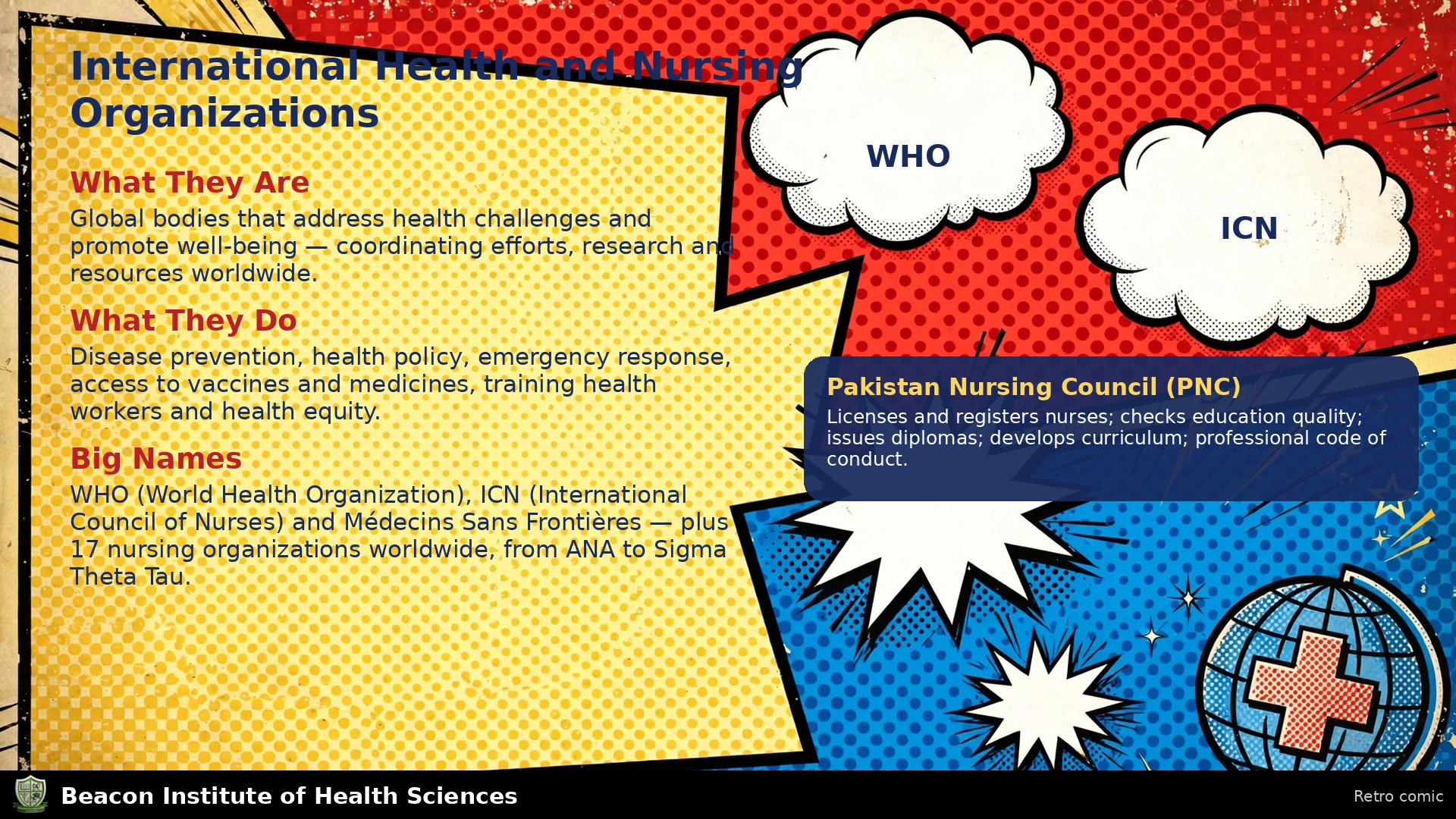
The World Health Organization, or WHO, is the United Nations health agency. Its work includes health guidance, support for health systems and cooperation on health emergencies. Students often encounter WHO technical recommendations and health information. Distinguish a global guideline from country-specific implementation. A nurse should examine the date, target population and setting of a recommendation, then use it alongside approved local guidance. WHO information supports learning; it does not replace professional accountability.
4. UNICEF
UNICEF is the United Nations Children's Fund. Its health work focuses strongly on children and the conditions that support their survival and development, including maternal and child health, immunization and related community services. Nursing relevance includes family communication and equitable access. Do not describe UNICEF as a licensing body for nurses. In a project, identify the particular programme and implementing partners rather than attributing every child-health activity in a country to one organization.
5. UNFPA
The United Nations Population Fund, or UNFPA, focuses on sexual and reproductive health and rights. Its work is relevant to maternal health, informed choices and the needs of women, girls and young people. Use respectful language and protect confidentiality when discussing these topics. An organization may support systems, supplies or education while local qualified professionals deliver care. Students should distinguish the broad mandate from the exact services available through a particular programme.
6. International Council of Nurses
The International Council of Nurses, or ICN, is a federation of national nursing associations. It represents nursing internationally and works on professional advancement, workforce concerns, health policy and nursing knowledge. This differs from a national regulator that grants practice authorization. Read ICN statements for their professional perspective, but verify local legal and regulatory requirements separately. An international association's publication can inform discussion without granting a student permission to perform an unfamiliar procedure.
7. National associations and regulators
A professional association and a regulator have different functions. Associations can support members, education and advocacy; regulators establish or administer requirements for authorized practice according to their jurisdiction. Some tasks may appear related, but membership is not the same as registration. In Pakistan, students should verify nursing registration and programme-recognition requirements with the relevant official authority. Do not infer recognition from a logo, an international partnership or an advertisement claiming professional affiliation.
8. Red Cross and Red Crescent cooperation
The International Federation of Red Cross and Red Crescent Societies, or IFRC, supports its member National Societies in work before, during and after disasters and health emergencies. Nursing relevance includes preparedness, community support and humanitarian coordination. The wider movement contains distinct components, so do not use all names interchangeably. For a practical assignment, identify the responsible local partner and its role rather than assuming an international office directly manages every community activity.
9. Partnerships and responsibilities
Organizations often work with governments, local services, professional groups and communities. A partnership can bring resources and expertise, but responsibilities should remain clear. Ask who supervises the activity, maintains records, handles referrals and reviews results. A nurse needs a practical contact pathway rather than a long list of logos. Clear responsibility also prevents families from being sent between organizations without receiving help. Community participation should remain central when outside partners design or support programmes.
10. Guidelines, advocacy and direct services
A guideline recommends an approach using a stated evidence process. Advocacy seeks change in policy or resources. A direct service provides a defined activity to people. These outputs answer different questions. A position statement may express a professional view without being a clinical protocol. In an assignment, identify the document type before explaining its importance. Do not present an advocacy announcement as evidence that a local clinic already offers a particular treatment.
11. Evaluating official information
Check the official website, publication date, authorship, intended audience and supporting references. Examine whether a document is current or archived. Avoid assuming that a search result summary contains the complete recommendation. Read the relevant limitations and distinguish a draft from final guidance. If a source describes one country or pilot programme, keep that boundary clear in your writing. A reliable citation allows another student to locate the same document and assess its meaning.
12. Ethical cooperation and communication
Partnerships should respect dignity, informed participation and privacy. Collect only information needed for an authorized purpose and use approved channels. Do not share identifiable family details with an organization merely because it works in health. Obtain the appropriate consent and authorization for any referral or information transfer. Explain the purpose of a programme in plain language. International branding can create expectations, so be accurate about what assistance is available and what has not been promised.
13. Worked organization comparison
A fictional student team prepares a school-health project. It uses WHO information to understand a health issue, reads UNICEF material on child wellbeing, and consults a nursing association about professional communication. The local health service remains responsible for clinical activities and referrals. The team should describe each contribution separately. A comparison table with mandate, document type and local partner is more useful than naming an organization without explaining how its work relates to the project.
14. Answered review and practical task
Prepare a five-row comparison of WHO, UNICEF, UNFPA, ICN and IFRC using their official pages. Answers: WHO focuses on health cooperation; UNICEF serves children; UNFPA focuses on sexual and reproductive health and rights; ICN represents nursing through national associations; IFRC supports National Societies in humanitarian work. Membership does not equal a nursing licence. Why check document type? Guidance, advocacy and services have different purposes. Recap: understand both an organization's contribution and the limits of its authority.