
Introduction to Skin-Contact Transmitted Diseases
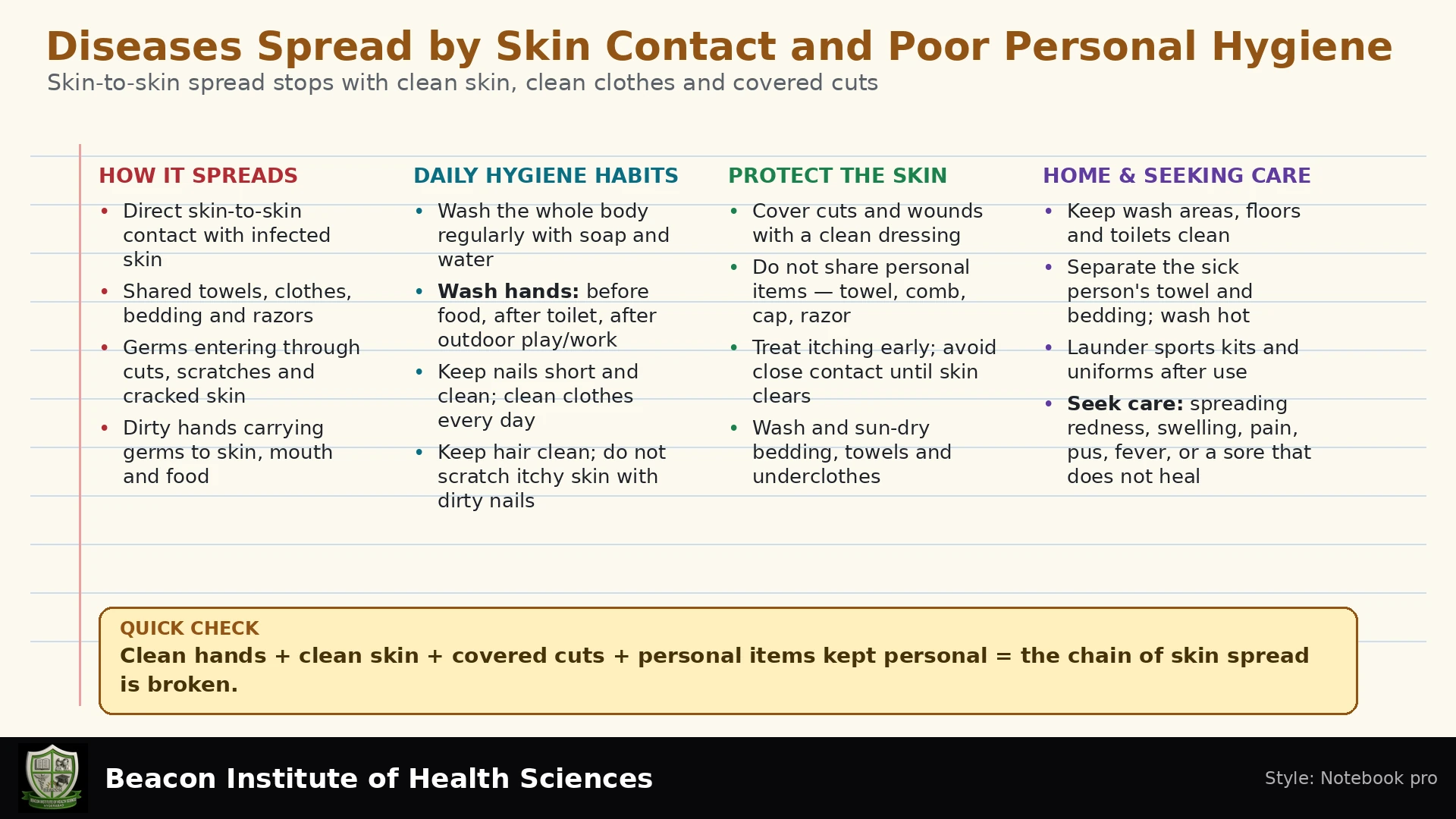
As future and current nursing professionals, understanding the mechanisms of disease transmission, particularly through skin contact and related to personal hygiene, is fundamental to patient care and community health. This lesson delves into common dermatological conditions—scabies, head lice, ringworm, and impetigo—highlighting their transmission, clinical presentation, and comprehensive nursing management strategies. A core principle emphasized is that certain conditions, like scabies and head lice, can affect individuals regardless of their cleanliness, underscoring the importance of education over blame.
Learning Objectives
Upon completion of this lesson, BSN students and nursing educators will be able to:
- Differentiate between direct and indirect contact transmission for common skin infections.
- Identify key characteristics, causative agents, and modes of transmission for scabies, head lice, ringworm, and impetigo.
- Explain the significance of skin integrity in susceptibility to dermatological infections.
- Describe the nursing assessment and recognition of these skin conditions.
- Outline general principles of prescribed treatment, patient education, and environmental care.
- Discuss strategies for household contact management and destigmatizing skin-contact conditions.
- Apply the nursing process to a fictional case involving skin-contact infections.
Understanding Transmission: Direct and Indirect Contact
The spread of many dermatological infections relies on physical contact, which can be categorized into direct and indirect forms. Understanding these modes is crucial for implementing effective prevention and control measures.
Direct Contact
Direct contact transmission occurs when there is physical contact between an infected person and a susceptible person. This can involve skin-to-skin contact, such as hugging, touching, or intimate contact. For instance, scabies and impetigo are commonly spread through direct skin-to-skin contact.
Indirect Contact and Shared Items
Indirect contact transmission involves the transfer of pathogens via an inanimate object, known as a fomite. This happens when an infected person touches an object, leaving behind pathogens, which are then picked up by a susceptible person who touches the same object. Shared items frequently act as fomites. Examples include:
- Clothing: Lice and scabies mites can survive for a short period on infested clothing.
- Bedding: Sharing beds can facilitate the spread of scabies and head lice.
- Towels: Ringworm and impetigo can be transmitted via contaminated towels.
- Hairbrushes/Combs: Head lice spread mainly through head-to-head contact; spread through shared items is less common.
- Sports equipment: Fungal infections like ringworm can spread in communal areas or through shared gear.
Importance of Skin Integrity
Skin integrity plays a vital role in the body's defense against infections. The skin acts as a primary physical barrier, preventing microorganisms from entering the body. Any break in this barrier—due to cuts, abrasions, rashes, dryness, or other skin conditions—can compromise its protective function, making an individual more susceptible to infections like impetigo. Maintaining healthy skin integrity through proper hydration, gentle cleansing, and protection from injury is therefore a key preventive measure.
Common Skin-Contact Transmitted Diseases
Let's examine specific diseases commonly spread through skin contact, focusing on their characteristics and transmission.
Scabies (Mite Infestation)
- Causative Agent: Sarcoptes scabiei, a microscopic mite that burrows into the outer layers of the skin.
- Transmission: Primarily through prolonged, direct skin-to-skin contact, but also via infested clothing, bedding, and towels.
- Recognition/Assessment: Intense itching, especially at night; rash with tiny red bumps and visible burrows (fine, wavy lines) on wrists, finger webs, elbows, armpits, genitals, and waistline.
- Clinical Relevance: Scabies can affect anyone, regardless of hygiene status. Itching is an allergic reaction to the mites, their eggs, and feces.
- Prescribed Treatment Principles: A clinician prescribes a suitable scabicide. Application sites and repeat treatment depend on the patient’s age, medicine and clinical condition; follow the exact instructions rather than a universal neck-down rule.
- Nursing Consideration: Emphasize that scabies is not a sign of poor hygiene; avoid shaming the patient. Educate on proper application of medication and environmental decontamination.
Head Lice (Pediculosis Capitis)
- Causative Agent: Pediculus humanus capitis, a tiny, wingless insect that lives on the human scalp and feeds on blood.
- Transmission: Direct head-to-head contact is the most common, but also through shared combs, brushes, hats, scarves, and bedding.
- Recognition/Assessment: Intense scalp itching; presence of nits (lice eggs) firmly attached to hair shafts near the scalp, especially behind ears and at the nape of the neck; visible live lice moving on the scalp.
- Clinical Relevance: Lice infestations are common, particularly among school-aged children, and do not indicate poor hygiene.
- Prescribed Treatment Principles: Over-the-counter or prescription topical pediculicides (shampoos, lotions) applied to hair and scalp, often followed by manual removal of nits with a fine-toothed comb. Repeat treatment may be necessary.
- Nursing Consideration: Educate families on manual nit removal, cleaning personal items, and dispelling myths about hygiene and lice. Encourage consistent, thorough treatment to prevent re-infestation.
Ringworm (Tinea Corporis)
- Causative Agent: Various species of fungi (dermatophytes).
- Transmission: Direct skin-to-skin contact with an infected person or animal, or indirectly through contaminated surfaces like shower floors, locker room benches, or shared towels/clothing.
- Recognition/Assessment: Characterized by a red, circular, itchy rash with raised edges and clearer centers, resembling a ring. Can appear anywhere on the body.
- Clinical Relevance: Highly contagious; often seen in individuals who sweat heavily, participate in contact sports, or have weakened immune systems.
- Prescribed Treatment Principles: Topical antifungal creams or powders applied to the affected area. Oral antifungal medications may be prescribed for widespread or resistant cases.
- Nursing Consideration: Advise patients to keep the affected area clean and dry. Educate on not sharing personal items and thorough cleaning of communal spaces.
Impetigo (Bacterial Skin Infection)
- Causative Agent: Primarily Staphylococcus aureus or Streptococcus pyogenes bacteria.
- Transmission: Direct contact with the sores of an infected person or indirectly through contaminated towels, sheets, or clothing. Often enters through a break in the skin.
- Recognition/Assessment: Red sores that quickly rupture, ooze for a few days, and then form a yellowish-brown crust (honey-colored crusts). Common on the face, especially around the nose and mouth, and on hands and arms.
- Clinical Relevance: Most common in infants and children. Highly contagious. Can be associated with poor hygiene but also occurs in clean environments, especially with skin trauma.
- Prescribed Treatment Principles: Topical antibiotic ointment for mild cases. Oral antibiotics for more widespread or severe infections. Good hygiene is crucial.
- Nursing Consideration: Educate on strict hand hygiene, covering lesions, and not sharing personal items to prevent spread. Advise to complete the full course of antibiotics.
Comparison Table: Key Features of Skin-Contact Diseases
| Disease | Causative Agent | Primary Transmission | Key Clinical Signs | Treatment Principle (No Doses) |
|---|---|---|---|---|
| Scabies | Mite (Sarcoptes scabiei) | Prolonged direct skin-to-skin contact | Intense nocturnal itching, burrows, papules | Topical scabicides, oral agents for severe cases |
| Head Lice | Insect (Pediculus humanus capitis) | Head-to-head contact, shared items | Scalp itching, nits on hair shafts, live lice | Topical pediculicides, nit combing |
| Ringworm | Fungus (Dermatophytes) | Direct skin-to-skin, contaminated surfaces | Red, circular rash with raised edges, clear center | Topical or oral antifungals |
| Impetigo | Bacteria (Staphylococcus aureus, Streptococcus pyogenes) | Direct contact with sores, contaminated items | Red sores, honey-colored crusts | Topical or oral antibiotics |
The Nursing Process in Managing Skin-Contact Infections
Applying the nursing process ensures comprehensive and patient-centered care for individuals with skin-contact transmitted diseases.
Assessment
- History: Inquire about onset, duration, severity of symptoms (itching, pain, rash characteristics), recent contacts (family, school, daycare), shared items, travel history, and previous treatments.
- Physical Examination: Inspect the entire skin surface, scalp, and mucous membranes for characteristic lesions, burrows, nits, lice, erythema, scaling, and signs of secondary infection. Assess skin integrity.
- Psychosocial Assessment: Evaluate for signs of embarrassment, anxiety, or social isolation. Address concerns about stigma, particularly for conditions like lice and scabies that are often mistakenly linked to poor hygiene.
Nursing Diagnosis
Examples of nursing diagnoses may include:
- Impaired Skin Integrity related to scratching and rash.
- Risk for Infection Transmission related to contagious nature of disease and lack of knowledge.
- Disturbed Body Image related to visible lesions and social stigma.
- Knowledge Deficit regarding disease transmission, treatment regimen, and prevention.
- Pruritus related to allergic reaction to mites/insects or fungal/bacterial infection.
Planning (Goals and Expected Outcomes)
Goals should be realistic and patient-centered, such as:
- Patient will verbalize understanding of treatment regimen and transmission prevention within 24 hours.
- Patient will demonstrate proper application of topical medication.
- Patient and nurse will agree on a review date and assess documented skin changes.
- Patient will record itching severity and discuss change at the planned follow-up.
- Patient will identify strategies to prevent re-infestation and manage household contacts.
Implementation (Interventions)
Patient and Family Education
- Explain the disease in clear, non-judgmental terms, emphasizing that conditions like scabies and head lice can affect anyone.
- Teach about the causative agent, mode of transmission, and importance of adherence to the prescribed treatment plan (without discussing specific doses).
- Instruct on proper hygiene practices, wound care (for impetigo), and strategies to relieve itching.
Hygiene and Environmental Care
- Laundry: Follow disease-specific instructions for recently used clothing and bedding. Wash and dry appropriate items on hot cycles when safe for the material. Bagging duration differs by condition; obtain the correct instructions rather than using a single time period for all infestations.
- Cleaning: Vacuum carpets and upholstered furniture regularly, especially in areas where the infected person spends time.
- Disinfection: Clean and disinfect shared items like combs, brushes, and sports equipment.
Addressing Stigma
- Provide a supportive and empathetic environment.
- Correct misinformation and emphasize that cleanliness does not prevent all infestations.
- Encourage open communication within families and communities to foster understanding and reduce blame.
Household Contact Management
- Educate on the necessity of examining close contacts (household members, intimate partners) for signs of infestation/infection.
- For scabies, the clinician may arrange simultaneous treatment of household members and close contacts. For head lice, examine household members and treat those who meet treatment criteria; do not automatically medicate everyone.
Evaluation
- Monitor the patient's skin for resolution of lesions, decreased itching, and signs of healing.
- Assess patient and family understanding of the disease and adherence to the treatment plan.
- Evaluate for any signs of re-infestation or secondary infection.
- Solicit feedback on the effectiveness of comfort measures and educational interventions.
Fictional Case: A Child With Head Lice
A school nurse finds live crawling lice in a child’s hair. The parent feels ashamed and asks whether poor washing caused the infestation. The nurse explains that head lice are mainly spread through head-to-head contact and are not caused by lack of cleanliness.
Plan: Explain appropriate treatment instructions, check household members, arrange treatment for those who need it, and provide clear advice about personal items. Agree on follow-up and discourage blame or unnecessary insecticide spraying.
Practice With Explained Answers
- Is ringworm caused by a worm? No. It is a fungal infection.
- What distinguishes head lice from dandruff? Live lice confirm active infestation; nits attach to hair, while loose flakes alone do not confirm lice.
- Should every household member receive lice medication? No. Examine contacts and follow treatment criteria.
- Why can scratching matter? It can damage skin and increase the chance of secondary bacterial infection.
- Does every itchy rash mean scabies? No. Clinical assessment is necessary because many conditions cause itching.
Review and Escalation
Seek clinical review for worsening pain, spreading redness, fever, extensive crusting, treatment failure or vulnerable patients. Document findings, teaching and follow-up. Privacy and respectful explanations support cooperation.