
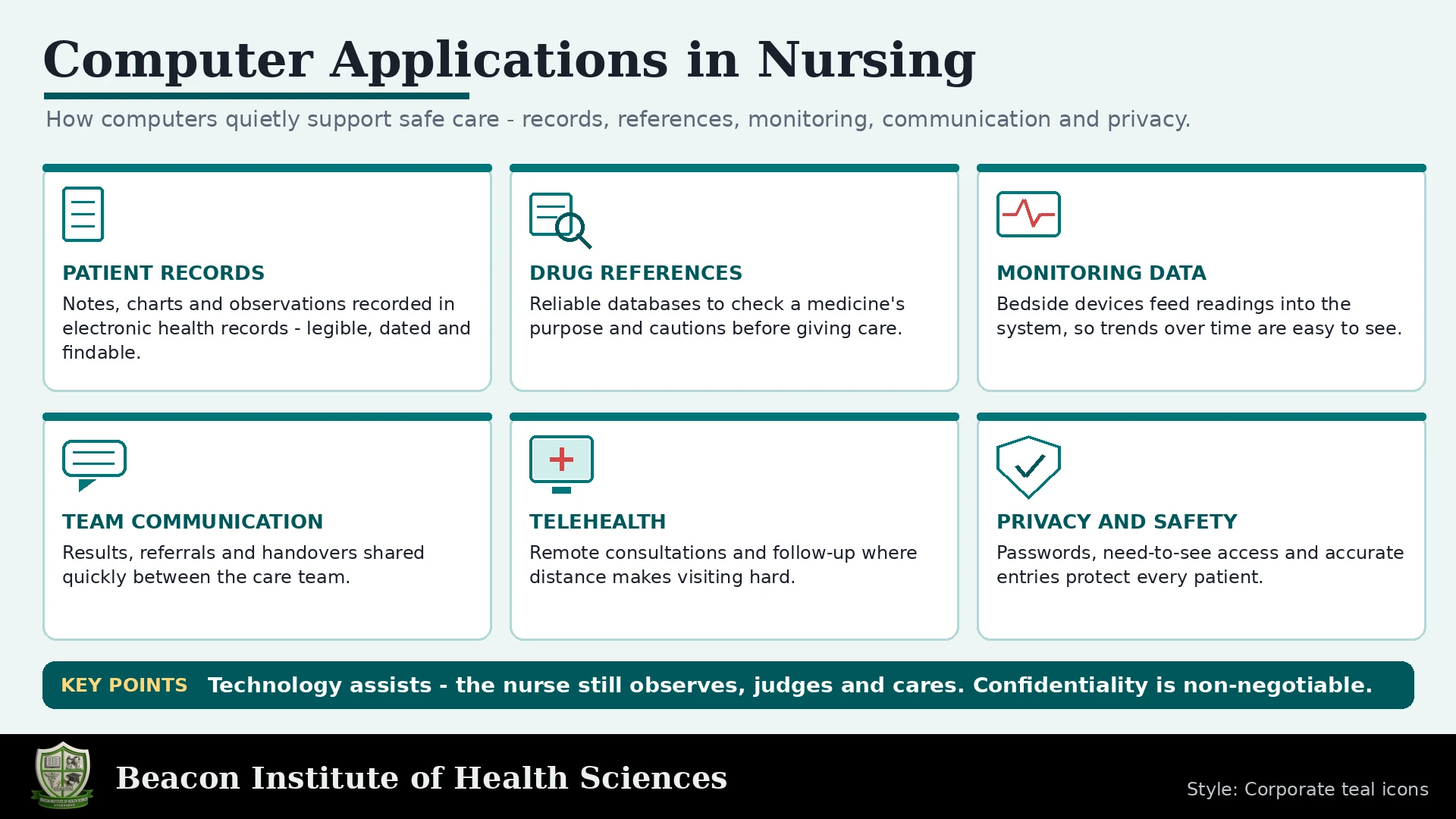
1. Purpose and nursing informatics
Objectives: explain nursing informatics, identify common digital systems, describe data quality and confidentiality, recognize technology risks and respond through approved processes. Nursing informatics combines nursing knowledge, information and digital tools to support practice, education, administration and research. Technology assists professional judgment; it does not replace assessment or accountability. Examples are fictional and do not prescribe local clinical procedures.
2. Data, information and knowledge
Data are recorded facts; information organizes them; knowledge interprets patterns in context. A temperature entry becomes useful only when patient identity, time, unit, method and context are correct. A computer can calculate or display inaccurate input convincingly. Nurses help ensure that documentation is accurate, relevant and understandable.
3. Electronic records
Electronic health records can bring documentation, history, orders and results into a shared approved environment. Access depends on role and authorization. A longitudinal EHR and a facility-focused electronic medical record are related concepts, and real products differ. Do not assume every hospital uses the same workflow or that all records are interoperable.
4. Accurate documentation
Documentation: use the correct patient record, verify identifiers through the approved process, enter observations promptly and distinguish observation from interpretation. Confirm dates, units and whether information is current. Do not document care that was not provided, share logins or copy previous notes without checking them. Corrections should follow the system's audit trail and institutional policy rather than concealing the original entry.
5. Medication-related systems
Medication-related systems may include electronic orders, electronic medication administration records, barcode identification and decision support. Their safe use requires local training, authorized roles and independent checks required by policy. A successful scan does not guarantee the whole task is correct. Report a mismatch or technical failure and use the approved escalation process; never invent a workaround or bypass a warning merely to finish quickly.
6. Clinical decision support
Clinical decision support may provide reminders, alerts or reference information. Alerts can be helpful but also irrelevant or excessive. Verify the situation and source; do not assume every alert is correct or every absent alert means safety. Explain and escalate concerns according to local procedures. Software cannot independently assess every nuance of a patient's condition.
7. Monitoring and connected devices
Monitoring and devices: digital monitors collect and display measurements; networked devices may send information to records. Measurements require correct setup, appropriate interpretation and assessment of the person. Check device identity, time and data transfer when trained to do so. Do not change unfamiliar device or alarm settings on the basis of a classroom article.
8. Professional communication
Communication: approved messaging and handover systems can support coordination. Verify the recipient and urgency, use appropriate channels and confirm receipt when needed. A sent message is not proof that an urgent issue was addressed. Personal messaging, public social media and unapproved email can expose private information. Follow the institution's escalation process for urgent concerns.
9. Education and research
Education and research: learning platforms, simulation, online libraries and databases support study. Word prepares academic documents, PowerPoint supports teaching and Excel supports approved fictional or de-identified analysis. De-identification requires more than removing a name because combinations of details may identify someone. Research use requires necessary approval and appropriate data governance.
10. Administration and indicators
Administration: systems can support scheduling, inventory, staffing and quality review. Define each indicator, denominator and reporting period. For a fictional audit with 36 completed checks out of 40 eligible checks, completion is 90 percent. The number does not explain why checks were missed or establish the quality of care. Interpret with context and avoid punitive assumptions from incomplete data.
11. Privacy and security
Privacy and security: use personal authorized accounts, least necessary access, strong authentication and approved devices. Lock screens, protect printouts, verify sharing permissions and report suspected incidents. Do not browse records out of curiosity or photograph screens. This is general educational guidance; applicable Pakistani requirements and institutional policies govern local practice. Foreign legal frameworks are not automatically local law.
12. Downtime and recovery
Downtime: power, network or software failure can interrupt access. Follow the trained downtime plan, notify the responsible team and use approved documentation and verification procedures. After recovery, reconcile records through the authorized process to avoid omissions and duplication. Do not use personal cloud services as an improvised clinical record. Practise the local plan before a failure.
13. Technology risks and AI
Technology risks include wrong-patient selection, stale copied information, interface confusion, incomplete transfers and overreliance on automation. Human factors matter: clear displays, training and realistic workflows support safer use. Report usability problems without exposing patient information. Artificial-intelligence outputs can be inaccurate or biased; use only approved tools, verify evidence and do not upload confidential data to public systems.
14. Case exercises and answered review
Fictional case exercise: a student notices that a training record contains yesterday's assessment under today's date. Stop copying, check the source, tell the instructor and correct through the approved training process. A second case involves a failed barcode scan: report and follow local procedure, never override without authorization. Review answers: Does an EHR eliminate errors? No. Why personal logins? Accountability and access control. Does removing a name always anonymize data? No. What governs downtime? The local approved plan. Recap: technology, accurate data, professional judgment and secure workflow work together.
15. Worked learning activities and final checks
A fictional documentation scenario illustrates the difference between availability and accuracy. A training record displays a measurement, but its timestamp belongs to an earlier session. The student should identify the mismatch, verify the source and inform the instructor. Copying the number into a current note would create misleading information. A clear audit trail records corrections without pretending the original error never happened.
Another scenario concerns communication. A student sends a nonurgent training question through an approved platform and receives no response. They should check the expected response process rather than assuming that sending equals receiving. For urgent clinical issues, the local escalation process governs action; a classroom example cannot define a hospital's emergency communication system. The important concept is matching the channel to purpose and urgency.
For a quality-review exercise, define a fictional indicator as completed training checks divided by eligible training checks during one week. State inclusion rules before counting. If 36 of 40 are completed, report 90 percent together with the numerator, denominator and period. Investigate missing entries and whether the data collection was consistent. Avoid claiming causation or improved outcomes from a single percentage.
Digital competence includes recognizing when to ask for help. A student should know how to contact support, report a privacy concern and find approved instructions. They should not guess unfamiliar clinical-system settings or use another person's login to overcome an access problem. Learning to use technology responsibly means understanding its limits, protecting information and maintaining professional accountability even when a system is fast or convenient.