
1. Learning objectives
After this lesson, explain the primary health care approach, distinguish it from first-contact clinical care, identify its major components and apply its principles to a community project. Primary health care, usually shortened to PHC, is a way of organizing health around people and communities. It asks how prevention, treatment and support can be made accessible throughout life while also addressing the conditions that influence health.
2. PHC and primary care
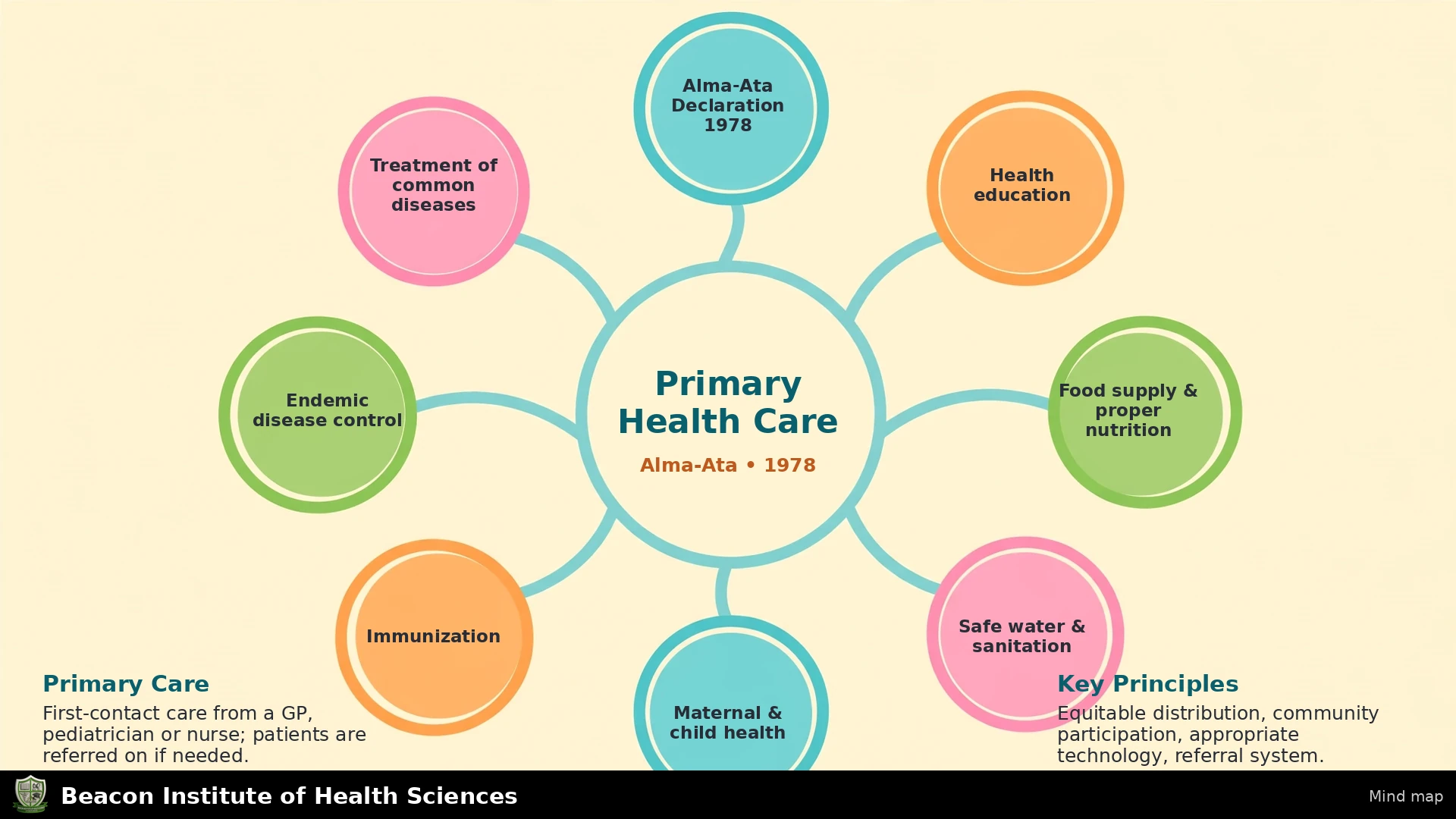
Primary care usually describes first-contact, continuing clinical services. PHC is broader: it includes those services, population health work, action across sectors and community participation. A clinic consultation may be excellent primary care, yet the surrounding PHC system also needs attention to safe water, transport and service access. Avoid using the two terms as exact synonyms. Explain which part of the system an example describes and how it connects to the wider approach.
3. Historical foundations
The Declaration of Alma-Ata in 1978 established an influential international commitment to primary health care. The Declaration of Astana in 2018 renewed that commitment. Learn the historical sequence without assuming a declaration guarantees that every community has received all services. Policy statements establish direction; implementation requires resources, trained workers, community involvement and continuing evaluation. In an examination answer, connect the historical milestones with the purpose of equitable, people-centred care rather than memorizing dates alone.
4. Three connected components
WHO describes PHC through integrated services, action on wider determinants across sectors, and empowerment of people and communities. These components support each other. A child-health service can identify illness, but safe neighbourhood water and informed family participation influence what happens after the consultation. A useful planning exercise is to write one activity under each component for the same concern. This reveals whether a proposed programme depends only on clinic attendance or includes the surrounding conditions.
5. Equity and accessibility
Accessibility includes physical distance, affordability, suitable hours, understandable information and respectful treatment. Equity examines who is repeatedly excluded and why. A wheelchair-accessible entrance is useful, but a person may still face transport or communication barriers. Ask the affected group what prevents access instead of assuming a single solution. Evaluate access separately from service availability: a facility can exist without being usable by everyone who needs its care.
6. Community participation
Participation means involving people in identifying concerns, making decisions and reviewing results. It is more meaningful than inviting residents to receive instructions after a plan has been finalized. Include people who are often absent from meetings, and explain what decisions the group can actually influence. Record disagreements respectfully. A student project should not promise control over budgets or staffing that belongs to another authority. Clear expectations support trust and make participation more useful.
7. Appropriate technology and sustainability
An appropriate method is scientifically sound, suited to the setting and supportable with available skills and resources. The newest device is not automatically the best choice. Consider maintenance, supplies, training, privacy and what happens during power failure. Sustainability asks whether the activity can continue after a short project ends. A paper referral checklist may be more reliable than an unsupported application; the decision should depend on local evidence rather than preference for a particular technology.
8. Intersectoral collaboration
Many health concerns need cooperation beyond health services. Water supply may require municipal teams; school attendance may involve education staff; safe housing may involve local authorities. Identify the responsible partner and an agreed action. A nurse can describe health implications and advocate for action without claiming technical authority over another sector. Collaboration needs a practical communication route and follow-up, because listing many partners on a poster does not show that their work is coordinated.
9. Traditional essential PHC activities
Traditional PHC teaching includes education about health problems, nutrition, safe water and sanitation, maternal and child health with family planning, immunization, control of endemic disease, care for common illness and injury, and access to essential medicines. These are historical core activities rather than the full limit of modern PHC. Mental health, chronic conditions, rehabilitation and palliative needs also require attention. Medicines and clinical procedures must remain within qualified practice and current local protocols.
10. Continuity across the lifespan
People need different services as their circumstances change. A child grows into an adolescent, an adult may develop a long-term condition, and an older person may need rehabilitation or support at home. Continuing care connects these stages and services. Avoid organizing every contact around one disease only. An agreed care plan should state the next contact, responsible team and route for concerns, while respecting personal preferences and ability to participate.
11. PHC and universal health coverage
Universal health coverage aims for access to needed quality services without financial hardship. PHC helps organize services close to everyday life, but an accessible clinic alone cannot guarantee financial protection or high-quality referral care. Distinguish service coverage, quality and cost protection when discussing progress. Do not equate enrolment counts with complete coverage. Ask whether people can obtain the needed service, whether it is appropriate and whether the cost creates avoidable hardship.
12. Nursing roles and referral
Nurses contribute assessment, prevention, education, follow-up and coordination. They identify barriers, support informed decisions and connect people with appropriate services. A referral should include findings, urgency and destination, with confirmation of the next step where possible. Follow the local referral pathway and escalate emergencies promptly through qualified services. Community practice does not justify unsupervised diagnosis or prescribing. A student can contribute accurate observation, clear communication and reliable documentation under supervision.
13. Worked planning and calculation
A fictional outreach project invites forty eligible households; thirty attend and twenty-four complete a follow-up discussion. Attendance is thirty divided by forty times one hundred, or seventy-five percent. Follow-up among attendees is twenty-four divided by thirty times one hundred, or eighty percent. These measures answer different questions. Investigate why some households could not attend before describing them as uninterested. A PHC response may combine better hours, understandable information and an agreed transport solution.
14. Answered review and practical task
Choose a fictional local concern and write one service action, one action involving another sector and one participation action. Answers: PHC is broader than primary care; Alma-Ata preceded Astana; accessibility includes more than distance; appropriate technology must fit the setting; participation includes decisions and evaluation; coverage measures need a denominator. Explain why attendance does not prove quality. Recap: PHC links comprehensive care, fairness, community influence and coordinated action.