
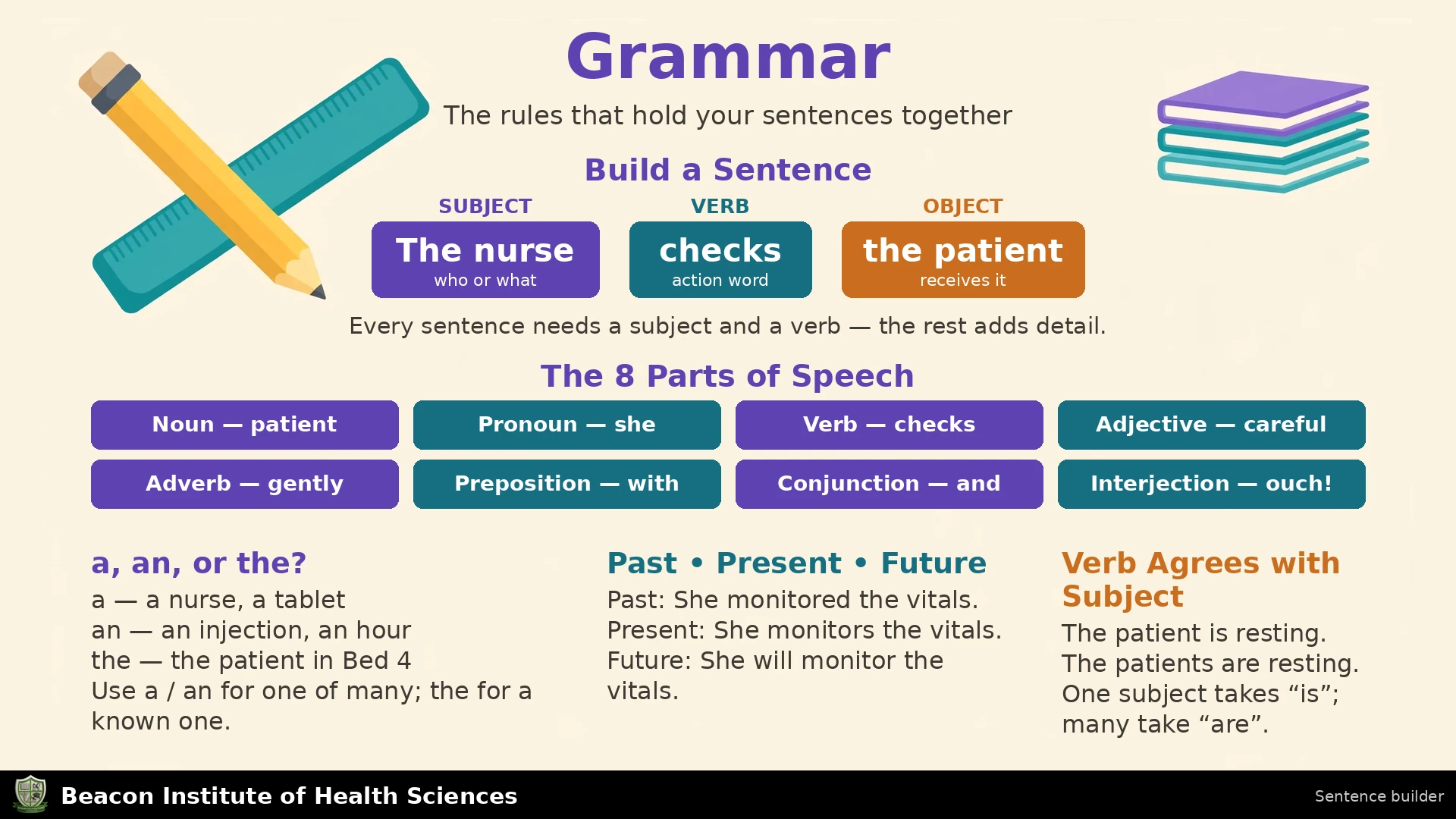
1. Learning objectives and the purpose of grammar
Grammar describes how words combine to communicate meaning. BSN students need it for understandable conversation, academic work and precise professional writing. This lesson teaches English language, using fictional examples rather than clinical instructions. By the end, you should be able to recognize sentence elements, choose suitable verb forms, check agreement and articles, correct common sentence errors and revise a paragraph systematically. Accuracy should support a clear message rather than make writing unnecessarily complicated.
2. Parts of speech in context
Nouns name people, places, things or ideas. Pronouns refer to noun phrases. Verbs express actions or states. Adjectives describe nouns; adverbs modify verbs, adjectives or other adverbs. Prepositions show relationships, conjunctions connect units and interjections express reactions. Determiners, including articles, help identify the noun being discussed.
In The careful student writes clearly, student is a noun, careful an adjective, writes a verb and clearly an adverb. The is a determiner. A word's role can change: We record observations uses record as a verb, while The record is complete uses it as a noun. Identify function from the sentence, not only from a memorized list.
3. Subjects, verbs, objects and clauses
The subject identifies what the clause is about. The predicate says something about the subject and includes the verb. In Amina completed the form, Amina is the subject, completed the verb and the form the object. A complement adds information required by some constructions: in The explanation is clear, clear describes the subject.
A clause typically contains a subject and a verb. An independent clause can stand alone as a sentence. A dependent clause relies on another clause: because the room was unavailable leaves the reader expecting a result. A phrase functions as a unit without forming a complete clause, such as in the library. Understanding this distinction helps identify sentence fragments.
4. Sentence structures
A simple sentence has one independent clause: The students reviewed the notes. A compound sentence joins independent clauses: The students reviewed the notes, and they discussed difficult terms. A complex sentence includes a dependent clause: The students discussed difficult terms because the notes were unfamiliar.
Use structure to express a real relationship. And adds information, but contrasts, and because provides a reason. Longer sentences are not automatically more academic. If a sentence contains too many ideas, divide it or reorganize it. Check that each connection preserves the intended meaning.
5. Subject-verb agreement
In the present simple, a third-person singular subject commonly takes a verb ending in -s: The student attends the class. A plural subject uses the base form: The students attend the class. Find the actual subject rather than selecting the nearest noun. In The list of topics is ready, list determines is; topics is part of a modifying phrase.
Pronouns must also agree with the intended subject: she writes, they write, I am, they are. Some collective-noun uses vary across English varieties and context, so avoid a blanket rule based on one example. The central task is to keep the grammatical form consistent with the meaning and chosen convention.
6. Nouns, articles and determiners
Countable nouns can usually take a number and singular or plural forms: a report, two reports. Uncountable nouns such as information and advice do not normally take an indefinite article in these meanings. Write some information or a piece of advice rather than an information or an advice.
Choose a or an according to the following sound, not merely the first letter: an hour, a university. The often identifies something already mentioned or otherwise known to the reader. No article is used in some general expressions, such as Students need information. Compare a report introducing one report with the report referring to a particular one. Article choice depends on reference and context.
7. Tense and aspect
Verb forms help show when an event occurs and how it relates to time. The present simple often expresses routines or general statements: The class starts at nine. The present continuous can describe a current activity: The students are reviewing their notes. The past simple presents a completed past event: Sana submitted the report yesterday.
The past continuous describes an activity in progress at a past time: Sana was writing when the phone rang. The present perfect connects a past event with the present: Sana has submitted the report. It does not normally combine with a finished past-time expression such as yesterday in standard uses. Future reference can use will, going to, the present continuous or scheduled present forms, according to meaning.
Maintain a consistent time perspective, but change forms when the time genuinely changes. Methods completed last week may use past forms while a current conclusion uses present forms. Tense consistency means meaningful organization, not forcing every sentence into the same tense.
8. Negatives, questions and auxiliaries
Auxiliary verbs help form questions, negatives and other constructions. Compare The student attends with Does the student attend? and The student does not attend. After does or did in these patterns, the main verb takes the base form. Did she attend? is correct; Did she attended? repeats the past marking unnecessarily.
Be and have also function as auxiliaries: Is she studying? Have they finished? Their forms depend on the construction. Do not add do indiscriminately to every question. Practise by identifying the original verb phrase, then choosing the suitable auxiliary. Check both word order and the main verb after making the change.
9. Modals and conditionals
Modals such as can, could, may, might, should and must express meanings including ability, possibility, requests and obligation. They are normally followed by the base verb: She can explain the task. Could you repeat the question? is a polite request. Might indicates a possibility rather than certainty. Must can express obligation, but the actual authority for a professional requirement comes from the relevant rule, not from grammar alone.
Conditional sentences connect a condition with a result. If I finish the outline, I will revise the introduction describes a possible future situation. If I had more time, I would revise another section describes a hypothetical situation. Learn the relationship between the clauses rather than memorizing a formula without meaning. These are language examples, not instructions for care.
10. Active voice, passive voice and reported speech
Active voice makes the actor the subject: The student completed the form. Passive voice makes the affected item the subject: The form was completed by the student. The passive normally uses a form of be with a past participle. It can be useful when the process or result is the focus, but it should not hide responsibility where the actor matters.
Reported speech conveys someone's words without necessarily reproducing them exactly. Direct example: Sana said, I am ready. Reported example: Sana said that she was ready. A shift to a past form is common after a past reporting verb, but time, continuing truth and context can affect the choice. Do not change every verb automatically without considering the intended meaning.
11. Pronouns, comparisons and prepositions
A pronoun needs an identifiable reference. In Amina spoke to Sana after she finished, she may be unclear. Rewrite the sentence to identify who finished. Ambiguous reference can make an otherwise grammatical sentence confusing.
Comparative and superlative forms express degrees: clear, clearer, clearest; useful, more useful, most useful. Avoid double forms such as more clearer. Prepositions also require attention: at nine, on Monday, in October, in the room. Patterns vary by meaning and expression, so learn them in complete phrases. Translation from another language does not always preserve English usage.
12. Punctuation and sentence boundaries
Use full stops to complete statements and question marks for direct questions. Commas can separate items and mark certain clause relationships, but a comma alone does not normally join two independent clauses. The sentence The room was full, we waited outside is a comma splice. Correct it with a full stop, a semicolon or a suitable conjunction: The room was full, so we waited outside.
A fragment such as Because the class ended needs completion: We left because the class ended. Apostrophes can mark possession or contraction. Its is possessive; it's means it is or it has. Their shows possession, there indicates location or introduces a construction, and they're means they are. Proofread for meaning because all may be valid dictionary words.
13. Practice corrections and answers
- The student attend regularly. Correct: The student attends regularly. The singular subject requires attends.
- The list of topics are ready. Correct: The list of topics is ready. List is the subject.
- She gave an advice. Correct: She gave some advice. Advice is uncountable in this meaning.
- A hour remains. Correct: An hour remains. Hour begins with a vowel sound.
- Did she submitted it? Correct: Did she submit it? Use the base form after did.
- She has finished yesterday. Correct: She finished yesterday. A finished past-time expression normally calls for this past-simple use.
- He can explains clearly. Correct: He can explain clearly. The modal takes a base verb.
- This version is more clearer. Correct: This version is clearer. Avoid a double comparative.
- Its ready. Correct: It's ready. The meaning is it is.
- They left, the meeting ended. One correction: They left after the meeting ended. This expresses the intended sequence without a comma splice.
- Because the room was closed. One completion: We waited outside because the room was closed.
- She spoke to Amina after she arrived. Clarify the intended reference: After Sana arrived, she spoke to Amina.
14. Paragraph editing and revision checklist
Original: The students was in the library yesterday. They has reviewed an information sheet, they can explains its purpose. Their ready for the discussion.
Corrected: The students were in the library yesterday. They reviewed an information sheet, and they can explain its purpose. They are ready for the discussion.
Students takes were. Reviewed gives a clear completed-past account. An is appropriate here because sheet is a singular countable noun. The conjunction joins the independent clauses; can takes explain; and they are expresses the intended state. Check the subject, verb form, agreement, reference and sentence boundary before checking spelling. Finally, reread the meaning: a technically corrected sentence must still say what you intended.